


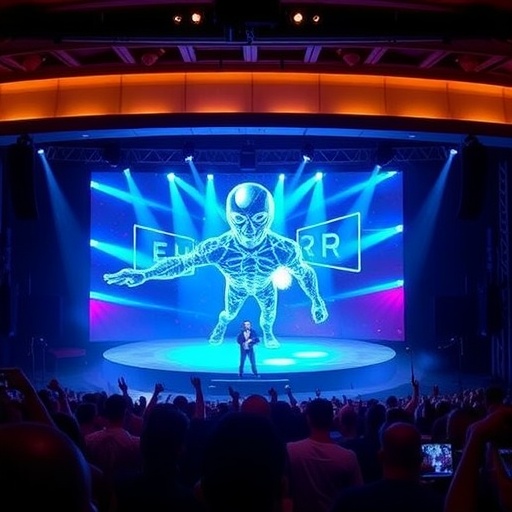
In recent years, the entertainment industry has witnessed a technological renaissance with the advent of holographic AI concert experiences that resurrect legendary artists through immersive 3D projections and motion capture technologies. These holograms recreate deceased performers on stage, offering audiences the unique opportunity to witness iconic musicians in a stunningly lifelike manner. Yet, beyond the dazzling visual effects and sophisticated digital wizardry lies a far more nuanced determinant of success: the intersection of ethics, trust, and emotional resonance.
Researchers at the University of South Florida have delved into this phenomenon, uncovering that the widespread acceptance and success of holographic AI concerts are shaped less by the novelty of the technology itself and more by the audience’s perception of respect, transparency, and moral responsibility toward the legacy of the artists being revived. This challenges common assumptions that consumers primarily seek innovation for innovation’s sake within tech-driven entertainment sectors.
These insights emerge from an empirical study involving 308 participants, conducted under the direction of Seden Dogan, assistant professor of instruction at USF’s School of Hospitality and Sport Management. The research implemented rigorous data collection and statistical analysis methods to establish a conceptual model linking ethical considerations with audience acceptance, revealing that ethical trust is a critical vector guiding emotional connection and willingness to embrace holographic performances.
From a technical perspective, holographic concerts hinge on cutting-edge technologies including 3D modeling, motion capture, and precise digital projection techniques that simulate dynamic performances in real time. However, the research shows that while these technological foundations are necessary to create immersive illusions, they remain insufficient without embedding human values that honor the artists’ legacies with authenticity and dignity.
One illustrative example lies in the success of the ABBA Voyage virtual reunion tour, which has gained acclaim not only for its replicative fidelity but also for its transparent communications regarding artist representation and audience engagement. Likewise, the viral hologram of Tupac Shakur at Coachella sparked intense conversations worldwide, underscoring the powerful emotional and cultural impact such holograms can evoke when ethical considerations are thoughtfully managed.
Central to the research findings is the recognition that concertgoers evaluate holographic AI performances through a lens of moral appropriateness—does the spectacle honor the memory of the artist, or does it exploit them for commercial gain? The audience’s trust in event organizers and technology developers directly informs the emotional response elicited during the experience, affecting the overall reception and legacy of these digital revivals.
From an event management standpoint, this research calls for a strategic pivot toward prioritizing ethical stewardship in holographic concerts. Organizers must engage in transparent dialogue with stakeholders, including artists’ estates, fans, and regulatory bodies, ensuring that performances are not only visually impressive but also aligned with broader cultural and ethical norms.
Moreover, this inquiry extends beyond concerts, as holographic AI technologies increasingly permeate other domains such as theme parks, museum exhibits, and heritage sites. For instance, immersive holographic displays at landmarks like the Colosseum in Rome leverage this technology to bring historical figures and narratives to life. The findings from the USF study highlight that the sustainable success of such applications demands an ethical framework tightly woven into technological deployment.
Innovation, while crucial, emerges here as just one dimension of a multidimensional experience. The human-centric values of respect, transparency, and legacy stewardship ultimately determine the meaningful impact and long-term viability of holographic AI experiences across entertainment and cultural sectors. Without these, there is a tangible risk of alienating audiences and diluting the reputations of both technology creators and represented artists.
This research sheds light on the broader discourse surrounding AI and digital reenactment in the arts. It challenges developers and entertainment companies to rethink the balance between technological capability and ethical responsibility, fostering new standards and practices that prioritize the voices and values of audiences and artist estates alike.
As the use of holographic AI continues to evolve, unfolding new frontiers in immersive entertainment, the University of South Florida’s study serves as a clarion call for embedding ethics at the core of innovation. It establishes a compelling case that technology’s role is not to overshadow but to enhance the human connection and cultural memory carried forward through legendary performances.
In sum, the future of holographic AI concerts and similar experiences will be shaped by those who master the delicate synergy of high-tech spectacle and heartfelt respect—a fusion that elevates artistry while honoring the past with integrity. This evolving landscape promises not only breathtaking visuals but also profound emotional experiences crafted on a foundation of trust and moral accountability.
Cite Scienmag News
Courtney Benton. (March 4, 2026). New USF Study Reveals Fans Prioritize Ethics Above Innovation in AI Hologram Concerts. Scienmag. https://scienmag.com/new-usf-study-reveals-fans-prioritize-ethics-above-innovation-in-ai-hologram-concerts/
Courtney Benton. "New USF Study Reveals Fans Prioritize Ethics Above Innovation in AI Hologram Concerts." Scienmag, 4 March 2026, https://scienmag.com/new-usf-study-reveals-fans-prioritize-ethics-above-innovation-in-ai-hologram-concerts/. Accessed 3 September 2026.
Courtney Benton. "New USF Study Reveals Fans Prioritize Ethics Above Innovation in AI Hologram Concerts." Scienmag. March 4, 2026. https://scienmag.com/new-usf-study-reveals-fans-prioritize-ethics-above-innovation-in-ai-hologram-concerts/


