


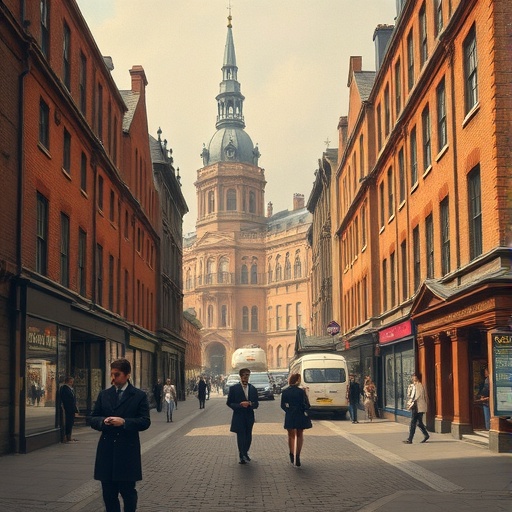
For decades, historians have envisioned mid-19th century Manchester as a city rigidly divided by class, where affluent middle-class families isolated themselves in elegant townhouses and leafy suburban villas, while the working poor were confined to squalid slums. This narrative, inspired in part by Friedrich Engels’ seminal 1844 work portraying Manchester as a city sharply segregated by socioeconomic status, has shaped popular and academic understanding of urban life during the Industrial Revolution. However, groundbreaking research led by Cambridge University historian Emily Chung is rewriting this conventional script. By employing meticulously digitized census data and detailed geographic mapping techniques, Chung reveals that the social fabric of Victorian Manchester was far more intricately interwoven than previously assumed.
Utilizing data extracted from the comprehensive 1851 census, Chung developed an unprecedentedly precise spatial analysis of residential patterns in Manchester. This involved painstakingly cross-referencing addresses from the census with contemporaneous Ordnance Survey maps and commercial directories to geolocate individuals to specific dwellings. Over eight months, she mapped thousands of buildings with striking accuracy, painstakingly accounting for landmarks such as public houses to anchor her spatial framework. This methodical approach enabled a granular examination of the residential proximities between diverse social classes within the cityscape, effectively reconstructing the everyday lived experience of Manchester’s mid-Victorian population.
The results overturn a central assumption in social history: that residential segregation by class was the principal mechanism dividing Manchester society. Instead, Chung’s research demonstrates that a significant number of middle-class professionals—doctors, engineers, architects, and shop owners—resided in the very same buildings and streets as unskilled laborers including weavers, spinners, and general factory workers. In fact, over 60% of the buildings that housed Manchester’s wealthier occupational groups also accommodated unskilled laborers. Moreover, in the notorious working-class district of Ancoats, approximately 10% of residents belonged to wealthier employed classes, blurring the stark boundaries once assumed to cleave social strata in the city.
This residential proximity, however, did not equate to social integration. Chung posits that the physical construction of housing played a pivotal role in maintaining social division beneath the surface closeness. Manchester’s rapid, largely unregulated expansion during the first half of the 19th century drove developers to maximize rental income by subdividing buildings into multi-occupancy tenements. Upper floors or street-level apartments were often occupied by wealthier residents, while basements and subterranean spaces housed cramped, poorly ventilated quarters for working-class families. Thick walls, separate entrances, and distinctly different living schedules insulated these disparate groups from direct interaction despite their physical nearness.
Beyond the built environment, patterns of daily life reinforced class separation. Long working hours—commonly twelve-hour days, six days a week—for many skilled and unskilled workers constrained their movement and narrowed their social spheres. In stark contrast, middle and upper-class residents enjoyed more flexible work schedules and greater liberty to navigate the city’s commercial and recreational spaces. This desynchronization of routines meant that streets and public venues seldom witnessed co-mingling of classes at the same time of day. The commercial district of Manchester’s southwest exemplified this dynamic, representing a zone of markedly higher social diversity relative to the predominantly residential neighborhoods to the north and east.
Chung’s analysis further delves into the social segregation manifest in cultural and leisure institutions. Middle-class Mancunians increasingly gravitated towards churchgoing, which offered a controlled, class-conscious environment. Churches operated pew rents and conducted separate services, effectively segregating congregations by social status. Conversely, the city’s 600 pubs held far greater appeal for working-class residents, providing affordable and unpretentious spaces for socialization. Yet, law enforcement practices actively marginalized the working classes from middle- and upper-class dominated public spaces. Police routinely dispersed groups of working-class men, underscoring the use of public order mechanisms to reinforce societal hierarchies and spatial separations.
These findings offer a nuanced reframing of Victorian urban segregation. Rather than simplistic geographical separation, it was the confluence of architectural design, work regimes, cultural practices, and policing that maintained social boundaries in Manchester. This layered complexity challenges notions that physical proximity naturally leads to social integration and highlights how segregation can manifest through multiple, interlocking mechanisms even amid spatial intermixing. Understanding Manchester’s historical urban fabric through this lens provides fresh insights into the evolution of class relations in industrial cities, with resonances for contemporary debates on urban segregation worldwide.
While Chung’s research effectively clarifies many aspects of Victorian Manchester’s social topography, some questions remain. For instance, the logistics of sanitary arrangements, such as shared outdoor toilets used by multiple households from different classes, remain elusive due to sparse contemporary documentation. Chung speculates that middle-class residents may have relied on chamber pots, thus limiting direct contact with working-class neighbors in such intimate domestic spaces. These unresolved details underscore the ongoing challenges of reconstructing granular social histories from archival sources.
Funded by the Economic and Social Research Council and affiliated with the Cambridge Group for the History of Population and Social Structure, Chung’s study exemplifies the power of combining digital humanities methodologies with traditional historical scholarship. By leveraging geographic information systems to unlock the latent patterns within historical census data, this research sets a new standard for investigating urban social dynamics in the Industrial Revolution era. Its revelations caution against uncritical acceptance of enduring narratives and invite reevaluation of how class and space intertwine to shape human experience.
The implications of this study extend beyond historical curiosity. As contemporary cities grapple with persistent and emergent forms of segregation and inequality, understanding historical precedents offers critical lessons. Manchester’s example reveals that physical cohabitation does not inherently dissolve social divides; rather, the rhythms of daily life, institutional structures, and urban governance often enforce differentiation and exclusion. Policymakers and urban planners may find value in such historical perspectives when designing interventions aimed at fostering genuine social integration.
Ultimately, Emily Chung’s research breathes new life into the study of one of the Industrial Revolution’s emblematic cities. By meticulously reconstructing the complex coexistence of social classes amid Manchester’s explosive industrial growth, her work enriches our understanding of how people navigated and contested the boundaries of class in everyday life. It also cautions against simplistic binaries of rich versus poor and highlights the multifaceted realities of urban life, past and present.
Cite Scienmag News
Courtney Benton. (October 20, 2025). New Study Reveals Wealthy Doctors and Engineers Lived in Victorian Manchester’s ‘Slums’. Scienmag. https://scienmag.com/new-study-reveals-wealthy-doctors-and-engineers-lived-in-victorian-manchesters-slums/
Courtney Benton. "New Study Reveals Wealthy Doctors and Engineers Lived in Victorian Manchester’s ‘Slums’." Scienmag, 20 October 2025, https://scienmag.com/new-study-reveals-wealthy-doctors-and-engineers-lived-in-victorian-manchesters-slums/. Accessed 3 September 2026.
Courtney Benton. "New Study Reveals Wealthy Doctors and Engineers Lived in Victorian Manchester’s ‘Slums’." Scienmag. October 20, 2025. https://scienmag.com/new-study-reveals-wealthy-doctors-and-engineers-lived-in-victorian-manchesters-slums/


