


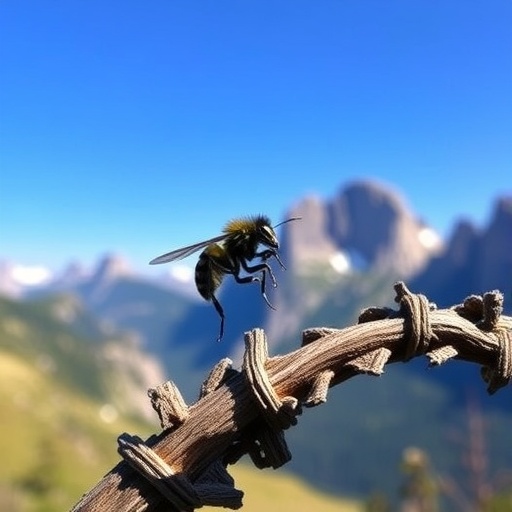
A groundbreaking long-term study conducted by researchers at the University of North Carolina at Chapel Hill has revealed alarming declines in insect populations within a relatively pristine subalpine meadow ecosystem in Colorado. The research, spanning 20 years and involving extensive seasonal monitoring, documents a precipitous drop in flying insect abundance—a 72.4% decline—correlated strongly with rising summer temperatures. This discovery challenges prior assumptions that insect losses primarily occur in human-altered habitats, highlighting climate change as a potent driver even in minimally disturbed natural environments.
Insects are foundational components of terrestrial and freshwater ecosystems, fulfilling a variety of essential ecological functions such as pollination, nutrient cycling, and serving as prey for myriad species. Despite their critical role, global insect populations have been understudied, particularly in regions relatively insulated from direct anthropogenic impacts such as pesticide application, urbanization, or habitat fragmentation. This study addresses that gap by leveraging a uniquely well-documented montane field site, chronicling insect abundance over 15 discrete seasons from 2004 through 2024.
The field site, a subalpine meadow in Colorado, is remarkable not only for its long-term insect monitoring but also for its 38-year meteorological record and limited human disturbance. Utilizing standardized techniques for capturing flying insect biomass, the research team, led by associate biology professor Keith Sockman, quantified trends over two decades, revealing an average yearly decline of 6.6%. The consistency and rigor of these methods provide robustness to the findings, indicating that the decline is not a localized anomaly but potentially representative of broader montane insect dynamics.
Importantly, statistical analyses from the study reveal a clear association between escalating summer temperatures and decreasing insect abundance. This climatic linkage suggests that warming summers impose physiological stress or disrupt critical life-cycle timing for insects adapted to cooler montane climates. As these species often rely on tightly synchronized temperature cues and resource availability, deviations can lead to population crashes, ultimately threatening ecosystem stability.
These findings have profound implications for biodiversity conservation and ecosystem functioning. Mountainous regions, often considered refuges for endemic species, may be more vulnerable than previously understood. The significant loss of flying insects documented here potentially jeopardizes pollination services, nutrient turnover, and food webs that sustain vertebrate and invertebrate communities. This cascade effect underscores insects’ indispensable role in sustaining the integrity of montane ecosystems.
The study’s results also illuminate gaps in current biodiversity monitoring frameworks. Many prior investigations into insect declines have focused on agricultural landscapes, urbanized areas, or other zones heavily influenced by direct human activities. By documenting substantial insect attrition far from these anthropogenic pressures, the research emphasizes the pervasive nature of climate change impacts and the need to expand monitoring efforts into less disturbed ecosystems globally.
Researchers caution that the documented trends may foreshadow parallel declines in other montane insect assemblages, particularly as climate warming continues unabated. This realization necessitates urgent, multidisciplinary approaches to biodiversity management that integrate climatic projections with ecological resilience strategies. Enhanced protective measures and habitat management tailored to mountain ecosystems could become pivotal in preventing further biodiversity erosion.
The ecological ramifications extend beyond biodiversity loss. Flying insects act as vectors of energy transfer and nutrient cycling, mediating processes such as decomposition and soil fertility. Reduced insect populations can, therefore, compromise ecosystem productivity and resilience against perturbations such as drought or invasive species. The disruption of these critical ecological functions underscores the broad, systemic consequences of declining insect biodiversity.
Moreover, the study adds weight to the concept of “insect decline syndrome,” a multifaceted phenomenon influenced not only by land-use changes but increasingly by climatic variables. As temperature regimes shift, interactions between insect species, their host plants, and predators will be altered, with unpredictable outcomes. Understanding these complex dynamics requires integration of long-term ecological data with climate science and species-specific physiological studies.
The rigorous temporal span of this study—two decades of data—sets a methodological benchmark for ecological research. It highlights the value of sustained, systematic monitoring in unraveling the subtleties of ecological change across temporal scales. Without such commitment, transient fluctuations may mask profound declines, delaying recognition and response to biodiversity crises.
This research also underscores the urgency of global climate change mitigation. Even ecologically intact ecosystems are vulnerable to temperature-driven species declines, reaffirming that climate policies cannot be compartmentalized but must encompass conservation strategies broadly. Protecting insect biodiversity demands concerted action addressing greenhouse gas emissions alongside habitat preservation.
Keith Sockman and his colleagues advocate for expanded monitoring networks spanning varied ecosystems and geographies, to better capture the scope and nuances of insect population trends. Combining remote sensing, automated insect trapping, and citizen science initiatives could enrich data collection, offering comprehensive insights critical for informed conservation policymaking.
Ultimately, this study serves as both a wake-up call and a scientific foundation for biodiversity stewardship in a rapidly warming world. The fate of insects in the Colorado subalpine meadow mirrors a broader planetary challenge—preserving the intricate, interdependent web of life upon which human and ecological well-being alike depend.
News Publication Date: 4-Sep-2025
Web References: https://esajournals.onlinelibrary.wiley.com/doi/10.1002/ecy.70187
References: DOI: 10.1002/ecy.70187
Cite Scienmag News
Gavin Prescott. (September 5, 2025). New Study Reveals Rapid Insect Decline in Pristine Ecosystems. Scienmag. https://scienmag.com/new-study-reveals-rapid-insect-decline-in-pristine-ecosystems/
Gavin Prescott. "New Study Reveals Rapid Insect Decline in Pristine Ecosystems." Scienmag, 5 September 2025, https://scienmag.com/new-study-reveals-rapid-insect-decline-in-pristine-ecosystems/. Accessed 4 September 2026.
Gavin Prescott. "New Study Reveals Rapid Insect Decline in Pristine Ecosystems." Scienmag. September 5, 2025. https://scienmag.com/new-study-reveals-rapid-insect-decline-in-pristine-ecosystems/


