


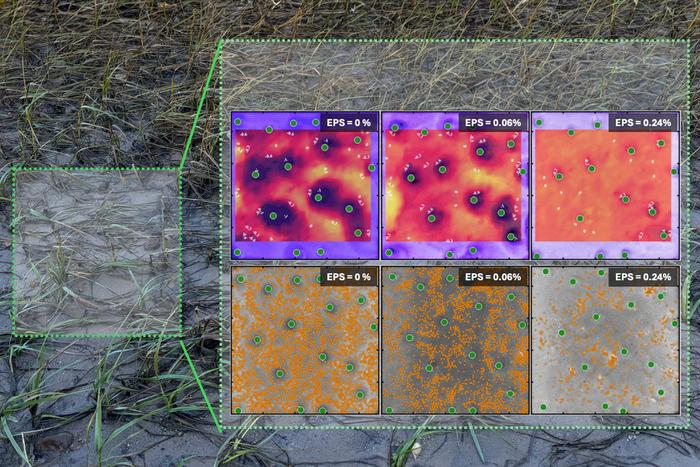
The relentless proliferation of microplastics in aquatic environments has emerged as a pivotal concern for environmental scientists and public health experts alike. Despite their minuscule size, these particles pervade ecosystems in alarming concentrations, sneaking into the food chain and inevitably affecting human health. However, a critical gap remains in our understanding of the specific mechanisms governing the distribution and deposition of microplastics in natural waterways. Recent research led by scientists at the Massachusetts Institute of Technology (MIT) unveils groundbreaking insights into how biological films, or biofilms, on sediment beds influence the fate of microplastics in the environment.
This innovative study focuses on the interaction between extracellular polymeric substances (EPS) produced by microorganisms and the transport dynamics of microparticles, including microplastics. EPS are complex mixtures of biopolymers secreted by bacterial, fungal, and algal communities that form cohesive, sticky layers on surfaces such as sand and sediment. Traditionally overlooked in physical transport models, these biopolymers significantly modify sediment surface properties and, thereby, the behavior of suspended particles. By simulating conditions with and without EPS presence, the research delineates how biofilm-infused sediments alter particle accumulation, with profound implications for environmental fate prediction.
The experimental design employed a state-of-the-art flume setup, replicating riverine and coastal conditions with a bottom bed of fine sand complemented by vertical plastic tubing mimicking mangrove roots. These surrogates for natural emergent vegetation allowed the researchers to observe microscale flow patterns and turbulence effects that can modulate particle settlement. A critical innovation involved the integration of fluorescent-tagged microplastic particles into the flow, coupled with ultraviolet imaging techniques to visualize and quantify particle depositions across varying EPS concentrations.
Findings from this thorough investigation reveal a counterintuitive trend: the presence of biofilms substantially reduces net microplastic deposition on sediment beds. Contrary to the conventional view that sticky substances promote particle adherence, EPS fills the interstitial spaces among sand grains, effectively reducing the sediment’s pore space and limiting the depth to which particles can embed. This shallow embedding increases the exposure of particles to hydrodynamic forces, enhancing their susceptibility to resuspension and downstream transport under flowing water conditions.
Moreover, the study elucidates the role of emergent canopy analogs—modeled by vertical rods—in generating local turbulence that deters particle accumulation immediately adjacent to these structures. This turbulence creates microhabitats within which deposition dynamics fluctuate markedly, suggesting that structural complexity of vegetated zones plays a crucial part in spatial distribution patterns of microplastics. Such findings underscore the multifaceted physical and biological interactions that dictate microparticle behavior beyond simplistic sedimentation models.
The implications of this research extend far beyond laboratory confines, offering a conceptual framework for interpreting microplastic hotspots in natural water bodies. Riverbeds or coastal zones with sandy or gravel substrates devoid of extensive biofilm coverage are predicted to harbor greater concentrations of microplastics due to deeper particle trapping and lower resuspension probability. Conversely, muddy or biofilm-rich zones act as dynamic filters, effectively delaying and redistributing microplastic deposition through enhanced particle mobility.
This nuanced understanding significantly enriches existing sediment transport models by integrating biological factors previously marginalized in microplastic research. It also hints at spatial heterogeneity within ecosystems such as mangroves, where peripheral sandy regions may serve as critical accumulation zones, demanding targeted monitoring and remediation efforts. By focusing conservation strategies on these identified hotspots, environmental managers can optimize resource allocation and develop more sophisticated pollution mitigation technologies.
The study’s methodology—employing multiplexed fluorescence imaging and controlled flow environments—represents a compelling advancement in experimental techniques for environmental engineering. It enables precise quantification of microplastic spatial patterns and identifies specific physical and biological variables influencing particle fate. Such quantitative insights are vital for refining the parameters in computational fluid dynamics models and for advancing predictive tools critical to managing the escalating microplastic crisis.
Despite its breakthroughs, the research team acknowledges the complexity underlying real-world environments, where factors like turbulent flow fluctuations, sediment heterogeneity, and diverse microbial communities interact intricately. Unraveling these dynamics demands multidisciplinary approaches combining field measurements, laboratory experiments, and theoretical modeling. Future research is poised to dissect these complexities further, incorporating varying particle properties such as size, shape, and density, as well as more diverse biofilm compositions.
Furthermore, the work highlights the paramount importance of biological-physical coupling in sediment-particle dynamics, a paradigm often underrepresented in pollution studies. Recognizing that microorganisms and their secreted polymers act as essential moderators of particle retention shifts the narrative from purely physical sedimentation to a more integrative ecological perspective. Such insights enrich our understanding of sedimentary processes and their role in controlling contaminant pathways.
Ultimately, this MIT-led study not only illuminates a previously underappreciated mechanism influencing microplastic dispersion but also charts a strategic path forward for environmental monitoring and remediation efforts. By offering a refined lens through which to view microparticle behavior, it empowers researchers, policymakers, and conservationists to devise more effective interventions to safeguard aquatic ecosystems and public health from the pervasive threat of microplastic pollution.
Web References:
DOI: 10.1029/2025GL115331
Cite Scienmag News
Violet Maxwell. (June 5, 2025). New Study Identifies Key Zones of Microplastic Accumulation. Scienmag. https://scienmag.com/new-study-identifies-key-zones-of-microplastic-accumulation/
Violet Maxwell. "New Study Identifies Key Zones of Microplastic Accumulation." Scienmag, 5 June 2025, https://scienmag.com/new-study-identifies-key-zones-of-microplastic-accumulation/. Accessed 4 September 2026.
Violet Maxwell. "New Study Identifies Key Zones of Microplastic Accumulation." Scienmag. June 5, 2025. https://scienmag.com/new-study-identifies-key-zones-of-microplastic-accumulation/


