


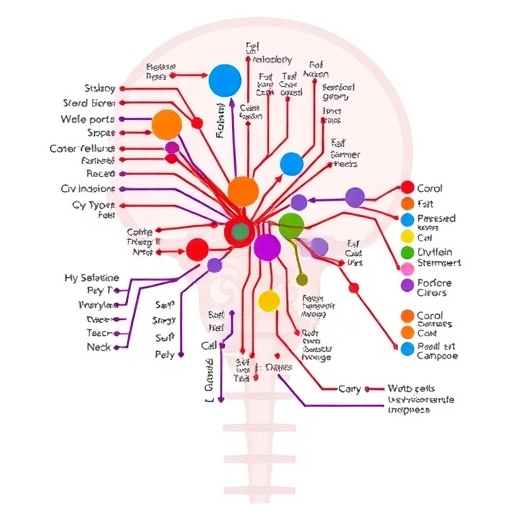
In an ambitious leap forward in the battle against head and neck squamous cell carcinomas (HNSCC), researchers at Boston University’s Chobanian & Avedisian School of Medicine have unveiled an unprecedented single-cell atlas that meticulously charts the intricate cellular ecosystems within HPV-negative tumors. This groundbreaking resource promises to redefine therapeutic strategies for a cancer subtype that has long eluded consistent clinical success due to its biological heterogeneity and complex tumor microenvironment.
HNSCC, ranking as the seventh most common cancer globally, manifests primarily as two distinct disease subtypes defined by their association with human papilloma virus (HPV) infection status. While HPV-positive tumors generally respond better to existing treatments, HPV-negative variants—often linked to tobacco and alcohol exposure—are notorious for high relapse rates and unpredictable treatment outcomes. This variability is largely attributed to the profound heterogeneity found both among tumors and within their surrounding cellular milieus, complicating efforts to develop universally effective therapies.
The research team, led by Stefano Monti, PhD, undertook an integrative analysis of over 230,000 individual cells culled from tumors of 54 treatment-naive patients with HPV-negative HNSCC. By synthesizing six distinct single-cell RNA sequencing datasets, they constructed a harmonized and comprehensive cellular atlas that captures the nuanced diversity of tumor and stromal populations. Employing rigorous quality control measures, the data underwent normalization and annotation with established reference databases and marker genes, culminating in an intricate cellular taxonomy and revealing previously obscured patterns of cell-to-cell communication.
Delving deeper into the atlas, the investigators mapped functional states of immune cells, distinguishing cytotoxic T lymphocytes poised for antitumor activity from dysfunctional variants that fail to mount effective responses. They also identified signaling interactions among malignant cells, myeloid populations, fibroblasts, and endothelial cells, elucidating the complex networks that drive tumor progression, immune evasion, and therapeutic resistance. This high-resolution portrait offers a refined understanding of how cellular crosstalk shapes disease trajectories.
By correlating cellular compositions and transcriptomic signatures with clinical parameters such as tumor stage and patient gender, the study uncovered associations that could underpin personalized therapeutic approaches. The atlas further incorporated spatial validation from external datasets to confirm the physical tumor architecture and cellular niches within the tissue, enhancing the biological relevance of these findings. Such spatial insights are paramount for designing interventions that target microenvironmental dependencies critical to tumor survival.
Beyond mapping, this integrative resource sheds light on the limitations of current immunotherapies. Although three immune checkpoint inhibitors have gained approval for treating HNSCC, their effectiveness is variable, particularly in HPV-negative cases. The atlas highlights candidate molecular targets involved in myeloid cytokine pathways that may contribute to chemotherapy resistance and blunt immunotherapy efficacy. Addressing these pathways could unlock new avenues to potentiate existing drugs or devise novel treatment regimens with broader impact.
The transformative potential of this atlas extends beyond head and neck cancers. Given shared microenvironmental traits among diverse tumor types, insights gleaned here may inform therapeutic design strategies for other malignancies characterized by similarly complex stromal and immune landscapes. By providing an open-access roadmap, the study invites the global scientific community to explore and validate these cell-specific vulnerabilities, accelerating translational discoveries.
At its conceptual core, the work underscores the emerging paradigm that a tumor’s microenvironment holds equally critical cues as its genetic mutations when determining disease behavior and response to treatment. As Lina Kroehling, the study’s first author and a bioinformatics PhD candidate, elaborates, these cellular fingerprints could revolutionize precision oncology by enabling clinicians to tailor not only genotype-targeted therapies but also interventions that modulate the tumor’s ecological niche.
Furthermore, the comprehensive integration of single-cell omics data with advanced computational analysis and spatial mapping exemplifies a new frontier in cancer biology research. This methodological synergy provides unprecedented granularity in resolving tumor heterogeneity and the dynamic interplay among diverse cell types, thereby overcoming limitations inherent in bulk tissue analyses that obscure critical microenvironmental details.
The open accessibility of this atlas will empower researchers and clinicians worldwide to interrogate complex cellular networks driving aggressive head and neck cancers. It serves as a foundational platform to identify biomarkers predictive of therapeutic response, to discover new drug targets, and ultimately to inform clinical trial designs that stratify patients based on microenvironmental attributes—moving towards truly personalized medicine.
This landmark study was published in the journal Communications Medicine and received support from prominent funding bodies including the National Institute of Dental and Craniofacial Research and the Find the Cause Breast Cancer Foundation. Its multidisciplinary approach, combining oncology, immunology, bioinformatics, and spatial transcriptomics, exemplifies the collaborative spirit critical to tackling recalcitrant cancers.
As the oncology community grapples with the challenges posed by tumor heterogeneity and immune resistance, this highly resolved single-cell atlas stands as a beacon of progress. It not only characterizes the complex cellular landscape within HPV-negative HNSCC but also charts a forward path for leveraging microenvironment-aware diagnostics and therapeutics—a vital step towards improving patient outcomes and survival in a devastating disease.
Cite Scienmag News
Nathaniel Bowman. (March 13, 2026). New Study Charts Cell Types Driving Head and Neck Tumors, Revealing How Cellular Interactions Influence Tumor Behavior. Scienmag. https://scienmag.com/new-study-charts-cell-types-driving-head-and-neck-tumors-revealing-how-cellular-interactions-influence-tumor-behavior/
Nathaniel Bowman. "New Study Charts Cell Types Driving Head and Neck Tumors, Revealing How Cellular Interactions Influence Tumor Behavior." Scienmag, 13 March 2026, https://scienmag.com/new-study-charts-cell-types-driving-head-and-neck-tumors-revealing-how-cellular-interactions-influence-tumor-behavior/. Accessed 3 September 2026.
Nathaniel Bowman. "New Study Charts Cell Types Driving Head and Neck Tumors, Revealing How Cellular Interactions Influence Tumor Behavior." Scienmag. March 13, 2026. https://scienmag.com/new-study-charts-cell-types-driving-head-and-neck-tumors-revealing-how-cellular-interactions-influence-tumor-behavior/


