


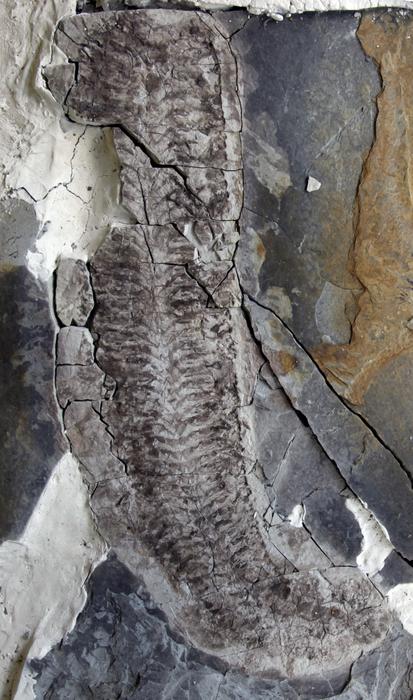
A remarkable discovery in paleontology has emerged from the depths of Earth’s ancient oceans, shedding light on life forms that existed over 440 million years ago. This remarkable new species, named Keurbos susanae, represents a significant leap in our understanding of ancient marine arthropods, marking a notable point in the evolutionary timeline. The fossil, affectionately dubbed ‘Sue’ after the mother of the lead researcher, Professor Sarah Gabbott, is not just another entry in the fossil record; it is an unprecedented look into life at a time when the Earth was undergoing dramatic changes due to glaciation and mass extinction events.
The study of this unique fossil, featured in the journal Palaeontology, describes not only the characteristics of Keurbos susanae but also the intricate details of its preservation, which defy the norm for fossilized marine life. Traditionally, fossils provide a glimpse into the external features of organisms. However, the exceptional state of Sue’s remains allows scientists to analyze the organism’s internal structures, including muscles, sinews, tendons, and even gut remnants, all preserved with remarkable clarity. This internal preservation invites questions about the conditions that facilitated such an extraordinary fossilization process, inspiring a wave of curiosity across the scientific community.
The background of this discovery is steeped in historical relevance, taking place in the Soom Shale formation, located approximately 250 miles north of Cape Town, South Africa. The strata that contain Sue were deposited during a period when a major global glaciation occurred, which led to the extinction of around 85% of species on Earth — a critical event known as one of the "big five" mass extinctions. Interestingly, the marine environment in which Keurbos susanae thrived seems to have uniquely escaped the harshest conditions of this glaciation. This raises questions about ecological niches that may have existed, allowing various forms of life to survive an otherwise catastrophic event.
Professor Gabbott’s research took 25 years, a testament to the long road scientific inquiry can sometimes entail. The initial excavation of the fossil sparked a passion that would lead her to unravel the mysteries embedded within the rock surrounding Sue. One of the primary objectives was to create a clearer picture of the evolution of marine arthropods, a massive phylum that today constitutes around 85% of all animal species on Earth, including familiar creatures like lobsters, crabs, and insects. In her quest, she uncovered a wealth of anatomical details, but the extraordinary preservation of the fossil posed unique challenges in situating it within the broader evolutionary narrative.
A crucial aspect of this fossilized specimen is its status as an “inside-out” archaic creature, which deviates from the typical fossil narrative that primarily focuses on external morphology. Keurbos susanae reveals internal anatomical features rarely observed in fossil records. This contrast not only provides valuable insights into the biology of ancient life forms but also introduces complexities in determining how these organisms relate to their evolutionary successors. The preservation of internal features may reveal essential clues about the functional morphology and lifestyle of this ancient marine arthropod.
The conditions that led to the exceptional preservation of Sue are equally intriguing. Researchers speculate that the sediments where the fossil was found contained toxic environments, characterized by a lack of oxygen and the presence of hydrogen sulfide. Such conditions create a formidable challenge for decay, as anaerobic environments can inhibit the decomposition processes responsible for breaking down organic matter. Understanding the geochemical processes that contributed to this preservation could ultimately help paleontologists develop a clearer framework for interpreting other similarly preserved specimens.
While the discovery of Keurbos susanae marks a significant milestone, it also raises challenging questions about future discoveries and interpretations. The small roadside quarry that served as the original excavation site for this extraordinary fossil is no longer accessible, suggesting that further specimens from this unique layer of geological history may remain elusive. This raises concerns about potential research limitations, as identifying more fossils of this nature would strengthen comparative studies necessary for establishing precise evolutionary classifications.
Professor Gabbott emphasizes the uniqueness of her find, remarking on the profound level of anatomical complexity visible within Sue. The layers of detail encapsulated in this specimen necessitate extensive analysis and interpretation, a process that highlights the challenges inherent in paleontological research. The ambiguity surrounding the precise evolutionary relationships of Keurbos susanae reflects the broader complexity that characterized life during the Ordovician period, where experimentation in form and function may have dominated evolutionary pathways.
This discovery not only enriches our knowledge of marine arthropods but also illustrates the relationship between personal history and scientific discovery. Naming the fossil after her mother adds an emotional layer to the research narrative, intertwining familial bonds with the quest for knowledge. It is a reminder that many scientific journeys are rooted in personal motivations, enthusiasm, and sometimes the need to honor those who inspire us. Professor Gabbott’s experiences signify how personal narratives can intertwine with academic pursuits, leading to significant contributions to science.
In sum, the unveiling of Keurbos susanae serves as a cornerstone in our understanding of early marine life and its evolutionary history. This fossil, preserved against the odds of time, acts as a valuable time capsule that may inspire further research into ancient marine ecosystems and the evolutionary trajectories of modern arthropods. As scientists continue to analyze the wealth of information contained within this fossil, Keurbos susanae will undeniably drive discussions in paleontology about the nuances of fossilization, the diversity of ancient life forms, and the intricate stories these remnants can tell about our planet’s history.
Cite Scienmag News
Violet Maxwell. (March 27, 2025). New Species Unveiled After 25 Years of Research on ‘Inside Out’ Fossil, Honoring Discoverer’s Mother with Its Name. Scienmag. https://scienmag.com/new-species-unveiled-after-25-years-of-research-on-inside-out-fossil-honoring-discoverers-mother-with-its-name/
Violet Maxwell. "New Species Unveiled After 25 Years of Research on ‘Inside Out’ Fossil, Honoring Discoverer’s Mother with Its Name." Scienmag, 27 March 2025, https://scienmag.com/new-species-unveiled-after-25-years-of-research-on-inside-out-fossil-honoring-discoverers-mother-with-its-name/. Accessed 3 September 2026.
Violet Maxwell. "New Species Unveiled After 25 Years of Research on ‘Inside Out’ Fossil, Honoring Discoverer’s Mother with Its Name." Scienmag. March 27, 2025. https://scienmag.com/new-species-unveiled-after-25-years-of-research-on-inside-out-fossil-honoring-discoverers-mother-with-its-name/


