


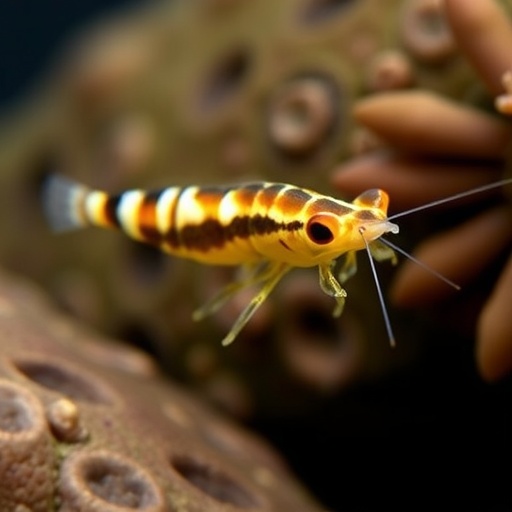
A reef shrimp-goby with a flare-bright personality has just been added to the scientific record. Researchers from Indonesia’s Museum Zoologicum Bogoriense, working with the National Research and Innovation Agency (BRIN), have described a new species, Tomiyamichthys oriens, from coastal waters off Banyuwangi in East Java.
Published in the open-access journal ZooKeys on 24 June 2026, the study is based on two museum specimens—one male and one female—each about 35.5 mm SL. The fish were initially noticed through an ornamental fish exporter, CV Cahaya Baru, after being collected from sandy shallows near Banyuwangi.
What makes T. oriens stand out is its vivid appearance. The species shows radiant orange blotches along the flanks and, in males, two elegant filamentous spines that extend from the first dorsal fin—traits that likely play roles in species recognition and display within shallow reef habitats.
Taxonomically, the new goby belongs to a shrimp-associated lineage across the tropical Indo-Pacific. Its closest known relative is T. hyacinthinus, recently described from southern Japan. The two species share a rare internal “blueprint” in the genus: nine segmented rays in both the dorsal and anal fins, plus the male-specific elongated dorsal filament spines.
However, T. oriens can be separated from its Japanese cousin using a package of technical characters. These include differences in pectoral fin rays, branched caudal fin ray counts, the arrangement of longitudinal scale rows, and the number and structure of gill rakers—as well as finer details of colour patterning.
To strengthen the case, the authors used genetic evidence from mitochondrial COI sequencing. The Indonesian and Japanese lineages show a 3.1% divergence, supporting the conclusion that these are distinct species rather than local variants.
Ecologically, local fishermen report that the new shrimp-goby favours sandy bottoms in shallow coastal zones. Yet, despite the genus’ typical association with burrowing alpheid shrimps, the exact pairing in the wild has not been directly observed in this study.
With this addition, the number of valid Tomiyamichthys species worldwide rises to 21, bringing Indonesia—at the heart of the Coral Triangle—to 13 species, the highest national total. The authors argue that small, overlooked reef fishes remain fertile ground for discovery, especially in biodiverse Indonesian waters.
Cite Scienmag News
Violet Maxwell. (July 28, 2026). New Shrimpgoby Species Named After Indonesia’s Java “Sunrise”. Scienmag. https://scienmag.com/new-shrimpgoby-species-named-after-indonesias-java-sunrise/
Violet Maxwell. "New Shrimpgoby Species Named After Indonesia’s Java “Sunrise”." Scienmag, 28 July 2026, https://scienmag.com/new-shrimpgoby-species-named-after-indonesias-java-sunrise/. Accessed 3 September 2026.
Violet Maxwell. "New Shrimpgoby Species Named After Indonesia’s Java “Sunrise”." Scienmag. July 28, 2026. https://scienmag.com/new-shrimpgoby-species-named-after-indonesias-java-sunrise/


