


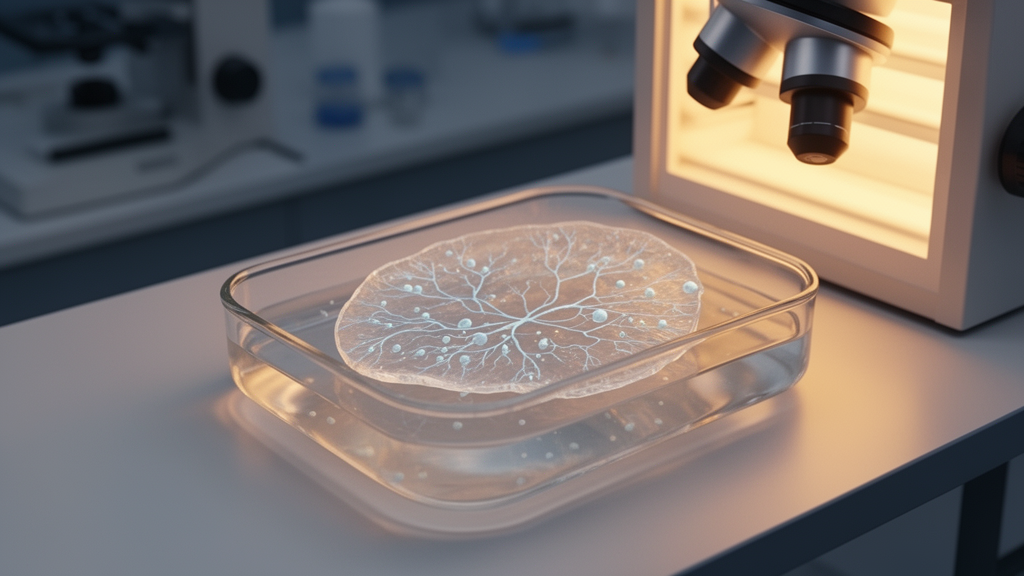
Deep inside the hippocampus, the brain region that anchors learning and memory, a thin layer of neural stem cells keeps producing new neurons long after birth. Studying that process has always posed a dilemma: cell cultures in a dish are easy to manipulate but lose the three-dimensional architecture that guides a young neuron’s fate, while living animals offer realism but are difficult to access and control. A research team at the University of Nottingham has now published a detailed, refined protocol for keeping intact slivers of mouse hippocampus alive and healthy for weeks, allowing scientists to watch new neurons being born, migrate and wire themselves into circuits in a piece of brain tissue that retains its native structure.
The method, described in the journal Experimental Biology and Medicine by Irem Akyel and Graham K. Sheridan, is a modernization of the interface technique first introduced by Stoppini and colleagues in 1991. In the classic approach, thin brain slices are placed on porous membrane inserts so that the tissue sits at an air-liquid interface: the underside draws nutrients from the medium while the upper surface remains exposed to oxygen, mimicking conditions in the living brain more closely than full immersion. The Nottingham team’s version streamlines the entire workflow so that dissection, slicing and plating can be completed in roughly three hours, and it adapts the technique across developmental stages, rodent species and brain regions.
The technical heart of the protocol is the preparation of 400-micrometre-thick slices from postnatal day 7 to 10 mouse pups using a McIlwain tissue chopper, a device that cuts rapidly and reproducibly. Each hippocampus yields about ten slices, which are separated under a stereomicroscope with fine syringe needles, screened for damage, and plated three at a time onto sterile Millicell membrane inserts in six-well plates. The slices attach firmly to the membrane within four to six days without any coating of poly-D-lysine or extracellular matrix proteins, and they can be maintained for several weeks, giving researchers a stable platform for live-cell imaging, electrophysiology and pharmacological experiments.
The most significant refinement lies in how the cultures are fed. The original Stoppini method relied on high-serum media, sometimes containing up to 25% horse serum, which supported survival but encouraged overgrowth of glial cells at the expense of the delicate neurogenic niche. The new protocol introduces a phased, two-media transition. During the first three days, slices recover in a mixture of DMEM/F12 and Opti-MEM supplemented with 6% horse serum and 4% foetal bovine serum, together with nerve growth factor and a MITO+ serum extender rich in EGF, FGF, insulin and transferrin. The higher serum concentration helps seal membranes damaged during slicing and promotes attachment, while the growth factors keep the proliferative machinery of the subgranular zone running.
From day three onward, the medium is gradually swapped to a Neurobasal-A backbone containing the defined supplements B27 and N21, with serum dropping in steps from 10% to 7.5% and finally to 5% by day five. Neurobasal-A is formulated to support post-mitotic neurons while suppressing non-neuronal overgrowth, and crucially it lacks the high glutamate levels of standard basal media that can cause chronic excitotoxicity in wounded tissue. The B27 supplement delivers antioxidants, including catalase, superoxide dismutase and vitamin E, which counteract the oxidative stress generated when intact tissue is cut, while N21 provides a consistent source of essential fatty acids and antioxidants such as alpha-lipoic acid. The slices are also held at 35.5 degrees Celsius, slightly below physiological temperature, a mild hypothermia the authors note is neuroprotective.
To validate the system, the team used the thymidine analogue EdU, which is incorporated into DNA as cells divide, combined with a panel of immunofluorescent markers. On the sixth day in culture, slices were pulsed with 5 micromolar EdU for six hours and then grown for a further thirteen days before fixation. Confocal imaging revealed that Ki67-positive proliferating cells and SOX2-expressing neural precursors remained densely clustered in the subgranular zone of the dentate gyrus, exactly where they sit in the intact brain, confirming that the stem cell niche survives the preparation. Nestin-positive progenitors retained their organized horseshoe pattern within the dentate gyrus, and quantification showed an average of about 24 EdU-positive cells per 0.05 square millimetres of dentate tissue, a consistent and reliable measure of ongoing proliferation.
The lineage data were equally encouraging. Of the dividing cells, roughly 15% went on to express NeuN, marking mature neurons, around 35 to 40% became S100β-positive glia, and the remaining 45 to 50% were double-negative, a population the authors interpret as transit-amplifying progenitors that sustain the proliferative capacity of the dentate gyrus. Staining for synaptophysin and the GluA1 subunit of the AMPA receptor showed that presynaptic terminals and postsynaptic glutamate receptors were preserved, including the mossy fibre tract that links the dentate gyrus to CA3 pyramidal neurons. Perhaps most strikingly, Wisteria floribunda agglutinin staining revealed intact perineuronal nets, the specialized extracellular matrix structures that stabilize synapses and shape the neurogenic microenvironment, features that dissociated cultures and even most brain organoids fail to reproduce.
The authors are candid about the method’s limitations. Cutting the tissue necessarily severs the major afferent and efferent projections of the hippocampus, removing entorhinal cortex input and leaving the trisynaptic circuit functionally deafferented. This triggers reactive synaptogenesis, mossy fibre sprouting and progressive hyperexcitability that can lower the threshold for epileptiform activity. They also observed pronounced GFAP-positive astrogliosis in their cultures, an inflammatory glial response that is an inevitable companion of long-term slice culture. Slicing strategy involves trade-offs too: the McIlwain chopper is fast and reproducible, minimizing the metabolic stress of prolonged preparation, while vibratome sectioning produces cleaner cut surfaces but extends the interval between harvest and culture. The authors suggest entorhino-hippocampal co-cultures as one way to preserve perforant pathway connectivity, though they found the dentate gyrus actually survives better without attached cortex.
Where does this leave the booming field of human stem cell models? The authors argue that induced pluripotent stem cell-derived organoids, while valuable for capturing human genetics, often lack structural maturity, show stochastic cell placement and lack the organized extracellular matrix and pre-assembled circuits, such as the mossy fibre pathway and radial glial scaffold, that new neurons need for authentic integration. Human organotypic slices from surgical samples exist but are rare, inconsistent and typically drawn from patients with tumours or epilepsy. The refined rodent protocol, by contrast, is accessible, reproducible and physiologically faithful, positioning it as a practical middle ground between oversimplified monolayers and the complexity of the living brain. It also dovetails with emerging tools: tissue-clearing methods like ScaleS, expansion microscopy and light-sheet fluorescence microscopy could all be combined with these slices to track progenitor division, migration and circuit integration in three dimensions over time.
For researchers probing how biochemical enhancers boost the birth of new neurons, or how neurodevelopmental disorders derail circuit assembly, the protocol offers a standardized starting point with a comprehensive troubleshooting guide covering everything from contamination to poor slicing technique. By sustaining the spatial relationships between neurons, astrocytes and microglia, along with the mechanical and biochemical cues of the niche, this quietly meticulous piece of bench craft could accelerate the search for ways to harness neurogenesis for repair, and provide a rigorous ex vivo testbed for drugs that might one day coax the aging hippocampus into making new neurons again.
Subject of Research: A refined organotypic slice culture protocol for quantifying hippocampal neurogenesis ex vivo
Article Title: Refined protocol for quantifying hippocampal neurogenesis in organotypic slice cultures
Article References: Akyel, I., & Sheridan, G. K. (2026). Refined protocol for quantifying hippocampal neurogenesis in organotypic slice cultures. Experimental Biology and Medicine, 251, Article 11165. https://doi.org/10.3389/ebm.2026.11165
Image Credits: AI Generated
Keywords: hippocampus, neurogenesis, organotypic slice cultures, neural stem cells, dentate gyrus, EdU assay, subgranular zone, brain organoids, immunofluorescence, extracellular matrix, perineuronal nets, cell culture protocol
Cite Scienmag News
Cassandra Pierce. (October 15, 2026). New Protocol Keeps Living Brain Slices Alive for Weeks to Track Birth of New Neurons. Scienmag. https://scienmag.com/new-protocol-keeps-living-brain-slices-alive-for-weeks-to-track-birth-of-new-neurons/
Cassandra Pierce. "New Protocol Keeps Living Brain Slices Alive for Weeks to Track Birth of New Neurons." Scienmag, 15 October 2026, https://scienmag.com/new-protocol-keeps-living-brain-slices-alive-for-weeks-to-track-birth-of-new-neurons/. Accessed 15 October 2026.
Cassandra Pierce. "New Protocol Keeps Living Brain Slices Alive for Weeks to Track Birth of New Neurons." Scienmag. October 15, 2026. https://scienmag.com/new-protocol-keeps-living-brain-slices-alive-for-weeks-to-track-birth-of-new-neurons/


