


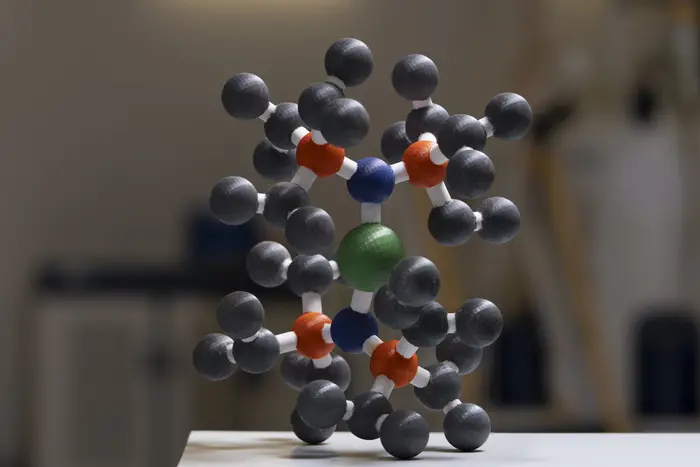
In a remarkable stride towards the future of digital data storage, chemists from The University of Manchester and The Australian National University (ANU) have synthesized a novel molecule capable of retaining magnetic memory at unprecedented temperatures. This breakthrough ushers in a new era for molecular magnets, potentially revolutionizing how data is stored and compressed in hardware devices drastically smaller than today’s conventional technologies. Through the intricate engineering of a dysprosium-based molecule with a rare linear atomic arrangement, researchers have paved the way for hardware as compact as a postage stamp, yet able to store digital information at densities hundreds of times greater than current standards.
Unlike traditional hard drives that rely on the collective magnetism of billions of atoms to encode data, the innovation centers on single-molecule magnets (SMMs)—unique entities where individual molecules themselves serve as discrete magnetic bits. The main challenge surrounding SMMs has been their operational fragility at extremely low temperatures, often requiring conditions near absolute zero to maintain magnetic memory. However, the newly created molecule defies this limitation by preserving its magnetic hysteresis up to 100 Kelvin, a temperature roughly equivalent to minus 173 degrees Celsius. This temperature is not far from conditions found on the moon’s night side and marks a significant leap beyond the prior record of 80 Kelvin, or minus 193 degrees Celsius.
The secret behind this advance lies in precise atomic geometries. At the core of the molecule, the rare earth element dysprosium is situated in an almost perfectly linear coordination with two nitrogen atoms. Such linearity, long theorized to enhance magnetic performance by stabilizing electron spin orientations, had remained experimentally elusive—until now. Previous attempts resulted in more distorted or bent molecular arrangements, limiting the thermal robustness of the resulting magnets. In this breakthrough molecule, the inclusion of an alkene substituent acts as a molecular clamp, securing the spatial configuration and thus dramatically improving magnetic stability at elevated cryogenic temperatures.
To fully unlock the potential of this newly synthesized molecule, the research team employed pioneering quantum mechanical simulations capable of capturing time-dependent spin dynamics at the atomic level. Leveraging substantial computational resources at ANU and the Pawsey Supercomputing Centre, scientists translated fundamental quantum equations into predictive models of the molecule’s magnetic behavior. This deep theoretical understanding elucidated how the unique electronic structure and linear geometry contribute synergistically to magnetic retention and allowed identification of avenues to further optimize these properties in future designs.
The practical applications of these findings could redefine data storage technologies dramatically. Conventional hard disks encode data by magnetizing clusters of atoms en masse, inevitably imposing a lower bound on physical size and storage density. Single-molecule magnets, in contrast, offer the promise of ultra-miniaturization by making every molecule a single magnetic memory unit independent of its neighbors. Successfully integrating these molecular magnets into hardware could compress data storage by orders of magnitude — for instance, cramming roughly three terabytes of digital data into a storage space no larger than a postage stamp.
To put this capacity in perspective, the researchers highlight iconic cultural touchstones such as Pink Floyd’s landmark album “The Dark Side of the Moon.” This atom-sized hard drive could hold the equivalent of 40,000 copies of that album, or around half a million TikTok videos, showcasing the transformative scale of this molecular data compression. With digital content and internet traffic increasing exponentially, such storage technology is urgently needed to support future data centers and cloud infrastructures facing escalating demand.
Although the need for cooling remains a practical limitation—these molecular magnets currently operate at temperatures far below room temperature—the team’s progress brings hope for more accessible cryogenic solutions. Cooling to 100 Kelvin is feasible using liquid nitrogen, a common and inexpensive refrigerant widely used in industrial and research contexts. Whereas previous materials’ reliance on liquid helium (around 4 Kelvin) rendered large-scale applications unviable, the ability to function at liquid nitrogen temperatures opens the door for integration into large data centers, where cooling infrastructure is already commonplace.
"This development won’t instantly revolutionize consumer technology," notes co-lead author Professor David Mills of The University of Manchester, "but it could soon make quantum-level magnetic data storage practical in large-scale server farms, potentially improving efficiency and density in the backbone of global internet infrastructure." This relatively accessible temperature range, combined with superior storage capabilities, bridges the gap between fundamental discovery and plausible real-world applications.
Moreover, this molecular design blueprint provides a rich platform for subsequent improvements. By experimentally demonstrating that a nearly perfectly linear coordination environment around dysprosium enhances magnetic remanence so dramatically, future research can explore variations of ligand chemistry, heavier rare earth elements, or structurally similar molecules to push working temperatures even higher, ideally toward ambient conditions. Such advancements could eventually yield consumer electronics with radically increased storage densities without sacrificing form factor or energy efficiency.
From a quantum materials perspective, the ability to simulate such complex magnetic phenomena from first principles heralds a new era of materials discovery. The combination of synthesis, characterization, and high-performance quantum simulations accelerates the path from hypothesis to functional materials through numerical insights unattainable via experimentation alone. This integrative approach serves as a model for tackling other grand challenges in functional material design beyond data storage, from quantum computing qubits to advanced spintronic devices.
Reflecting on the journey since the early 1970s when digital media like vinyl records and magnetic tape ruled data storage, the researchers draw an inspiring parallel to Pink Floyd’s “The Dark Side of the Moon.” The monumental shifts in how we create, store, and transmit music and media underscore the exponential progress technology has made. Today’s emergence of single-molecule magnetic storage promises an equally transformative leap, compressed into the span of molecules, and may well define data technologies for the next half-century and beyond.
In summary, this breakthrough in dysprosium-based single-molecule magnets marks a watershed moment in molecular magnetism and quantum data storage. By transcending former low-temperature constraints and utilizing atomic precision in molecular design, the research teams from ANU and Manchester have unlocked a new realm of possible hardware miniaturization and data density. As computational techniques and synthetic chemistry co-evolve, the vision of ultra-dense, energy-efficient, molecular-scale storage devices steadily moves toward reality, ready to meet the ever-growing global demand for digital information in our increasingly interconnected world.
News Publication Date: 25-Jun-2025
Web References:
https://www.nature.com/articles/s41586-025-09138-0
http://dx.doi.org/10.1038/s41586-025-09138-0
References:
Chilton, N. et al. Soft magnetic hysteresis in a dysprosium amide–alkene complex up to 100 kelvin. Nature (2025).
Keywords
single-molecule magnets, dysprosium, molecular memory, quantum simulations, high-density data storage, cryogenic temperatures, magnetic hysteresis, rare earth elements, linear coordination, ligand design, quantum materials, data center technology
Cite Scienmag News
Bethany Barker. (June 25, 2025). New Molecule Paves Way for Stamp-Sized Hard Drives with 100x Greater Storage Capacity. Scienmag. https://scienmag.com/new-molecule-paves-way-for-stamp-sized-hard-drives-with-100x-greater-storage-capacity/
Bethany Barker. "New Molecule Paves Way for Stamp-Sized Hard Drives with 100x Greater Storage Capacity." Scienmag, 25 June 2025, https://scienmag.com/new-molecule-paves-way-for-stamp-sized-hard-drives-with-100x-greater-storage-capacity/. Accessed 4 September 2026.
Bethany Barker. "New Molecule Paves Way for Stamp-Sized Hard Drives with 100x Greater Storage Capacity." Scienmag. June 25, 2025. https://scienmag.com/new-molecule-paves-way-for-stamp-sized-hard-drives-with-100x-greater-storage-capacity/


