


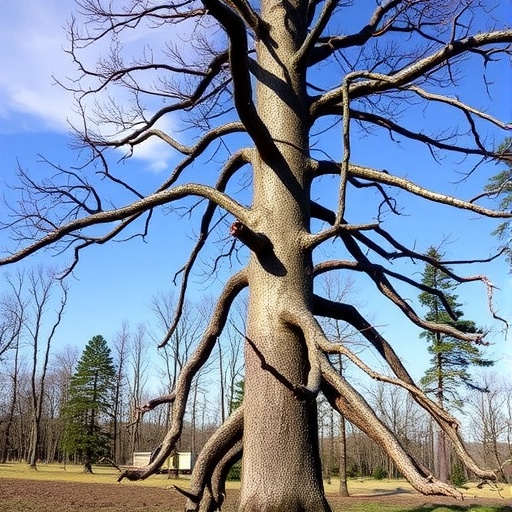
The intricate relationship between urban forests and carbon cycling has garnered significant attention in contemporary environmental science. A recent research article investigates the implications of various estimation methods for biomass and carbon associated with standing dead trees across the United States. The decision on which methodology to adopt is pivotal, as it can influence policy and management practices that aim to mitigate climate change effects. This topic is particularly relevant as dead trees, often overlooked, play a crucial role in carbon storage and nutrient cycling within forest ecosystems.
Standing dead trees, or snags, represent a vital ecological asset. They provide habitat for wildlife, support biodiversity, and contribute to overall forest health. However, accurately assessing their biomass and carbon content poses challenges that can vary widely depending on the methodological approach employed. The study conducted by Russell et al. aims to quantify these differences and highlight how they can impact environmental assessments and forest management strategies.
One significant aspect of the research examines the discrepancies between traditional biomass estimation methods and modern, advanced techniques. Traditional models often rely on site-specific growth factors and generalized equations that may not capture the complexities inherent in tree physiology and varying environmental conditions. By contrast, newer models incorporate advanced remote sensing technology, enhancing accuracy in carbon stock estimation. These advancements could fundamentally shift how we perceive the carbon contributions of standing dead trees.
The researchers utilized an array of data sources, including satellite imagery and ground-based measurements, to illuminate the differences in carbon stock estimates derived from alternative methodologies. This approach not only provided a comprehensive overview of the standing dead tree populations but also illuminated the discrepancies that arise when applying different estimation techniques. Understanding these variances is crucial, as they could lead to significant differences in national carbon accounting frameworks.
Moreover, the article delves into the environmental implications of these estimation methods in the policy context. Accurate biomass and carbon assessments are vital for developing strategies to enhance forests’ capability to sequester carbon. As policies and frameworks evolve in response to climate challenges, understanding the nuanced role of standing dead trees becomes increasingly critical. Decision-makers must be equipped with precise data to inform their management practices effectively.
The research also highlights how local conditions, such as soil type, climate, and urbanization levels, can influence the effectiveness of estimation methods. For example, in urban settings, standing dead trees may exhibit different growth patterns and decay rates than those in more remote areas. Thus, tailoring methodologies to local conditions could facilitate more accurate assessments, leading to better-informed forest management practices.
The implications of this research are manifold and speak to broader themes in environmental science, particularly in terms of biodiversity conservation and ecosystem restoration. The role of standing dead trees in promoting habitat diversity cannot be overstated; they create niches for various species, contribute to soil health through decomposing biomass, and influence forest dynamics. As such, a nuanced understanding of their biomass and carbon contributions is vital for preserving ecosystem integrity.
Employing alternative estimation methods can also raise awareness about the ecological significance of standing dead trees among the public and policymakers alike. By disseminating accurate information about their role in carbon cycling, we can foster greater appreciation for these often-ignored components of forest ecosystems. This heightened awareness can galvanize public support for conservation measures aimed at preserving and promoting the health of urban and rural forests.
Another critical avenue explored in the study is the potential for integrating these methods into nationwide carbon monitoring initiatives. As the urgency of climate change mitigation escalates, developing standardized methodologies that accurately account for all tree types, including standing dead trees, is essential. Having robust data on carbon stocks can play a decisive role in crafting strategies aimed at reducing carbon emissions and enhancing carbon sequestration capacities.
In terms of future research directions, the study underscores the need for continuous refinement of biomass estimation methodologies. By fostering collaboration between ecologists, remote sensing specialists, and policymakers, we can work towards more coherent frameworks that standardize data collection and enhance the reliability of carbon accounting. This multidisciplinary approach is crucial for advancing scientific understanding and informing effective management strategies.
The significance of accounting for standing dead trees in biomass and carbon estimation extends beyond ecological metrics; it also touches on social aspects such as community engagement. Engaging local communities in monitoring programs can provide valuable insights and foster a sense of stewardship toward forested lands. By embedding public participation into carbon monitoring initiatives, we can enhance environmental literacy and inspire collective action for conservation efforts.
In conclusion, the landscape of forest management and carbon estimation is evolving rapidly. The research conducted by Russell et al. underscores the importance of embracing innovative methodologies to improve the accuracy of biomass and carbon assessments related to standing dead trees. By recognizing the ecological importance of these trees and employing precise data collection techniques, we can significantly enhance our understanding of forest ecosystems and their role in climate change mitigation. As we move forward, integrating these insights into practicality will be key to fostering sustainable forest management practices and promoting resilient ecosystems in the face of a changing climate.
Russell, M.B., Edgar, C.B. & Domke, G.M. Implications of alternative biomass and carbon estimation methods for standing dead trees in the United States.
Environ Monit Assess 198, 85 (2026). https://doi.org/10.1007/s10661-025-14896-5
Cite Scienmag News
Margaret Porter. (January 5, 2026). New Methods Transform Standing Dead Tree Carbon Estimates. Scienmag. https://scienmag.com/new-methods-transform-standing-dead-tree-carbon-estimates/
Margaret Porter. "New Methods Transform Standing Dead Tree Carbon Estimates." Scienmag, 5 January 2026, https://scienmag.com/new-methods-transform-standing-dead-tree-carbon-estimates/. Accessed 4 September 2026.
Margaret Porter. "New Methods Transform Standing Dead Tree Carbon Estimates." Scienmag. January 5, 2026. https://scienmag.com/new-methods-transform-standing-dead-tree-carbon-estimates/


