


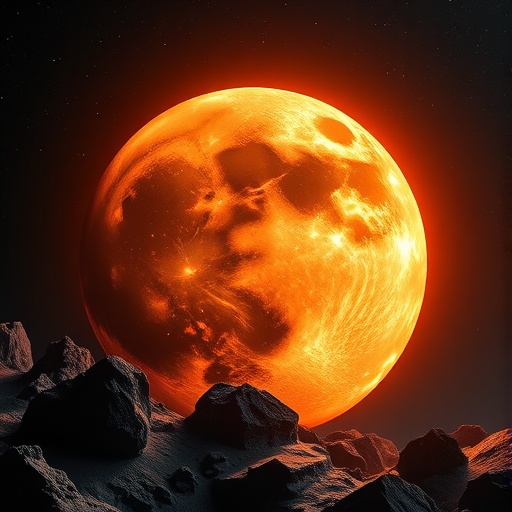
Researchers Merle, Deligny, and Whitehouse have recently made a groundbreaking revelation regarding the origins of lunar basalts, specifically those dating back approximately three billion years. Their study, set to be published in “Commun Earth Environ” in 2026, delves into the mantle processes following the crystallization of the lunar magma ocean—a period that has long intrigued scientists seeking to unravel the geological history of the Moon. This research not only sheds light on the nature of the Moon’s mantle but poses significant implications for our understanding of planetary formation and evolution in the solar system.
The study builds upon foundational theories regarding the lunar magma ocean (LMO), which is believed to have formed shortly after the Moon’s creation, around 4.5 billion years ago. This primordial ocean likely consisted of molten rock that eventually crystallized as it cooled, solidifying into the crust we observe today. However, the exact processes that led to the formation of the underlying mantle and the composition of subsequent volcanic eruptions have remained enigmatic. The team’s work presents evidence that challenges existing paradigms and suggests an intricate sequence of events that occurred after the initial crystallization of the LMO.
Central to their findings is the suggestion that a secondary mantle source, distinct from the previously assumed components, emerged after the LMO’s extensive cooling period. This new mantle source suggests that the evolution of the Moon’s geology did not conclude with the crystallization of the magma ocean, but rather, new materials were introduced to the mantle, likely due to tectonic or magmatic processes over geological timeframes. Such a revelation posits that the Moon’s geological activity may have been more dynamic and prolonged than previously believed.
In their analysis, the authors utilized a combination of geochemical modeling, isotopic analysis, and a review of existing lunar samples returned by the Apollo missions. These extensive datasets facilitated a comparative analysis of the lunar basalts, prompting the authors to identify specific mineralogical signatures indicative of an origin that deviates from a simple, uniform mantle source. This nuanced interpretation emphasizes the chemical diversity and complexity of lunar materials, often masked by the challenges of working with limited samples and the harsh lunar environment.
The researchers highlighted the significance of isotopic ratios, especially those of elements like strontium, neodymium, and oxygen. These isotopes act as fingerprints of the geological processes that shaped the Moon’s surface and mantle. The variations noted in the lunar basalts suggest involvement of materials that were possibly recycled or re-fortified through faults, magma chambers, or other mechanisms that contributed to the evolving mantle structure post-LMO crystallization.
Furthermore, the team underscored the importance of understanding such processes not only for lunar geology but also for broader planetary science contexts. The insights gained from the Moon can provide a comparative framework for studying other terrestrial bodies, such as Mars or the larger moons of the outer planets, which may exhibit similar mantle processes. This cross-planetary perspective enriches our understanding of how planetary bodies evolve, emphasizing the notion that they are not static but undergo complex geological transformations over eons.
As the team prepares for the forthcoming publication, they acknowledge the collaborative efforts of the international scientific community. This endeavor is indicative of the collective pursuit of knowledge that characterizes modern planetary science, where findings from different teams converge to provide a multidimensional view of celestial phenomena. Such collaboration is pivotal, especially given the limited lunar sample inventory and the intricate nature of interpreting geological records on the Moon.
Another key takeaway from this research is the potential for future lunar exploration missions. With initiatives targeting a return to the Moon, including plans for sample collection and in-situ analysis, the findings provide a compelling case for further investigation of the lunar mantle. Robotic missions and human-crewed expeditions could enhance our understanding by accessing regions that remain unexplored, possibly uncovering further evidence for the proposed secondary mantle sources suggested by the findings of Merle and colleagues.
The implications of this work extend into various scientific disciplines, including astrobiology and planetary formation theories. Understanding the Moon’s mantle and its evolution provides context for the conditions that were present during the early solar system. Insights into such environments can inform hypotheses regarding the formation of other celestial systems and the potential for habitable conditions beyond Earth.
Emerging technologies also play a critical role in advancing lunar geological studies. High-resolution imaging and precise geochemical analytical techniques have become instrumental in dissecting complex geological histories. The combination of these technologies with the increasing availability of computational power fosters innovative approaches to modeling the Moon’s evolution, paving the way for deeper explorations into its past.
As the date of publication approaches, anticipation builds within the scientific community regarding peer feedback and subsequent discussions regarding the implications of this research. It is a remarkable time for lunar science, as the intersection of newly discovered data and ongoing exploration initiatives promises to expand the horizons of our knowledge and understanding of our closest celestial companion.
In summary, the work of Merle, Deligny, and Whitehouse serves as a turning point in lunar geology. Their groundbreaking findings reveal that the narrative of the Moon’s geological evolution is far more intricate than previously conceived, suggesting not only a re-evaluation of existing theories but a clarion call for future exploration. The lunar landscape continues to unveil its secrets, igniting scientific curiosity and inspiring a new generation of researchers to delve into the mysteries of our cosmic neighbor.
By enhancing our understanding of the Moon’s mantle and its post-crystallization evolution, the researchers contribute significantly to the larger dialogues in planetary science. As we stand on the precipice of renewed lunar exploration, the foundations laid by this research will indubitably shape future missions, guiding them to probe the depths of our lunar satellite and uncover the tantalizing secrets still hidden beneath its surface.
Merle, R.E., Deligny, C., Whitehouse, M.J. et al. A mantle source formed after the lunar magma ocean crystallisation for the 3000 Ma-old lunar basalts. Commun Earth Environ (2026). https://doi.org/10.1038/s43247-025-03002-9
Cite Scienmag News
Violet Maxwell. (January 22, 2026). New Mantle Source Emerges After Lunar Magma Ocean. Scienmag. https://scienmag.com/new-mantle-source-emerges-after-lunar-magma-ocean/
Violet Maxwell. "New Mantle Source Emerges After Lunar Magma Ocean." Scienmag, 22 January 2026, https://scienmag.com/new-mantle-source-emerges-after-lunar-magma-ocean/. Accessed 7 September 2026.
Violet Maxwell. "New Mantle Source Emerges After Lunar Magma Ocean." Scienmag. January 22, 2026. https://scienmag.com/new-mantle-source-emerges-after-lunar-magma-ocean/


