

Saturday, August 8, 2026
Science
No Result
View All Result
  • Login
  • HOME
  • SCIENCE NEWS
  • CONTACT US
  • HOME
  • SCIENCE NEWS
  • CONTACT US
No Result
View All Result
Scienmag
No Result
View All Result
Home Science News Chemistry

New Layered Crystal Enables High-Efficiency Thermoelectric Energy Conversion

July 17, 2026
in Chemistry
Reading Time: 2 mins read
0
New Layered Crystal Enables High-Efficiency Thermoelectric Energy Conversion

New Layered Crystal Enables High-Efficiency Thermoelectric Energy Conversion

65
SHARES
587
VIEWS
Share on FacebookShare on Twitter
ADVERTISEMENT

Thermoelectric materials are prized for their ability to harvest waste heat and turn it into electricity, yet they face a stubborn trade-off: boosting electrical transport typically raises thermal conductivity. A new study from the Institute of Science Tokyo tackles this dilemma by redesigning the internal architecture of a bulk crystal rather than only tuning its composition.

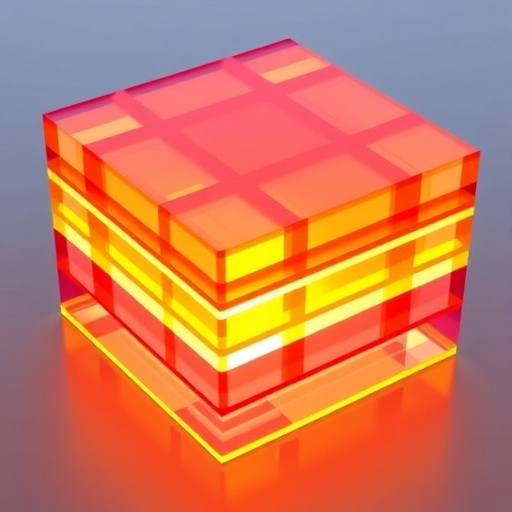
The researchers report TlFe1.6Se2, a layered material in which atomically thin FeSe sheets are periodically embedded inside a bulk host. The concept is to inherit the superior thermoelectric power factor associated with ultrathin FeSe while simultaneously suppressing heat flow in the surrounding crystal.

In their approach, the embedded FeSe layers coexist with ordered iron (Fe) vacancies. These vacancies act as built-in “phonon scatterers.” By disrupting local bonding and creating a complex lattice landscape, the vacancies strongly reduce the mobility of heat-carrying vibrations, lowering lattice thermal conductivity.

Electrical performance improves at the same time. The team finds that Seebeck coefficient values exceed 100 μV K−1 in the Fe-vacancy-ordered phase, delivering a thermoelectric power factor roughly five times larger than in the vacancy-disordered phase. The enhancement is linked to electronic structure changes induced by the vacancy ordering.

A key feature is a reversible temperature-driven transition near 180 °C, where the vacancy arrangement shifts from ordered to disordered. This dynamic behavior further strengthens phonon scattering and pushes thermal conductivity down to about 0.2 W m−1 K−1—at the level of, or lower than, leading thermoelectrics.

The results highlight a “low-dimensional functionality in bulk form” strategy: instead of building devices from films alone, the material embeds the benefits of two-dimensional physics inside a practical bulk crystal. Heavy thallium (Tl) atoms and the complex layered stacking additionally contribute by reducing phonon velocities and increasing scattering.

The publication also suggests broader applicability. Related alkali-intercalated FeSe systems containing potassium, rubidium, or cesium may offer tunable vacancy concentrations, providing a pathway to further optimize thermoelectric performance.

Overall, TlFe1.6Se2 demonstrates that power factor and thermal suppression can be engineered together through structural design—offering a viral, concept-forward blueprint for next-generation waste-heat converters.

Keywords
Thermoelectricity; FeSe; Vacancy ordering; Lattice thermal conductivity; Seebeck coefficient; Power factor; Layered crystals; Phonon scattering

Subject of Research: Not applicable
Article Title: Simultaneous enhancement of power factor and suppression of thermal conductivity in bulk TlFe1.6Se2 via embedded atomically thin FeSe layers
News Publication Date: 30-Apr-2026
Web References: https://pubs.rsc.org/ta/article/14/37/24666/1243050/Simultaneous-enhancement-of-power-factor-and
References: 10.1039/D6TA02075E
Image Credits: Institute of Science Tokyo

Tags: atomic scale engineeringheat-to-electricity conversionlayered crystal structurephonon scattering mechanismstemperature-driven phase transitionthermal conductivity suppressionthermoelectric efficiency enhancementthermoelectric materialsthermoelectric power factorultrathin FeSe layersvacancy ordering effectswaste heat energy harvesting
Share26Tweet16
Previous Post

Brain circuits could explain cognitive symptoms in progressive supranuclear palsy

Next Post

New perception-based technology brings AR glasses closer to real life

Related Posts

New brain model reveals how regional chemistry shapes large-scale neural activity
Chemistry

New brain model reveals how regional chemistry shapes large-scale neural activity

August 8, 2026
Topological coupler breaks bandwidth tradeoff in broadband coupled resonator waveguides
Chemistry

Topological coupler breaks bandwidth tradeoff in broadband coupled resonator waveguides

August 7, 2026
Radical Chemistry Selectively Cleaves Strong Bonds While Preserving Weaker Ones
Chemistry

Radical Chemistry Selectively Cleaves Strong Bonds While Preserving Weaker Ones

August 7, 2026
Trading food, not animal feed, could shrink U.S.-China agriculture’s environmental footprint
Chemistry

Trading food, not animal feed, could shrink U.S.-China agriculture’s environmental footprint

August 7, 2026
Laser spectroscopy uncovers hidden nuclear properties of elusive fermium
Chemistry

Laser spectroscopy uncovers hidden nuclear properties of elusive fermium

August 7, 2026
Advincula Named Fellow of the American Chemical Society
Chemistry

Advincula Named Fellow of the American Chemical Society

August 7, 2026
Next Post
New perception-based technology brings AR glasses closer to real life

New perception-based technology brings AR glasses closer to real life

  • Mothers who receive childcare support from maternal grandparents show more

    Mothers who receive childcare support from maternal grandparents show more parental warmth, finds NTU Singapore study

    27656 shares
    Share 11059 Tweet 6912
  • University of Seville Breaks 120-Year-Old Mystery, Revises a Key Einstein Concept

    1061 shares
    Share 424 Tweet 265
  • Bee body mass, pathogens and local climate influence heat tolerance

    682 shares
    Share 273 Tweet 171
  • Researchers record first-ever images and data of a shark experiencing a boat strike

    546 shares
    Share 218 Tweet 137
  • Groundbreaking Clinical Trial Reveals Lubiprostone Enhances Kidney Function

    531 shares
    Share 212 Tweet 133
Science

Embark on a thrilling journey of discovery with Scienmag.com—your ultimate source for cutting-edge breakthroughs. Immerse yourself in a world where curiosity knows no limits and tomorrow’s possibilities become today’s reality!

RECENT NEWS

  • Lancet Obesity Definition Differs From Other Diagnostic Criteria for Adults
  • New wheat gene Sdd1 offers resource for improving plant architecture
  • Most early Alzheimer’s patients receiving anti-amyloid therapy overlook brain-health guidelines, study finds
  • C/EBPγ Links Cancer Plasticity, DNA Repair, and Therapy Resistance in Lung Adenocarcinoma

Categories

  • Agriculture
  • Anthropology
  • Archaeology
  • Athmospheric
  • Biology
  • Biotechnology
  • Blog
  • Bussines
  • Cancer
  • Chemistry
  • Climate
  • Earth Science
  • Editorial Policy
  • Marine
  • Mathematics
  • Medicine
  • Pediatry
  • Policy
  • Psychology & Psychiatry
  • Science Education
  • Social Science
  • Space
  • Technology and Engineering

Subscribe to Blog via Email

Enter your email address to subscribe to this blog and receive notifications of new posts by email.

Join 5,149 other subscribers

© 2025 Scienmag - Science Magazine

Welcome Back!

Login to your account below

Forgotten Password?

Retrieve your password

Please enter your username or email address to reset your password.

Log In
No Result
View All Result
  • HOME
  • SCIENCE NEWS
  • CONTACT US

© 2025 Scienmag - Science Magazine

Discover more from Science

Subscribe now to keep reading and get access to the full archive.

Continue reading
