

Friday, August 28, 2026
Science
No Result
View All Result
  • Login
  • HOME
  • SCIENCE NEWS
  • CONTACT US
  • HOME
  • SCIENCE NEWS
  • CONTACT US
No Result
View All Result
Scienmag
No Result
View All Result
Home Science News Technology and Engineering

New perception-based technology brings AR glasses closer to real life

July 17, 2026
in Technology and Engineering
Reading Time: 2 mins read
0
New perception-based technology brings AR glasses closer to real life

New perception-based technology brings AR glasses closer to real life

65
SHARES
587
VIEWS
Share on FacebookShare on Twitter
ADVERTISEMENT

A major snag in optical see-through augmented reality (AR) is the trade-off between realism and usability. When occlusion-capable head-mounted displays block or modify real-world light to hide virtual elements behind physical objects, they can also dim the environment—making everyday tasks harder and reducing safety margins.

Researchers led by Assistant Professor Xiaodan Hu at Shibaura Institute of Technology set out to rebalance this conflict. Instead of treating hardware occlusion as the only lever, the team designed a perception-driven strategy that adapts display behavior to what users can actually see under changing lighting.

Their approach combines two optical paths: one supports pixel-level occlusion using polarized components, while the other bypasses the optical system to preserve the real world’s natural brightness. The system then adjusts the cross-angle between a polarizing beam splitter and a linear polarizer, blending the occlusion-capable and brightness-preserving views in real time.

Crucially, the blending is not arbitrary. Eye-tracking and scene analysis estimate visibility of both the surrounding environment and the virtual content, allowing the system to dynamically optimize the balance between them rather than relying on static settings.

To translate human perception into engineering constraints, the team ran user studies. One experiment with 12 participants measured contrast requirements for recognizing virtual texture details, quantifying how occlusion affects perceived clarity. A second study involved 24 participants to evaluate perception of lighting effects in the augmented scene.

These perceptual thresholds were integrated into the dynamic balancing strategy. Validation used a benchtop prototype, followed by a final user study with 12 participants across different illumination conditions.

Results showed improvements in real-world visibility while maintaining convincing appearance for virtual objects—addressing the long-standing realism-versus-visibility dilemma that has limited occlusion-capable AR adoption in practical settings.

Published online on April 8, 2026, the work appeared in IEEE Transactions on Visualization and Computer Graphics (TVCG), Volume 32, Issue 5, reinforcing the growing idea that display systems should be designed around human perception as much as optical performance.

The team’s contribution points toward future AR glasses that better preserve awareness of the surroundings while still delivering high-quality virtual augmentation, opening pathways for industrial maintenance, medical assistance, education, navigation, and remote collaboration where attention and visibility both matter.

Keywords

Virtual reality, Augmented reality, Perception-driven design, Occlusion, Optical see-through displays, Human visual perception, Eye tracking, Polarization optics, User studies, Dynamic visibility balancing

Subject of Research: People (Human perception and user studies)
Article Title: Mask Balancing: Perception-Driven Dynamic Visibility Enhancement for Occlusion-Capable Optical See-Through Head-Mounted Displays
News Publication Date: 8-Apr-2026 (available online)
Web References: https://doi.org/10.1109/TVCG.2026.3679903
References: IEEE Transactions on Visualization and Computer Graphics (TVCG), Volume 32, Issue 5
Image Credits: Assistant Professor Xiaodan Hu from Shibaura Institute of Technology, Japan

Article Title: New perception-based technology brings AR glasses closer to real life

Article References: Original research article

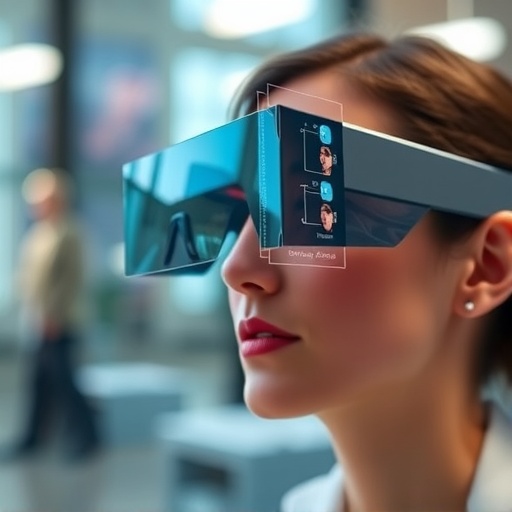
Image Credits: AI Generated

DOI: Not provided

Keywords: adaptive display blending in AR glasses, augmented reality head-mounted displays, balancing virtual and real-world visibility, dynamic brightness adjustment in AR devices, eye-tracking in augmented reality, light management in AR headsets, occlusion-capable AR system design, optical see-through AR challenges, perception-driven AR technology, polarized optical components for AR, real-time scene analysis in AR, user perception-based AR optimization

Cite Scienmag News

SCIENMAG. (July 17, 2026). New perception-based technology brings AR glasses closer to real life. https://scienmag.com/new-perception-based-technology-brings-ar-glasses-closer-to-real-life/

SCIENMAG. "New perception-based technology brings AR glasses closer to real life." Scienmag, 17 July 2026, https://scienmag.com/new-perception-based-technology-brings-ar-glasses-closer-to-real-life/. Accessed 28 August 2026.

SCIENMAG. "New perception-based technology brings AR glasses closer to real life." Scienmag. July 17, 2026. https://scienmag.com/new-perception-based-technology-brings-ar-glasses-closer-to-real-life/


Tags: adaptive display blending in AR glassesaugmented reality head-mounted displaysbalancing virtual and real-world visibilitydynamic brightness adjustment in AR deviceseye-tracking in augmented realitylight management in AR headsetsocclusion-capable AR system designoptical see-through AR challengesperception-driven AR technologypolarized optical components for ARreal-time scene analysis in ARuser perception-based AR optimization
Share26Tweet16
Previous Post

New Layered Crystal Enables High-Efficiency Thermoelectric Energy Conversion

Next Post

New DNA approach offers a strategy to fight gum disease

Related Posts

Noninvasive Physical Stimulation Reprograms Tumor Macrophages for Cancer Immunotherapy
Technology and Engineering

Noninvasive Physical Stimulation Reprograms Tumor Macrophages for Cancer Immunotherapy

August 28, 2026
Pentachlorophenol Promotes Bladder Cancer Cell Invasion by Disrupting Protein Stability
Technology and Engineering

Pentachlorophenol Promotes Bladder Cancer Cell Invasion by Disrupting Protein Stability

August 28, 2026
4D Body Scans Enable Data-Driven Skin Modeling for Better Compression Leggings
Technology and Engineering

4D Body Scans Enable Data-Driven Skin Modeling for Better Compression Leggings

August 28, 2026
Hydrogel Microneedles Navigate Diseased Tissue and Overcome Rigid Scars
Technology and Engineering

Hydrogel Microneedles Navigate Diseased Tissue and Overcome Rigid Scars

August 28, 2026
How Differential Replication Helps Adapt Deployed AI Under Real-World Constraints
Technology and Engineering

How Differential Replication Helps Adapt Deployed AI Under Real-World Constraints

August 28, 2026
DigitalPedon introduces digital twins for soil profile monitoring and global data interoperability
Technology and Engineering

DigitalPedon introduces digital twins for soil profile monitoring and global data interoperability

August 28, 2026
Next Post
New DNA approach offers a strategy to fight gum disease

New DNA approach offers a strategy to fight gum disease

  • Mothers who receive childcare support from maternal grandparents show more optimized

    Mothers who receive childcare support from maternal grandparents show more parental warmth, finds NTU Singapore study

    27656 shares
    Share 11059 Tweet 6912
  • University of Seville Breaks 120-Year-Old Mystery, Revises a Key Einstein Concept

    1061 shares
    Share 424 Tweet 265
  • Bee body mass, pathogens and local climate influence heat tolerance

    682 shares
    Share 273 Tweet 171
  • Researchers record first-ever images and data of a shark experiencing a boat strike

    546 shares
    Share 218 Tweet 137
  • Groundbreaking Clinical Trial Reveals Lubiprostone Enhances Kidney Function

    531 shares
    Share 212 Tweet 133
Science

Embark on a thrilling journey of discovery with Scienmag.com—your ultimate source for cutting-edge breakthroughs. Immerse yourself in a world where curiosity knows no limits and tomorrow’s possibilities become today’s reality!

RECENT NEWS

  • One Health Lessons from Pteropus medius: Nipah Spillover, Microbiota, and Antimicrobial Resistance
  • Noninvasive Physical Stimulation Reprograms Tumor Macrophages for Cancer Immunotherapy
  • Unexpected Cardiac Tumor Diagnosed as Histiocytosis in Case Report
  • Pentachlorophenol Promotes Bladder Cancer Cell Invasion by Disrupting Protein Stability

Categories

  • Agriculture
  • Anthropology
  • Archaeology
  • Athmospheric
  • Biology
  • Biotechnology
  • Blog
  • Bussines
  • Cancer
  • Chemistry
  • Climate
  • Earth Science
  • Editorial Policy
  • Marine
  • Mathematics
  • Medicine
  • Pediatry
  • Policy
  • Psychology & Psychiatry
  • Science Education
  • Social Science
  • Space
  • Technology and Engineering

Subscribe to Blog via Email

Enter your email address to subscribe to this blog and receive notifications of new posts by email.

Join 5,150 other subscribers

© 2025 Scienmag - Science Magazine

Welcome Back!

Login to your account below

Forgotten Password?

Retrieve your password

Please enter your username or email address to reset your password.

Log In
No Result
View All Result
  • HOME
  • SCIENCE NEWS
  • CONTACT US

© 2025 Scienmag - Science Magazine

Discover more from Science

Subscribe now to keep reading and get access to the full archive.

Continue reading