


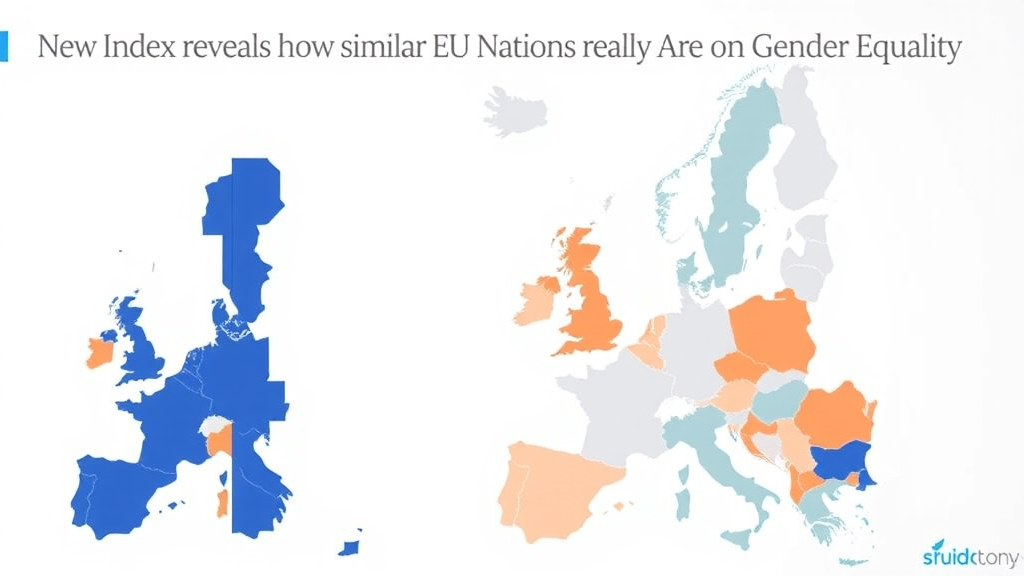
For more than a decade, the European Union has tracked gender equality through a single headline number: the Gender Equality Index, a composite score that condenses work, money, knowledge, time, power and health into one ranking. That score has proved politically useful, but it flattens a great deal of information. Two countries can post nearly identical overall scores while achieving them in completely different ways, excelling in one domain and lagging in another. A new study published in Social Indicators Research argues that this loss of structure matters, and it offers a mathematical remedy. Patrizia Pérez-Asurmendi of the Universidad Complutense de Madrid and Rocío de Andrés Calle of the Universidad de Salamanca have introduced a family of country gender homogeneity indices, a set of tools designed to measure not how equal a country is, but how similar countries are to one another across the full multidimensional profile of gender equality.
The central object of the new framework is the Mahalanobis Country Gender Homogeneity Index, or MCGHI. Instead of averaging national scores, the index measures the distance between the gender equality profiles of EU Member States, where each profile is a vector whose components describe the country’s position on the different dimensions of the Gender Equality Index. The key methodological choice is the distance function itself. The authors adopt the classical Mahalanobis distance, first proposed by the Indian statistician P. C. Mahalanobis in 1936, which weights differences between profiles through a positive definite matrix Sigma. This matrix encodes not only the dispersion of each dimension but also the statistical relationships among dimensions, allowing the index to distinguish, for example, between a gap in knowledge and a correlated combination of gaps in knowledge and money.
This structure gives the MCGHI a set of formal properties that the authors prove in detail. The index satisfies uniformity and country anonymity for any positive definite metric matrix, meaning that the measurement rules apply identically to every country and do not depend on national labels. Dimensional neutrality holds whenever the metric matrix is invariant under permutations of the dimensions; a particularly important special case arises when Sigma is a scalar multiple of the identity matrix, which treats all dimensions symmetrically and identically scales their variability. The index is also invariant under positive affine transformations of the data, provided the metric matrix is transformed consistently, so results do not change if dimensions are rescaled or shifted. In plain terms, the tool is robust to arbitrary units and conventions, which is essential when comparing indicators as heterogeneous as income, political representation and health outcomes.
The choice of Sigma is not innocuous, and the authors make its role explicit rather than burying it. Different specifications can account for scaling, for domain-specific dispersion and for cross-domain dependence among the six core domains and their underlying sub-domains of the Gender Equality Index. Because the empirical covariance structure of gender equality data changes over time and across specifications, the researchers treat the metric matrix as a family of alternatives to be tested, running the analysis under several plausible versions of Sigma and reporting how conclusions respond. This sensitivity discipline reflects a broader methodological literature on composite indicators, which has long warned that weighting and aggregation choices can drive rankings as much as the underlying data do. The MCGHI takes the opposite path from composite aggregation: it refuses to collapse the profile at all, and instead compares whole profiles directly.
The empirical application turns to data from the Gender Equality Index published by the European Institute for Gender Equality, which is publicly available and covers the EU Member States. Using national profiles from 2013 through 2024, the authors track the homogeneity of gender equality across the Union, asking whether countries have grown more alike or more distinct over the decade. The headline finding is a long-run increase in gender equality homogeneity between 2013 and 2024: by the distance-based measure, EU nations’ gender equality profiles have, on average, converged. The result echoes earlier European Commission analyses reporting upward convergence in gender equality, but it arrives through a fundamentally different measurement route, one that preserves the multidimensional composition of each country’s profile rather than compressing it into a single score first.
Yet the study is equally candid about the limits of that finding. The continuity, timing and magnitude of the homogeneity trend depend on the metric assumptions embedded in Sigma. When dimensions are scaled symmetrically, convergence appears one way; when domain-specific dispersion or cross-domain correlations are taken into account, the shape of the convergence path changes. Some sub-periods show steadier movement than others, and the timing of shifts in homogeneity is not invariant across metric choices. The authors do not present this as a weakness to be hidden but as the honest price of measuring a genuinely multidimensional phenomenon. The practical lesson for policymakers is that claims about convergence should be read alongside the assumptions that produced them, and the MCGHI is designed to make those assumptions visible and testable.
The distinction between level and homogeneity is more than a technical nuance, because the two can move in opposite directions. It is entirely possible for average gender equality across the EU to rise while the spread of national profiles widens, or for profiles to converge at a mediocre level rather than a high one. The overall Gender Equality Index score answers the first question, about levels, but is largely silent on the second, about structural similarity. By complementing rather than replacing the composite score, the new index allows analysts to detect whether progress is happening in a uniform European pattern or whether national gender regimes are pursuing distinct trajectories that happen to yield similar totals. That distinction matters for policy design, since uniform convergence suggests the possibility of EU-wide benchmarking, while persistent heterogeneity argues for differentiated national strategies.
The methodological lineage of the paper is broad. The authors build on the Mahalanobis distance tradition, including earlier work by González-Arteaga, Alcantud and de Andrés Calle that used the same distance in a cardinal dissensus measure, and they engage the substantial literature on composite indicators, from the OECD and European Commission Joint Research Centre handbook to multicriteria approaches and critiques of the Gender Equality Index itself. Scholars such as Permanyer and, more recently, Schmid and Elliot have argued that the EU index conflates corrected gender gaps with achievement levels, a debate that underscores how contested the definition of gender equality measurement remains. The homogeneity index sidesteps part of that controversy by measuring similarity of profiles without asserting what any single country’s score should be, though it inherits the dependence on however EIGE constructs the underlying dimensions.
The timing is significant. The 2024 edition of the Gender Equality Index, titled Sustaining Momentum on a Fragile Path, described progress that is real but uneven, and the 2025 edition promised sharper data for a changing world. Within that context, a tool that quantifies how tightly the Union’s gender equality landscape is knit together offers a new lens on the EU’s stated goal of a Union of Equality. If the 2013 to 2024 trend toward homogeneity continues, future editions of the index could document an increasingly uniform European gender regime; if metric-sensitive reversals appear, they may flag domains where convergence is stalling or where countries are drifting apart. The framework is general enough to be applied beyond the EU wherever multidimensional gender data exist, and the authors’ formal results on permutation invariance and affine robustness make it portable across indicator systems with different dimensional orders and scales.
What the study ultimately delivers is a change of question. Rather than asking which country is most gender equal, it asks how alike the family of European countries has become in the shape of its gender equality achievements, and it answers with a distance measure whose every assumption is stated, varied and stress-tested. The finding of a long-run increase in homogeneity across the EU between 2013 and 2024 is a cautiously optimistic signal that a decade of policy attention has drawn Member States closer together. But the paper’s deeper contribution is methodological: a demonstration that multidimensional social measurement can retain its full structure, respect formal fairness axioms, and remain honest about the metrics that shape its conclusions. For a Union that stakes its credibility on data-driven decision-making, that combination of rigor and transparency may prove as consequential as the headline result itself.
Subject of Research: A distance-based gender equality homogeneity index applied to European Union data
Article Title: A Distance-Based Gender Equality Homogeneity Index: Application to European Union Data
Article References: A Distance-Based Gender Equality Homogeneity Index: Application to European Union Data. (n.d.). https://doi.org/10.1007/s11205-026-03937-2
Image Credits: AI Generated
DOI: 10.1007/s11205-026-03937-2
Keywords: gender equality, European Union, Mahalanobis distance, Gender Equality Index, composite indicators, social indicators, convergence, multidimensional measurement, gender gap, homogeneity index, data-driven decision-making, Distance-Based
Cite Scienmag News
Courtney Benton. (September 22, 2026). New Index Reveals How Similar EU Nations Really Are on Gender Equality. Scienmag. https://scienmag.com/new-index-reveals-how-similar-eu-nations-really-are-on-gender-equality/
Courtney Benton. "New Index Reveals How Similar EU Nations Really Are on Gender Equality." Scienmag, 22 September 2026, https://scienmag.com/new-index-reveals-how-similar-eu-nations-really-are-on-gender-equality/. Accessed 5 October 2026.
Courtney Benton. "New Index Reveals How Similar EU Nations Really Are on Gender Equality." Scienmag. September 22, 2026. https://scienmag.com/new-index-reveals-how-similar-eu-nations-really-are-on-gender-equality/


