


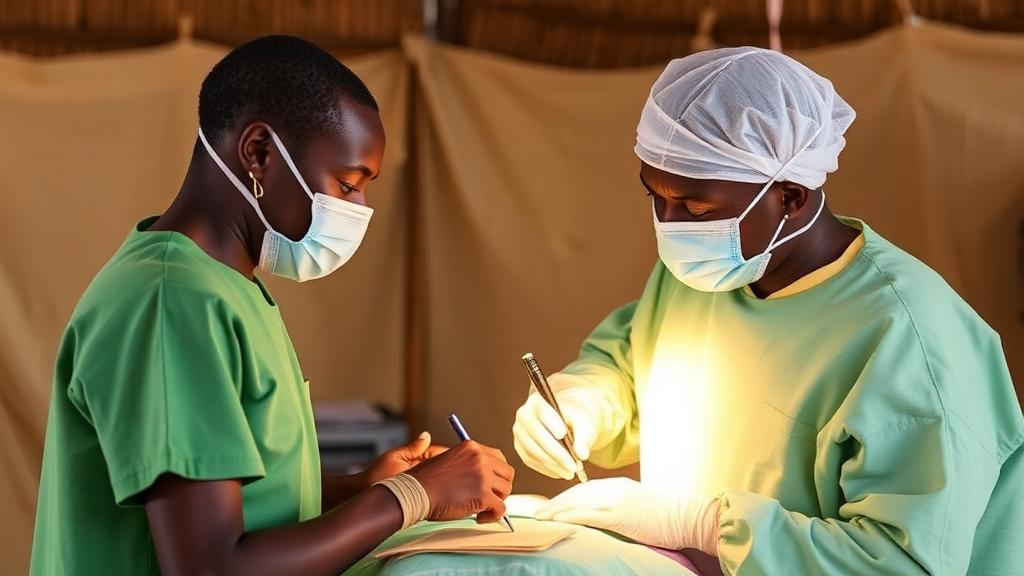
A pilot program in rural Kenya has shown that augmented reality technology can transform how surgeons in resource-limited settings are trained, delivering expert mentorship at a fraction of the cost of traditional in-person visits. According to a study published in Global Surgical Education, the Journal of the Association for Surgical Education, a digital platform that overlays real-time annotations onto live surgical video reduced the cost of mentoring a single caesarean section procedure by a factor of 8.31 compared with sending a specialist to the hospital in person. Over a five-year horizon, the researchers calculated a cost-benefit ratio of 1:8.81, driven almost entirely by the elimination of travel time and transport expenses that traditionally consume entire working days.
The intervention, known as ARC/S, or Augmented Reality for Safe Caesarean Section, was implemented by the international non-profit Jhpiego in partnership with the World Federation of Societies of Anesthesiologists and the Makueni County Department of Health. It layered the Proximie digital platform onto an existing Obstetric Safe Surgery program that had been running in the county since 2020. The platform allows a remote mentor to watch an operation through live video streams from multiple camera angles in the operating theater, and to draw augmented reality annotations directly onto the surgeon’s field of view. Every case is also recorded and uploaded to a secure cloud-based library, where it can be reviewed asynchronously for training and quality assurance purposes.
The scale of the surgical workforce problem the technology addresses is staggering. The Lancet Commission on Global Surgery and the World Health Organization have recognized timely access to safe and affordable surgical care as a fundamental component of universal health coverage, yet nearly five billion people, three-quarters of the global population, lack access to essential surgical services. In low- and middle-income countries, more than 90 percent of the population remains underserved. The distribution of specialists is even more skewed: only 12 percent of the world’s specialist surgical workforce serves Africa and Southeast Asia, despite those regions being home to a third of humanity. In Kenya, medical officers staffing district hospitals are supposed to receive ongoing mentorship from specialists, but those specialists are concentrated in a small number of urban facilities, and the travel distances involved make regular in-person support impractical.
Makueni County illustrates the geography of the problem. The five high-volume public hospitals participating in the study are separated by substantial distances: Makueni County Referral Hospital lies 69 kilometers from the Mbooni Sub-county Hospital it supports, while Makindu Sub-county Hospital must travel 60 kilometers to reach Sultan Hamud and 24 kilometers to reach Kibwezi. A single in-person mentoring visit was estimated to consume eight hours of a mentor’s time, including travel, at a total cost of 25,396 Kenyan shillings once travel expenses were added. A virtual mentoring session on the platform, by contrast, averaged 1.22 hours including feedback time and cost just 3,056 shillings per event.
Between February and October 2022, the technology supported 191 virtual mentorship sessions across the five hospitals, complemented by 17 in-person sessions. A total of 180 elective and emergency caesarean sections were carried out with the platform’s support, and 142 surgical providers were trained on its use. Of the recorded procedures, 125 were successfully reviewed for adherence to safe surgery standards; the remaining 55 recordings were excluded because intermittent internet connectivity produced incomplete files. The platform-generated data, cross-referenced with operational records, gave the research team an unusually objective picture of how the digital tool was actually integrated into surgical service delivery, capturing session durations, participant attendance, mentorship roles, and clinical checklists for each case.
The acceptability results were strikingly positive across every group surveyed. All 60 mentees reported that the platform improved provider and team performance in adhering to best practices, 98 percent felt it improved patient safety, and 92 percent found it easy to use during live procedures and said it enhanced team confidence in the operating theater. All nine mentors believed the technology strengthened the existing mentorship model, and all seven information and communications technology personnel reported that surgical teams were ready to use the platform for every caesarean section. Patients were equally receptive: 90 percent of the 125 post-caesarean mothers surveyed said they had been adequately informed about the use of cameras in the operating theater, and 89 percent said they would recommend the approach to other mothers.
The recorded cases also revealed uncomfortable truths about baseline surgical quality. Direct observation by expert mentors, using the World Health Organization Surgical Safety Checklist as a rubric, found variable adherence to critical safety practices. Correct completion and use of the checklist met standards in only 39.2 percent of the 125 reviewed cases, while timely administration of antibiotic prophylaxis met standards in 53.6 percent. Adherence to proper surgical scrubbing and appropriate use of personal protective equipment met standards in 45.6 percent of cases. The authors note that these quality gaps, detectable only because the platform enabled systematic video review, would likely have gone unnoticed through traditional audits, opening the door to targeted refresher training and site-specific quality improvement initiatives.
The economic analysis, while deterministic and based on a single county, proved robust to most sensitivity tests. Doubling ongoing training costs, increasing feedback time, or raising the discount rate from 3.5 to 10 percent each produced only small reductions in the benefit-to-cost ratio. The most consequential assumption was the time required for an in-person mentoring visit: halving it from eight hours to four cut the ratio to 4.85, still a substantial return. Conversely, assuming two mentors attended half of all in-person visits pushed the ratio up to 12.78. The authors emphasize that the efficiency gains represent potential value as programs expand rather than immediate budgetary savings, and that virtual mentoring is designed to complement, not replace, hands-on in-person training, which remains essential for complex cases and direct supervision.
The study’s technical findings offer a practical roadmap for other regions considering similar programs. The platform requires a stable connection of at least 5 to 7 megabits per second for each high-definition video stream, with 20 to 30 megabits per second of dedicated bandwidth preferable when multiple feeds run simultaneously. Standard laptops with at least 8 gigabytes of memory or mobile devices from 2020 onward are sufficient, and a wired network connection consistently outperformed 4G and 5G backups. Yet the researchers found that success depended far more on basic infrastructure and staffing than on device specifications: reliable power, protected outlets, at least one designated ICT focal person, and established workflows for permissions and data governance mattered more than hardware. Intermittent electricity, limited bandwidth, and absent leadership support pose greater barriers in lower-readiness sites than the technology itself.
The authors are candid about the pilot’s limitations. Clinical outcomes were not assessed, so no conclusions can be drawn about improvements in maternal or neonatal outcomes attributable to the intervention. The technology was embedded within an existing capacity-building program, making it difficult to disentangle its independent effects, and social-desirability bias may have inflated survey responses. The single-county setting, with relatively strong digital infrastructure and committed local government, may limit generalizability. Framed through Kirkpatrick’s four-level evaluation model, most outcomes measured learner reaction rather than objective learning or sustained behavior change. Still, the study demonstrates that in a geographically dispersed surgical network, combining onsite training with augmented reality-enabled virtual mentorship is feasible, acceptable to clinicians and patients alike, and dramatically more efficient than travel-dependent models, offering health systems in low- and middle-income countries a credible path toward decentralizing surgical expertise and strengthening workforce capacity.
Subject of Research: Augmented reality-enabled virtual surgical mentorship for building surgical workforce capacity in resource-limited settings
Article Title: Virtual surgical mentorship: a cost-efficient solution for building workforce capacity in resource limited settings
Article References: Mallender, J., Ferenchick, E., Worku, T. A., Shibata-Germanos, S., Varallo, J., Muthengi, M., Kiiru, S., Mbithi, D., Ruto, D., Nyaga, F. K., Mwatha, S., Muia, C., Bertram, M., Musila, P., Ndolo, S., Mwanthi, C. K., & Hachach-Haram, N. (2026). Virtual surgical mentorship: a cost-efficient solution for building workforce capacity in resource limited settings. Global Surgical Education – Journal of the Association for Surgical Education, 5(1), Article 125. https://doi.org/10.1007/s44186-026-00490-x
Image Credits: AI Generated
DOI: 10.1007/s44186-026-00490-x
Keywords: augmented reality, surgical mentorship, global surgery, caesarean section, Kenya, telementoring, health workforce, low- and middle-income countries, digital health, obstetric surgery, cost-efficiency, surgical training
Cite Scienmag News
Courtney Benton. (October 5, 2026). Augmented Reality Mentoring Cuts Surgical Training Costs Eightfold in Rural Kenya. Scienmag. https://scienmag.com/augmented-reality-mentoring-cuts-surgical-training-costs-eightfold-in-rural-kenya/
Courtney Benton. "Augmented Reality Mentoring Cuts Surgical Training Costs Eightfold in Rural Kenya." Scienmag, 5 October 2026, https://scienmag.com/augmented-reality-mentoring-cuts-surgical-training-costs-eightfold-in-rural-kenya/. Accessed 5 October 2026.
Courtney Benton. "Augmented Reality Mentoring Cuts Surgical Training Costs Eightfold in Rural Kenya." Scienmag. October 5, 2026. https://scienmag.com/augmented-reality-mentoring-cuts-surgical-training-costs-eightfold-in-rural-kenya/


