


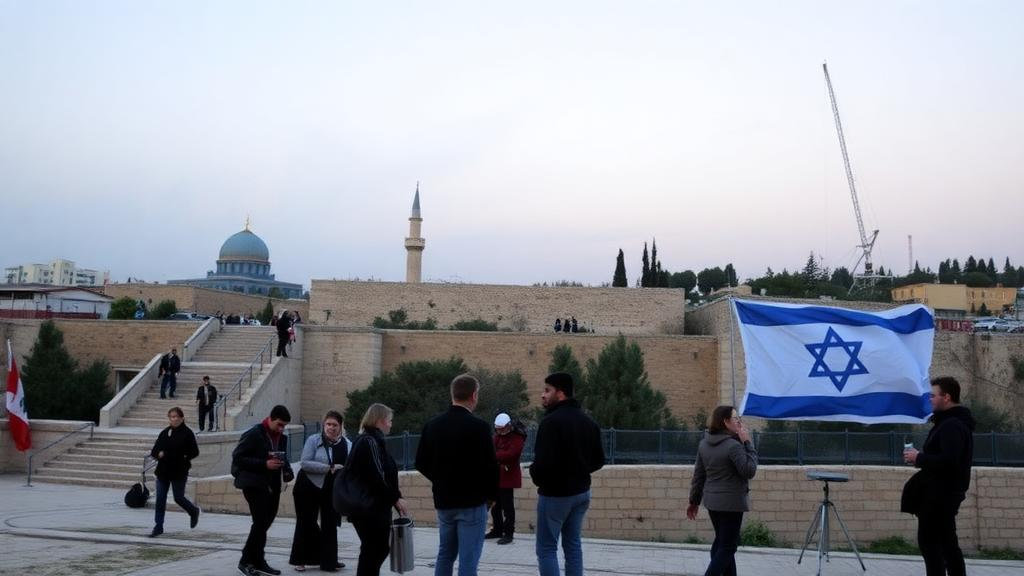
Three years after the October 7 attacks, the way Israelis understand themselves, their security, and their place in the world has shifted in ways that are now measurable with unusual clarity. The 2026 Hebrew University-European Forum Barometer, a recurring survey project led by Prof. Gisela Dachs of the Hebrew University of Jerusalem, documents a profound reassessment of identity and belonging among both Jewish and Arab Israeli respondents. The survey, which examines mutual perceptions between Israel and four European countries—Germany, France, Great Britain, and Poland—suggests that the events of the past three years, including the war that followed the October 7 attacks and the war with Iran, have not only reshaped Israeli politics but have redrawn the mental map that Israelis draw of their own country and its relationship to the continent that once loomed so large in Zionist history.
Among Jewish Israelis, the survey finds a strengthened sense of Israeli identity. Rather than eroding national cohesion, the traumas and conflicts of the past three years appear to have consolidated it, with respondents reporting that their identification with Israel has deepened since the attacks. The contrast with Arab Israeli respondents is stark and politically significant: Arab citizens of Israel were more likely to say that their sense of Israeli identity had weakened over the same period. This divergence points to a widening gap in how the country’s two major population groups experienced the same sequence of events, and it complicates any simple narrative about a nation unified by crisis. The Barometer’s longitudinal design, which allows comparison with earlier waves, makes these opposing trajectories visible in a way that single snapshots cannot.
Perhaps the most striking finding concerns geography and self-perception. When asked whether Israel is more like a Middle Eastern country or more like a European one, 42 percent of Israeli respondents chose the Middle Eastern description, while only 18 percent described Israel as more European. For a country whose founding generations often imagined themselves as an outpost of European civilization in the Levant, this represents a meaningful reorientation of collective self-understanding. The trend is even more pronounced among Arab respondents: the share of Arab Israelis who see Israel as a Middle Eastern country has more than tripled compared with the 2022 wave of the survey. Whatever the causes—regional diplomacy, prolonged conflict with neighbors, or a cooling toward European institutions—the direction of travel is unmistakable.
The survey also documents a widening perception gap between Israelis and Europeans on the question of Jewish safety. A substantial majority of Israeli respondents said that Israel is safer for Jews than Europe, a judgment that reflects both the memory of October 7 and Israeli perceptions of rising antisemitism on the continent. European respondents, by contrast, were far more divided on the same question, suggesting that the two publics inhabit sharply different realities when it comes to assessing where Jewish life is most secure. Among the four European countries surveyed, Poland stood out: 35 percent of Polish respondents—the highest share in any European sample—viewed Israel as the safer option for Jews, a notable result given Poland’s own complex history of Jewish life and loss.
Israeli attitudes toward the European Union have grown more skeptical as well. Compared with the 2024 wave, more Israeli respondents disagreed with the statement that the EU is, in general, a success, and this disagreement was particularly pronounced among Jewish Israelis. The finding arrives at a moment when relations between Israel and many European governments have been strained by the conduct and consequences of the Gaza war, and it suggests that the diplomatic friction is filtering down into public opinion. For a country that has long sought a special relationship with European institutions while officially belonging to no European bloc, the erosion of confidence in the European project represents a quiet but consequential shift in the political environment.
The Barometer also probes a question that has grown more uncomfortable for European observers: how Israelis view the continent’s far right. As in 2024, a large share of Jewish Israeli respondents said Israel should maintain ties with far-right parties in Europe if those parties support Israel. This pragmatic posture—prioritizing support for Israel over ideological compatibility—has long frustrated European Jewish communities who see populist nationalism as a threat. The survey adds a German dimension: fewer German respondents than in 2024 viewed the rise of the Alternative für Deutschland (AfD) as a dangerous development, with many saying the party’s ascent is no more dangerous than similar developments elsewhere in Europe. The normalization of a party that German establishment politics has long treated as beyond the pale is thus reflected not only in Israeli perceptions but in German self-assessment.
When Israelis are asked which European countries they consider friends of Israel, the ranking is unambiguous: Germany comes first, followed by Hungary. The prominence of Germany, a country whose relationship with Israel is shaped by historical responsibility, has been a consistent feature of the Barometer across waves, and Hungary’s second-place position reflects the Orbán government’s explicitly pro-Israel foreign policy. More surprising is the collapse of the Netherlands, which has fallen sharply in Israeli perceptions and now ranks among the countries seen as least friendly to Israel—a remarkable reversal for a state once regarded as one of Israel’s warmest European partners. At the other end of the emotional spectrum, Israeli respondents pointed most often to France and Spain when asked which European countries they perceive as most antisemitic, naming two governments that have taken prominently critical positions on Israel’s conduct of the war.
One of the Barometer’s longest-running questions concerns whether today’s Germany is a different Germany compared with the period before 1945. Here the survey records a subtle but telling decline: among Jewish Israelis, 67 percent answered yes in 2026, down from 75 percent in 2024. The generational pattern is equally significant, with older Jewish respondents more likely than younger ones to hold this view. The finding suggests that the postwar German project of earning Israeli and Jewish trust, built over decades of remembrance culture and staunch support, is not immune to erosion, whether through German political debates over the Gaza war, the mainstreaming of the AfD, or simply the passage of time as the generations with living memory of the Holocaust recede. That the decline is concentrated among younger respondents raises questions about how historical memory will continue to anchor the German-Israeli relationship in the decades ahead.
Prof. Dachs summarized the survey’s significance by observing that the Barometer captures a moment of profound reassessment: three years after October 7, Israelis are not only rethinking questions of security and identity, but also their relationship to Europe and the political forces shaping it. The methodological foundation of the study lends weight to these conclusions. The 2026 HU-EF Barometer is based on online surveys conducted by Kantar in Germany, Great Britain, France, and Poland, alongside a benchmark survey conducted in Israel. Each European country sample included 1,000 representative participants, while the Israeli sample comprised 1,003 respondents: 502 from the general sector, 250 Arab respondents, and 251 Orthodox Jewish respondents. Fieldwork in the four European countries was carried out in June and July 2026, with Israeli fieldwork conducted in May 2026. The questionnaire took approximately eight minutes to complete, and the sampling error is 3.1 percent per total market sample, a margin that places the headline findings on solid statistical ground.
Taken together, the 2026 Barometer paints a portrait of an Israeli society turning inward and eastward: more confident in its own identity, more convinced of its own indispensability to Jewish safety, more doubtful of the European project, and more willing to engage with political forces on the continent that traditional pro-European constituencies regard with alarm. The divergence between Jewish and Arab Israeli respondents on identity, the tripling of the Arab Israeli share viewing Israel as Middle Eastern, and the Dutch fall from favor all indicate that the realignment is not uniform but layered across communities and issues. What the survey cannot yet show is whether these shifts are durable transformations or acute responses to war that will soften as time passes. The Barometer’s value lies precisely in its ability to answer that question in future waves, tracking whether the Israel of 2026—a country that increasingly sees itself as Middle Eastern, safer than Europe, and skeptical of the EU—becomes the settled self-image of the next decade or a snapshot of a nation in the midst of crisis.
Subject of Research: Israeli and European public perceptions of Israeli identity, Jewish safety, and Israel-Europe relations three years after the October 7 attacks
Article Title: Three years after October 7, Israelis reassess identity, safety, and Europe, Hebrew University survey finds
Article References: Three years after October 7, Israelis reassess identity, safety, and Europe, Hebrew University survey finds. (n.d.). Original publication
Image Credits: AI Generated
DOI: Not provided
Keywords: October 7, Hebrew University, Barometer survey, Israeli identity, Jewish safety, Europe, European Union, Germany, antisemitism, far-right parties, Arab Israelis, public opinion
Cite Scienmag News
Courtney Benton. (October 5, 2026). Three Years After October 7, Israelis See Themselves as Middle Eastern and Safer Than Europe. Scienmag. https://scienmag.com/three-years-after-october-7-israelis-see-themselves-as-middle-eastern-and-safer-than-europe/
Courtney Benton. "Three Years After October 7, Israelis See Themselves as Middle Eastern and Safer Than Europe." Scienmag, 5 October 2026, https://scienmag.com/three-years-after-october-7-israelis-see-themselves-as-middle-eastern-and-safer-than-europe/. Accessed 5 October 2026.
Courtney Benton. "Three Years After October 7, Israelis See Themselves as Middle Eastern and Safer Than Europe." Scienmag. October 5, 2026. https://scienmag.com/three-years-after-october-7-israelis-see-themselves-as-middle-eastern-and-safer-than-europe/


