


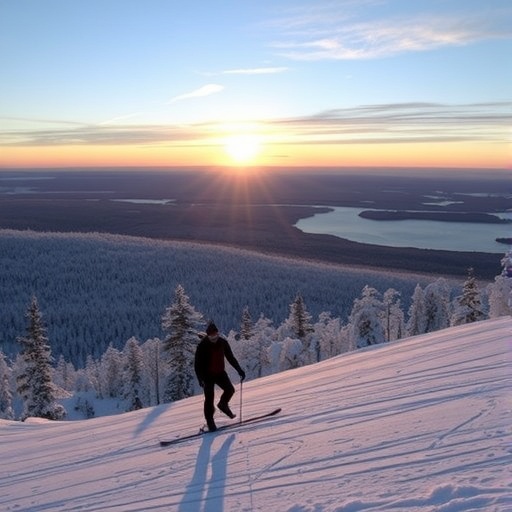
New research emerging from the University of New Hampshire casts a stark light on the burgeoning apprehension among ski industry professionals in the Granite State regarding the escalating impact of global warming. As a cornerstone of New Hampshire’s economy, contributing nearly $278.8 million each ski season, the industry stands at a critical intersection where environmental change and economic sustainability converge. This groundbreaking study, conducted by UNH’s Carsey School of Public Policy, delineates a consensus among those within the industry signaling a clear and urgent call for adaptive strategies and sustainable operations.
Central to this research is the recognition that the ski sector is not only vulnerable to rising temperatures and shifting winter climatology but also poised to take an active role in climate action. Elizabeth Burakowski, research associate professor in UNH’s Institute for the Study of Earth, Oceans, and Space, underscores that the collective sentiments of ski professionals represent a foundational pillar for mobilizing effective responses. As winters become shorter and less predictable due to anthropogenic climate shifts, maintaining the viability of ski tourism and its accompanying economic and cultural benefits is increasingly challenging.
The study anchors its findings on an online survey conducted in June 2025, targeting New Hampshire ski industry professionals to probe their perceptions of climate change and its ramifications. The responses revealed a striking 85% of participants identifying as either “alarmed” or “concerned” about climate change effects, a figure substantially higher than the national average of 54%. This disparity reflects the firsthand experiences and ecological observations by those most intimately tied to winter landscapes and snowfall patterns, amplifying their urgency for systemic change.
What draws significant attention is not only the heightened awareness but also the critical perspective on current industry responses. Over half of respondents articulated the view that the New Hampshire ski industry is insufficiently proactive in addressing the climate crisis. This gap between concern and action highlights a latent potential within the sector to pivot towards enhanced sustainability frameworks. Faculty and students collaborating on the project, such as co-author Jacklyn Tracy, advocate for a dual approach integrating carbon footprint mitigation at the operational level alongside vigorous support for broader climate policies.
The findings paint a landscape where enthusiasm for ecological stewardship is palpable; however, practical implementation remains deficient. The implications here are profound, suggesting that environmental innovation in the ski industry may hinge on aligning economic incentives with sustainability initiatives. The transition to renewable energy, improved energy efficiency, and comprehensive resource management protocols emerge as pivotal strategies to safeguard the winter recreational economy.
Moreover, the data accentuates how the ski industry’s economic footprint transcends direct revenue figures. Ski tourism is a linchpin for approximately 2.8 million recreational visitors annually in New Hampshire, fueling an estimated 16,000 jobs when combining seasonal and year-round employment. This socioeconomic dimension reinforces the imperative for climate resilience not merely as an environmental mandate but as an economic necessity underpinning community livelihoods and regional stability.
Scientific understanding substantiates that rising global temperatures affect snowpack formation and persistence through complex atmospheric and terrestrial feedback loops. Alterations in precipitation regimes, increased rain-on-snow events, and erratic freeze-thaw cycles directly disrupt the consistency and quality of snow crucial for ski operations. These dynamics are representative of abrupt and incremental climate change processes that demand agile adaptation strategies tailored to the unique vulnerabilities of mountainous ecosystems.
The study also sheds light on the growing recognition within the industry of the need for concerted advocacy and education. Professionals acknowledge that some influencing factors lie beyond local operational control, necessitating engagement with state and national climate policies. By mobilizing as stewards of winter environments, ski industry stakeholders can serve as potent advocates for systemic emissions reductions, energy policy reforms, and investment in climate adaptation funding.
Technologically, the industry is exploring various innovations, from advanced snowmaking systems calibrated for energy efficiency to smart infrastructure that monitors environmental variables in real time. These efforts embody a multifaceted response paradigm aiming to balance recreational demands with ecological sustainability amidst progressive climate perturbations. However, scaling these technological solutions requires significant capital infusion and strategic alignment with policy frameworks incentivizing low-carbon transitions.
In framing the broader context, the research advocates for expanding these inquiries beyond New Hampshire to capture regional and national trends. Climate change manifestations and adaptive capacities vary geographically, necessitating a nuanced understanding that can inform tailored interventions. Such broader datasets could enrich climate vulnerability assessments and foster collaborative networks for knowledge exchange and best practice dissemination across the ski industry.
The University of New Hampshire’s findings serve as a clarion call for immediate and comprehensive action within a sector intrinsically tied to environmental health. As ski professionals not only witness but are increasingly alarmed by climatic transformations, their collective voice represents a critical agent for driving change. Their readiness to implement sustainable practices and policy advocacy underscores the role of industry insiders as both catalysts and stewards in the evolving climate landscape.
Ultimately, this research underscores the inseparable link between climate science and socio-economic resilience in winter recreational economies. It heralds a future where informed, proactive responses can sustain the essence of ski culture while meeting the challenges posed by anthropogenic climate change. The University of New Hampshire’s initiative catalyzes a vital dialogue at the nexus of environment, economy, and community wellbeing, illuminating pathways to secure the snowy winters that define so much of New Hampshire’s identity.
Cite Scienmag News
Sloane Callahan. (April 9, 2026). New Hampshire Ski Industry Faces Challenges Amidst Climate Change Impacts. Scienmag. https://scienmag.com/new-hampshire-ski-industry-faces-challenges-amidst-climate-change-impacts/
Sloane Callahan. "New Hampshire Ski Industry Faces Challenges Amidst Climate Change Impacts." Scienmag, 9 April 2026, https://scienmag.com/new-hampshire-ski-industry-faces-challenges-amidst-climate-change-impacts/. Accessed 4 September 2026.
Sloane Callahan. "New Hampshire Ski Industry Faces Challenges Amidst Climate Change Impacts." Scienmag. April 9, 2026. https://scienmag.com/new-hampshire-ski-industry-faces-challenges-amidst-climate-change-impacts/


