


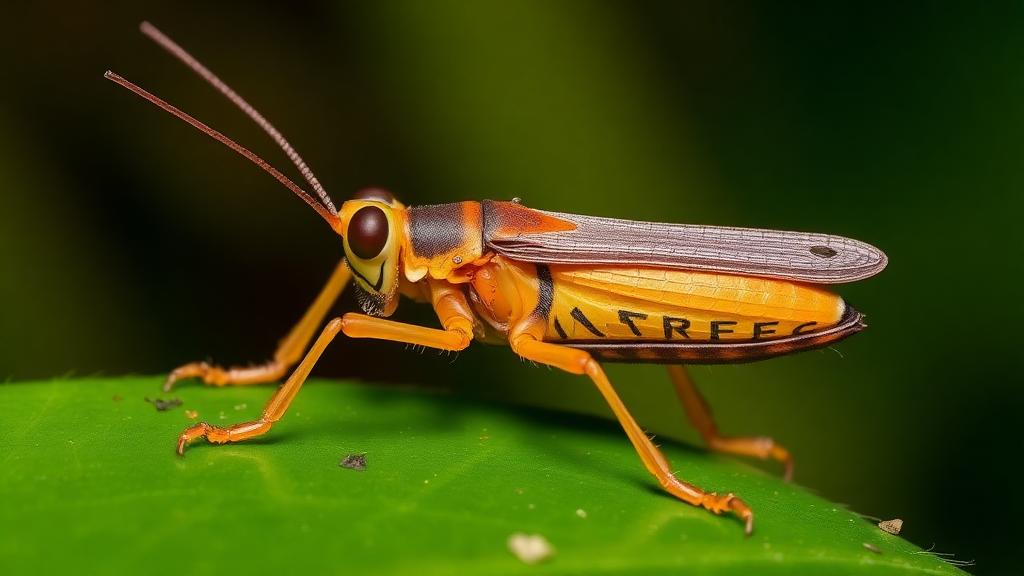
Deep in the humid forests of Bioko Island, a small black-and-yellow grasshopper has been quietly living on the herb layer of equatorial wet forest, unnoticed by science until now. Researchers collecting specimens in December 2023 have formally described it as Pterotiltus bioko, a new species of flightless grasshopper in the subfamily Oxyinae of the family Acrididae. The discovery, published in the Journal of Orthoptera Research, brings the number of described species in the genus Pterotiltus to 19 and adds another name to the growing list of endemic insects found only on this volcanic island in Equatorial Guinea.
The new species was found during a five-day field expedition from 15 to 19 December 2023, when a team of collectors worked across several sites on Bioko Island, including the Reserva Cientifica de la Caldera de Luba, Pico Basile National Park, and Lago Biao. In total, 36 males and 24 females were examined, collected at altitudes ranging from 165 meters near Bacake Grande to 1,864 meters in the Pico Basile National Park. The holotype, a male, was collected on the road to Ureka at 1,345 meters, while a female paratype came from Pico Basile National Park at 1,374 meters. Both type specimens are deposited at the Museum für Naturkunde in Berlin.
Bioko Island is of volcanic origin and, together with the nearby islands of Sao Tome and Principe, forms part of the Cameroon Volcanic Line. The island’s altitude ranges from sea level to 3,011 meters at the summit of Mount Pico Basile. Its climate is Guinean type, with two long rainy seasons separated by two short dry seasons, and rainfall varies from less than 2,000 millimeters in the peneplains to 3,500 millimeters on the highest parts of the mountain. The main plant groups include Fabaceae, Orchidaceae, and Poaceae, providing the lush vegetation in which these flightless grasshoppers live.
The genus Pterotiltus is distributed across West, Central, and East Africa, from Ghana through Cameroon and the Congo Basin to Rwanda and Central Uganda. All 19 known species live in the equatorial wet-forest belt at altitudes from sea level to more than 2,000 meters. Every species in the genus is flightless and lives on the herb layer of forests. The subfamily Oxyinae, to which Pterotiltus belongs, currently includes 230 described species in 38 genera, distributed across Africa, Asia, and Australia. Diagnostic characters of the subfamily include a subconical head, a short fastigium on the vertex, a sulcate frontal ridge, a conical prosternal process, an open mesosternal interspace, spines on the lower genicular lobes of the hind femora, and tufts of short hairs on the distal abdominal sternites.
Pterotiltus bioko is among the smallest species in the genus. Males average 14.22 millimeters in overall body length, while females average 18.11 millimeters. The male body is predominantly black with wide yellow patches on the pronotum, light-green prosternum and mesosternum, orange-green fore and middle femora, and green or orange-green abdominal segments. The antennae are longer than the combined length of the head and pronotum, and the eyes are protuberant. The pronotum is crossed dorsally by three deep sulci, and the metazona accounts for less than 25 percent of the pronotum length. The tegmina are extremely reduced, represented only by minute lobiform ridges of integument that do not extend beyond the hind margin of the mesothoracic segment.
The hind femur is slender, about five times longer than wide, with 6 to 7 external tibial spines and 8 to 9 internal tibial spines. The tympanum is wide and oval or rounded. The last abdominal tergite is divided, with two small lobiform processes forming a minute furcula on the hind margin, the tips separated by only 0.3 to 0.35 millimeters. The cercus is compressed laterally and slightly incurved with an acute apex, while the supra-anal plate is triangular in dorsal view. Female coloration differs markedly from the male: the body is predominantly green, with a red or yellow stripe below the eyes that widens toward the pronotal lobes and continues in two patches. Researchers observed two female morphotypes, with the majority showing red patches and a smaller number showing yellow patches that appeared to be newly molted individuals, suggesting the color difference is developmental and that mature females are all red.
The male phallic complex provides the decisive taxonomic characters. In Pterotiltus bioko, the phallic complex is of large size for the genus, and the epiphallus bears large, forwardly curved, blade-like outer lophi, while inner lophi are absent. The oval sclerites are large with pronounced pointed tubercles on their ventral surfaces, and the endophallic apodemes are slender dorsally, spatula-shaped laterally, with robust, long, and pointed gonopore processes. The valvular plate is foliose, showing large lobes that dorsally join the cingulum by a well-prolonged arch. The female spermatheca has a hooked terminal ampulla and a developed lateral diverticulum, and the bursa copulatrix is large, dorsally divided into two somewhat distinct lobes by a longitudinal groove. The ovipositor valves are smooth, slender, and rodlike, adapted to specialized oviposition sites on the food plant.
Sexual dimorphism in the new species follows patterns documented across the genus. The average pronotum length of males is 82 percent of that of females. Male antennae are proportionally longer than those of females, with a normalized male-to-female ratio of 1.23, while the male interocular space is smaller, at a ratio of 0.68 before normalization. The breadth of the fastigium is slightly shorter in males, and males generally have fewer internal tibial spines. After normalization, the ratios of most other body dimensions are closely similar between the sexes, and the foot formula, which expresses the relative lengths of the three hind tarsal segments, is identical in both sexes at 34 percent, 18 percent, and 48 percent.
The researchers distinguish Pterotiltus bioko from its closest mainland relative, Pterotiltus apicalis, known only from a female lectotype collected on Bioko Island itself and described in 1905. Pterotiltus apicalis is a medium-sized species with a body length of 22 millimeters, and its female is blackish brown with yellow head and pronotum, a red hind knee, and red posterior abdominal segments, in stark contrast to the green-bodied, smaller Pterotiltus bioko. The new species also differs from Pterotiltus ngoylaensis of eastern Cameroon, which is larger, predominantly green, and has oval sclerites of the epiphallus with only two small tubercles rather than pronounced pointed tubercles. An updated identification key for all species of Pterotiltus was provided in the publication, incorporating the new species alongside the 18 previously described ones.
The external characters of Pterotiltus bioko, including its extremely reduced tegmina and the shape of the ventral surface of the female subgenital plate, which shows two slightly inflated ridges distally, are reminiscent of the related genus Parapterotiltus. However, the structures of both male and female genitalia in the examined specimens are clearly those of Pterotiltus, with the large phallic complex, foliose valvular plate, long slender curved outer lophi of the epiphallus, well-developed anterior processes, hooked terminal ampulla of the spermatheca, and large bursa copulatrix. Based on these characters, the researchers classified the new species firmly within Pterotiltus. The species has been assessed as Least Concern on the IUCN Red List, with both sexes known, adequate numbers of specimens available in the field, and modern localities documented across the island.
Subject of Research: A new species of Pterotiltus Karsch (Orthoptera, Acrididae, Oxyinae) from Equatorial Guinea
Article Title: A new species of Pterotiltus Karsch ( Orthoptera , Acrididae , Oxyinae ) from Equatorial Guinea
Article References: Oumarou-Ngoute, C., Song, H., Mariño-Pérez, R., Woo, B. M., Linde, J., & Rowell, C. H. F. (2025). A new species of Pterotiltus Karsch (Orthoptera, Acrididae, Oxyinae) from Equatorial Guinea. Journal of Orthoptera Research, 34(2), 201-212. https://doi.org/10.3897/jor.34.141073
Image Credits: AI Generated
Keywords: species, Pterotiltus, Karsch, Orthoptera, Acrididae, Oxyinae, Equatorial, Guinea, scientific research
Cite Scienmag News
Gavin Prescott. (October 17, 2026). New Flightless Grasshopper Species Discovered on Volcanic Bioko Island. Scienmag. https://scienmag.com/new-flightless-grasshopper-species-discovered-on-volcanic-bioko-island/
Gavin Prescott. "New Flightless Grasshopper Species Discovered on Volcanic Bioko Island." Scienmag, 17 October 2026, https://scienmag.com/new-flightless-grasshopper-species-discovered-on-volcanic-bioko-island/. Accessed 17 October 2026.
Gavin Prescott. "New Flightless Grasshopper Species Discovered on Volcanic Bioko Island." Scienmag. October 17, 2026. https://scienmag.com/new-flightless-grasshopper-species-discovered-on-volcanic-bioko-island/


