


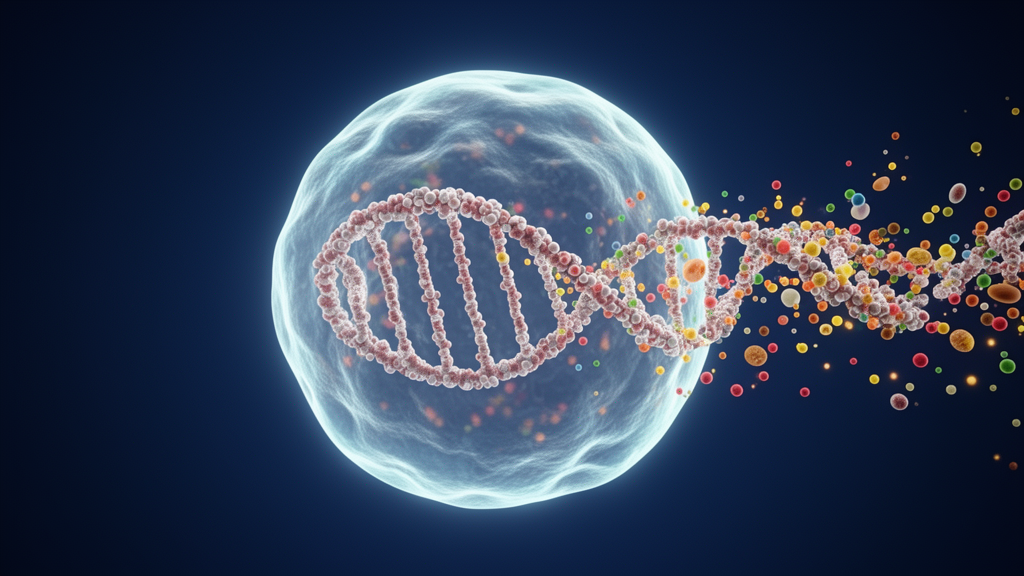
What if the food on your plate could quietly switch genes on and off without changing a single letter of your DNA? That is the central promise of nutritional epigenetics, a field that has exploded over the past two decades as researchers discovered that molecules in tea, turmeric, broccoli, and soy can chemically modify the proteins and DNA that package our genome. Now, a research team at the Universidad Nacional Autónoma de México has built the most comprehensive map yet of this molecular dialogue between diet and gene regulation. Their new resource, called NutriEpiDB, catalogs 653 dietary compounds linked to 80 epigenetic protein targets, drawing on nearly two thousand primary research papers published over 36 years.
The scale of the underlying literature is striking. The team systematically searched PubMed and Web of Science for studies reporting food-derived or dietary compounds with documented effects on epigenetic pathways, filtering out reviews, meta-analyses, non-English texts, and articles lacking essential metadata. The final corpus comprises 1,963 primary research articles spanning from 1991 through August 2026, with publication counts climbing steeply in recent years. The year 2025 alone contributed 211 articles, the highest annual total in the dataset, followed by 2022 with 153 and 2024 with 150. This temporal pattern mirrors the broader surge of interest in nutriepigenomics, the study of how nutrition modulates the chemical tags and chromatin structures that govern gene expression.
Building such a database by hand would have taken years of painstaking curation, so the Mexican team, led by Aylin Del Moral-Morales and José L. Medina-Franco of the DIFACQUIM Research Group, turned to artificial intelligence. They used a large language model, the Claude API accessed through the LangChain framework, to read each article and extract structured pairs of compound names and food sources. The model was instructed to adopt the analytical stance of a medicinal chemist, annotating every dietary, beverage, or food-derived compound explicitly described as a modulator of DNA methylation, histone modification, or non-coding RNA pathways. Crucially, the temperature parameter was set to zero to suppress output variability and minimize hallucinations, and the prompts explicitly excluded vague group designations such as vitamins or polyphenols in favor of identifiable molecular entities.
Raw extraction from scientific text is only the beginning; the real challenge is making thousands of heterogeneous terms speak the same language. Food source names varied wildly across the literature, so the researchers embedded every unique dietary source string as a dense numerical vector using the all-MiniLM-L6-v2 sentence-transformer model. Agglomerative hierarchical clustering with a cosine distance threshold of 0.3 then grouped lexically and semantically similar terms, and the shortest member of each cluster became the canonical label. This semantic harmonization collapsed the messy vocabulary of the literature into 585 standardized food and beverage source terms, from tea and grapes to turmeric, soy, citrus, olive, broccoli, beef, milk, egg, and fish oil.
Compound identity received equally rigorous treatment. Every extracted compound name was mapped to the PubChem database through the PubChemPy interface, retrieving compound identifiers, IUPAC names, InChIKeys, SMILES structure strings, and curated synonyms. When a query returned multiple matches, the first valid PubChem CID was adopted as the reference. The structures then passed through RDKit, a cheminformatics toolkit that stripped salts down to their primary fragments, neutralized formal charges, canonicalized tautomers, and converted everything into a single canonical SMILES form. Records lacking a valid CID, an annotated mechanism, or a compound name were systematically excluded, ensuring that every entry in the final database is chemically unambiguous and interoperable with other resources.
To add mechanistic depth, the team integrated quantitative binding data from BindingDB, a curated knowledgebase of protein-small molecule interactions. Only records involving human proteins were retained, and each interaction had to include a numeric affinity measure in nanomolar units, such as IC50, Ki, Kd, or EC50. The target proteins were then cross-referenced against the EpiFactors database, which classifies epigenetic regulators by molecular function, so that only proteins with validated roles in epigenetic regulation survived the filter. Each binding record was annotated with functional categories such as writer, reader, or eraser of epigenetic marks, allowing researchers to trace a dietary molecule all the way from the dinner table to a specific enzymatic pocket on a chromatin-modifying enzyme.
The resulting numbers reveal where the field’s attention has concentrated. Among the 653 compounds, folate, choline, L-methionine, resveratrol, and vitamin B12 top the citation rankings, each linked to more than 100 unique literature references. Curcumin, butyrate, bisphenol A, betaine, and sulforaphane round out the most-studied list. The distribution spans micronutrients, bioactive phytochemicals such as quercetin, genistein, and epigallocatechin gallate, and even synthetic or environmental agents like valproic acid. The strong emphasis on methyl donors, B vitamins, and polyphenols reflects their well-established mechanistic ties to DNA methylation, histone modification, and histone deacetylase inhibition. On the food side, tea leads the diversity ranking with 46 unique epigenetically active compounds, ahead of grapes, turmeric, and soy, and plant-derived sources generally outpace animal-derived ones in chemical variety.
The dataset also exposes gaps that could shape future research. Of the 43 distinct epigenetic mechanisms cataloged, DNA methylation and HDAC inhibition dominate the record counts, while RNA-related modifications such as RNA methylation, demethylation, and alternative splicing remain thinly represented. Among the 80 protein targets, histone-modifying writers and erasers are the most prevalent functional classes, with 29 and 20 factors respectively, whereas Polycomb group proteins and DNA modification cofactors count only one or two members each. Binding affinity data cover 101 unique compound-target pairs, with IC50 measurements accounting for over 90 percent of the 2,877 binding records, while Ki and Kd values are comparatively rare. These imbalances offer a roadmap for underexplored territory, particularly non-histone targets and less prevalent modification types.
What sets NutriEpiDB apart from earlier compilations is its commitment to machine readability and responsible artificial intelligence use. The dataset is FAIR2-certified, meeting findability, accessibility, interoperability, and reusability standards extended with AI-readiness and responsible AI criteria. All tables are provided in open formats including CSV, Parquet, and JSON, structured according to the MLCommons Croissant standard, and annotated with schema.org and W3C PROV-O provenance metadata that trace every variable back to its data generation step. The resource is released under the Open Data Commons Attribution License, permitting unrestricted reuse with attribution, and is accessible through an interactive data portal alongside a complete data package containing raw and processed data, transformation scripts, and methodological documentation.
The authors are candid about the limitations. Because the database was built primarily from article titles and abstracts, population descriptors such as ethnicity, genetic background, and country of recruitment are largely unavailable, and the English-language restriction plus reliance on PubMed and Web of Science may underrepresent certain geographic and cultural perspectives. Selection bias toward well-studied targets like histone deacetylases is evident, and compounds lacking well-defined PubChem structures, including some metabolites and obscure phytonutrients, are necessarily absent. Most binding data derive from in vitro assays, and the authors explicitly caution that the compounds and food sources listed should not be interpreted as dietary or therapeutic recommendations, since safety, tolerability, and dose-dependent effects must be assessed individually. Still, with semi-automated update pipelines planned and interoperability with PubChem, EpiFactors, UniProt, and BindingDB maintained as those repositories evolve, NutriEpiDB is positioned to become foundational infrastructure for hypothesis generation, machine learning model development, and evidence synthesis at the intersection of nutrition, epigenetics, and computational biology.
Subject of Research: A curated database of dietary compounds with epigenetic targets built from systematic literature mining and AI-assisted extraction
Article Title: NutriEpiDB: a database for dietary compounds with epigenetic targets
Article References: NutriEpiDB: a database for dietary compounds with epigenetic targets. (n.d.). https://doi.org/10.3389/fddsv.2026.1946880
Image Credits: AI Generated
DOI: 10.3389/fddsv.2026.1946880
Keywords: nutriepigenomics, epigenetics, dietary compounds, database, large language models, DNA methylation, histone modification, binding affinity, PubChem, nutrigenomics, FAIR data, cheminformatics
Cite Scienmag News
Juliet Wilcox. (October 16, 2026). New Database Maps How 653 Food Compounds Rewire Our Epigenome. Scienmag. https://scienmag.com/new-database-maps-how-653-food-compounds-rewire-our-epigenome/
Juliet Wilcox. "New Database Maps How 653 Food Compounds Rewire Our Epigenome." Scienmag, 16 October 2026, https://scienmag.com/new-database-maps-how-653-food-compounds-rewire-our-epigenome/. Accessed 16 October 2026.
Juliet Wilcox. "New Database Maps How 653 Food Compounds Rewire Our Epigenome." Scienmag. October 16, 2026. https://scienmag.com/new-database-maps-how-653-food-compounds-rewire-our-epigenome/


