

Friday, July 10, 2026
Science
No Result
View All Result
  • Login
  • HOME
  • SCIENCE NEWS
  • CONTACT US
  • HOME
  • SCIENCE NEWS
  • CONTACT US
No Result
View All Result
Scienmag
No Result
View All Result
Home Science News Chemistry

New Crystalline 3D Frameworks Linked by Spiroborates Developed

July 10, 2026
in Chemistry
Reading Time: 2 mins read
0
New Crystalline 3D Frameworks Linked by Spiroborates Developed

New Crystalline 3D Frameworks Linked by Spiroborates Developed

65
SHARES
587
VIEWS
Share on FacebookShare on Twitter
ADVERTISEMENT

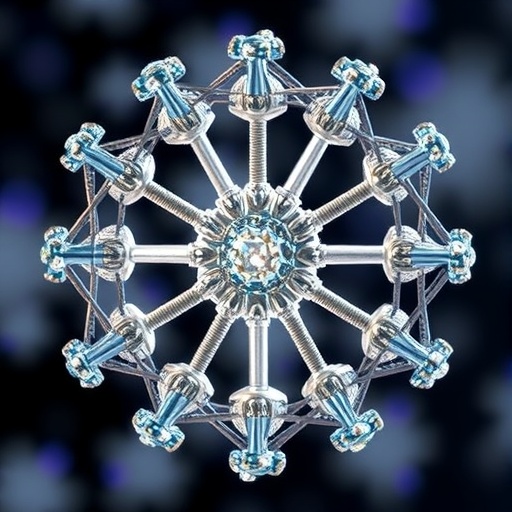
A groundbreaking advance in materials chemistry has been achieved with the synthesis and structural determination of a borate-linked three-dimensional covalent organic framework (3D COF) known as TCTP-COF. Utilizing cutting-edge microcrystal electron diffraction (microED) techniques, researchers have, for the first time, successfully elucidated the atomic-level structure of this complex 3D crystalline polymer. This development marks a pivotal step towards rational design and fine-tuning of COFs for next-generation applications.

3D COFs are a class of synthetic, porous crystalline polymers characterized by their highly ordered networks formed through covalent bonding. These materials hold immense promise for various critical applications including carbon capture, environmental cleanup, catalysis, and energy storage. However, widespread exploitation has been hampered by the challenge of synthesizing COFs with high crystallinity and well-defined structures, as rapid covalent bond formation often results in amorphous or poorly ordered materials.

Addressing this longstanding issue, the research team incorporated a novel borate anion linkage. Borate ions contribute to robust tetracoordinate spiro-type corners, conferring both rigidity and stability to the overall 3D architecture. These spiroborate centers link four tetracyclopentatetraphenylene (TCTP) molecules, assembling into a tetrahedral framework that imparts a unique and tunable 3D topology reminiscent of niobium monoxide crystal lattices, known as nbo topology.

The synthesized TCTP-COF exhibits permanent porosity, high thermal stability, and an open lattice structure, characteristics that are critical for practical deployment in filtration, catalysis, and energy-related devices. The successful synthesis was complemented by electron diffraction studies that unraveled its detailed crystal structure, a feat not previously accomplished with borate-linked COFs.

This work also underscores the potential of hetero[8]circulene analogues as sturdy molecular building blocks for crafting intricate 3D polymeric frameworks. By moving beyond traditional imine-based linkages, which restrict structural diversity, the exploration of borate linkages broadens the palette of COF architectures available for material scientists.

The implications of this research extend far beyond the specific framework studied. Precise structural elucidation bridges a critical knowledge gap, enabling scientists to decode structure-property relationships and effectively tailor materials for targeted functionalities. Such advancements pave the way for optimized carbon sequestration materials, selective adsorbents for environmental remediation, catalytic platforms, and robust electrodes for energy storage technologies.

This breakthrough represents a collaboration among leading Japanese institutions, including the National Institute of Natural Sciences, Osaka University, Nagoya University, and SOKENDAI. Their pioneering methodology and strategic molecular design establish a foundation for future innovations in 3D crystalline COF development that could revolutionize functional materials chemistry.

Subject of Research: Not applicable
Article Title: Crystalline 3D covalent organic frameworks with nbo topology
News Publication Date: 11-Jul-2026
Web References: http://dx.doi.org/10.1126/sciadv.aeg6230
Image Credits: Yasutomo Segawa

Keywords

3D Covalent Organic Frameworks, TCTP-COF, Borate Linkages, Microcrystal Electron Diffraction, Crystal Structure, Porous Polymers, Material Innovation, Nbo Topology

Tags: 3D covalent organic frameworksadvances in structural determination techniquesapplication of borate anion linkagesborate-linked crystalline polymersenergy storage materialsmaterials for environmental cleanupmicrocrystal electron diffraction (microED) structural analysisporous crystalline materials for gas capturerational design of covalent organic frameworksspiroborate linkages in COFssynthesis of high-crystallinity COFstopology of tetrahedral frameworks
Share26Tweet16
Previous Post

Insurance-Backed Integrative Oncology Program Eases Patient Symptoms

Next Post

Radiation Therapy Clinic Closures May Widen US Cancer Care Disparities

Related Posts

New Discovery Promises Brighter, More Energy-Efficient Digital Displays
Chemistry

New Discovery Promises Brighter, More Energy-Efficient Digital Displays

July 10, 2026
IBEC Joins Major European Grant on Living Matter Physics
Chemistry

IBEC Joins Major European Grant on Living Matter Physics

July 10, 2026
Innovative Ligand Design Enhances Nanocluster Catalyst Activity
Chemistry

Innovative Ligand Design Enhances Nanocluster Catalyst Activity

July 10, 2026
New Fluorescent Sensor Quickly Detects Pesticide Phoxim Visually
Chemistry

New Fluorescent Sensor Quickly Detects Pesticide Phoxim Visually

July 10, 2026
Advances in NASICON Cathodes: Structure, Electrochemistry, and Stability Explored
Chemistry

Advances in NASICON Cathodes: Structure, Electrochemistry, and Stability Explored

July 10, 2026
Scientists create new method to control quantum states in 2D materials
Chemistry

Scientists create new method to control quantum states in 2D materials

July 10, 2026
Next Post
Radiation Therapy Clinic Closures May Widen US Cancer Care Disparities

Radiation Therapy Clinic Closures May Widen US Cancer Care Disparities

  • Mothers who receive childcare support from maternal grandparents show more

    Mothers who receive childcare support from maternal grandparents show more parental warmth, finds NTU Singapore study

    27656 shares
    Share 11059 Tweet 6912
  • University of Seville Breaks 120-Year-Old Mystery, Revises a Key Einstein Concept

    1061 shares
    Share 424 Tweet 265
  • Bee body mass, pathogens and local climate influence heat tolerance

    682 shares
    Share 273 Tweet 171
  • Researchers record first-ever images and data of a shark experiencing a boat strike

    546 shares
    Share 218 Tweet 137
  • Groundbreaking Clinical Trial Reveals Lubiprostone Enhances Kidney Function

    531 shares
    Share 212 Tweet 133
Science

Embark on a thrilling journey of discovery with Scienmag.com—your ultimate source for cutting-edge breakthroughs. Immerse yourself in a world where curiosity knows no limits and tomorrow’s possibilities become today’s reality!

RECENT NEWS

  • New Discoveries in Eosinophil Subtypes Reveal Potential Therapeutic Targets
  • AI Enhanced with Cerebellum-Like Function for Improved Learning
  • New Discovery Promises Brighter, More Energy-Efficient Digital Displays
  • Insilico Medicine and Eli Lilly Lead 13th ARDD Meeting at Harvard

Categories

  • Agriculture
  • Anthropology
  • Archaeology
  • Athmospheric
  • Biology
  • Biotechnology
  • Blog
  • Bussines
  • Cancer
  • Chemistry
  • Climate
  • Earth Science
  • Editorial Policy
  • Marine
  • Mathematics
  • Medicine
  • Pediatry
  • Policy
  • Psychology & Psychiatry
  • Science Education
  • Social Science
  • Space
  • Technology and Engineering

Subscribe to Blog via Email

Enter your email address to subscribe to this blog and receive notifications of new posts by email.

Join 5,146 other subscribers

© 2025 Scienmag - Science Magazine

Welcome Back!

Login to your account below

Forgotten Password?

Retrieve your password

Please enter your username or email address to reset your password.

Log In
No Result
View All Result
  • HOME
  • SCIENCE NEWS
  • CONTACT US

© 2025 Scienmag - Science Magazine

Discover more from Science

Subscribe now to keep reading and get access to the full archive.

Continue reading
