


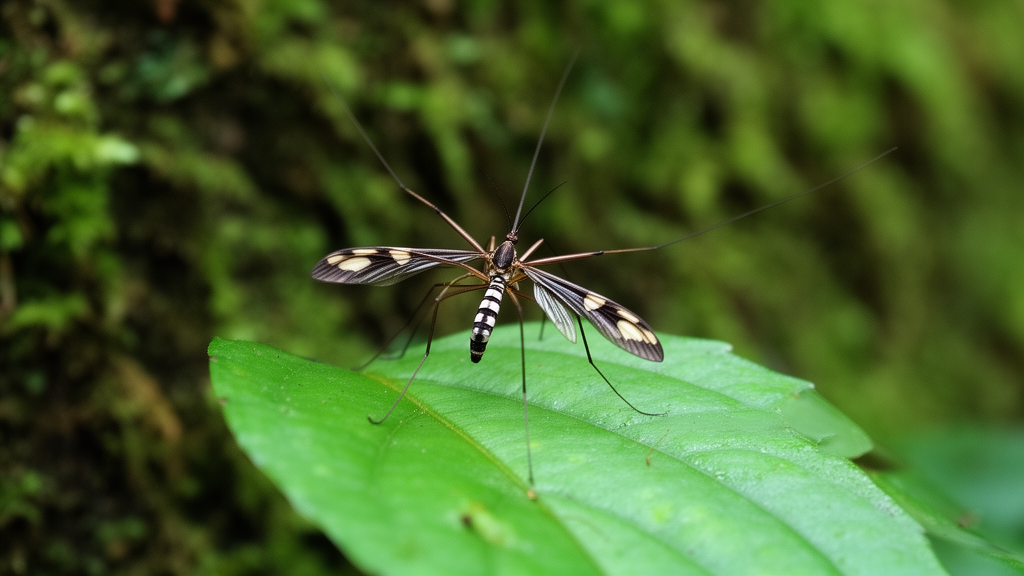
Deep in the humid forests of southern China, a large and conspicuously patterned crane fly has been quietly evading scientific recognition for decades. Taxonomists revisiting museum specimens collected as far back as 1963 have now formally described Hexatoma (Eriocera) guangxiensis as a species new to science, adding a third member to one of the most distinctive and species-poor lineages within the enormous limoniid subgenus Eriocera. The discovery, published in the open-access journal ZooKeys, is accompanied by a redescription of the closely related H. (E.) chrysomela and new provincial records that significantly extend that species’ known range in China.
The plumbicincta species group, to which both flies belong, stands out immediately among its relatives. Its members bear velvet-black heads and thoraxes, seven-segmented antennae, and wings decorated with an unusual combination of yellow, dark brown, and whitish-hyaline markings, including an oblique pale stripe crossing the middle of the wing and a larger hyaline stripe near the wing tip. This bold coloration makes them among the most visually striking crane flies in the region, yet the group has remained poorly documented, with only two species previously known from China: H. (E.) chrysomela, recorded from Fujian, Guangdong, Hong Kong and Jiangxi, and H. (E.) sincera, known only from Yunnan.
The new species was recognized from a small but telling series of male specimens: a holotype and two paratypes collected in May 1963 at Pingxiang in the Guangxi Zhuang Autonomous Region by the eminent Chinese dipterist Jikun Yang, together with a third paratype taken in 2006 at Hekou in Yunnan Province. All are deposited in the Entomological Museum of China Agricultural University in Beijing. The species name guangxiensis honors Guangxi, where the type locality is situated. The female of the new species remains unknown, a common and persistent gap in crane fly taxonomy that continues to complicate full species-level comparisons.
Distinguishing the new species from its closest relative, H. (E.) chrysomela, required close attention to both external features and fine details of male genital anatomy. Externally, the two flies are strikingly similar, sharing the same general body coloration and wing pattern, but they differ in leg and wing shading. In the new species, the femur is yellow on its basal third with the posterior margin becoming more blackish brown and thickened, and the basal third of the wing cells CuA, CuP and A1 is greyish yellow, darkening toward the wing margin. In H. (E.) chrysomela, by contrast, the femur is brownish black throughout, and the corresponding wing cells are pale yellow basally before darkening distally.
The decisive differences, however, lie in the male terminalia, the standard gold standard for crane fly identification. The new species has reddish-brown genitalia with a ninth tergite bearing a U-shaped posterior concavity roughly a third the width of the terminalia, a relatively straight, elongate-conical interbase that is thick at the base and gradually tapering, a subpentagonal paramere in lateral view, and a subtriangular aedeagal apodeme approximately one third the size of the paramere. In H. (E.) chrysomela, the terminalia are orangish yellow, the ninth tergite carries a deep triangular incision, the interbase is rod-shaped and uniform in width with a slight upward curve at the tip, the paramere is fan-shaped, and the aedeagal apodeme is fan-shaped and about half the paramere’s size.
Among the most remarkable shared features of the group is the aedeagus itself: extremely long, bent over ventrally into an almost U-shaped configuration, strongly sclerotized along its dorsal base, slender and bearing numerous short setae along its distal ventral section. This elaborate architecture, together with the characteristic wing pattern and the presence of vein M1 longer than its petiole and the m-cu crossvein at the outer end of the discal cell, defines the plumbicincta group morphologically. Such intricate genitalic structures are the product of millions of years of reproductive isolation, and they provide taxonomists with the fine diagnostic characters needed to separate even superficially identical sister species.
Putting the two species under the microscope required classical preparation techniques. Specimens were examined and illustrated with a ZEISS Stemi 2000 stereomicroscope, with coloration checked on individuals immersed in 75 percent ethyl alcohol. Male genitalia were macerated in cold 10 percent sodium hydroxide for twelve to fifteen hours, then transferred to fresh glycerol and stored in a microvial pinned beneath the corresponding specimen, allowing the delicate structures to be viewed and drawn in detail while remaining attached to the specimen record. Wing venation terminology followed the interpretations of Cumming and Wood and of Jong, while terminalia terminology followed the frameworks of Ribeiro, whose broader phylogenetic work has shown that the subgenus Eriocera as currently circumscribed is not monophyletic.
That broader context underscores why the discovery matters. The subgenus Eriocera is one of the largest and most morphologically diverse lineages of limoniid crane flies, encompassing 567 known species and subspecies distributed across every biogeographic realm, with the Oriental region alone harboring some 290 taxa. Yet its internal classification remains unstable, and its species groups are still being sorted and tested against modern phylogenetic expectations. Documenting the plumbicincta group carefully, with redescriptions, illustrations, and identification keys, provides the raw material that future molecular and morphological analyses will need to test whether these distinctive flies truly form a natural evolutionary lineage.
The redescription of H. (E.) chrysomela also delivered a significant biogeographic surprise. In addition to its previously known occurrences in Fujian, Guangdong, Hong Kong and Jiangxi, the species is now reported for the first time from Guangxi, Guizhou and Hunan provinces, based on specimens collected between 1985 and 2021 in locations ranging from forest parks in Guangdong to villages in the mountains of Hunan. Males measure 17.2 to 19.6 millimeters in body length with wings of 14.8 to 15.8 millimeters, while females are larger at 19.3 to 25.4 millimeters, with correspondingly longer wings. These records suggest the species is more widespread across subtropical southern China than earlier literature indicated.
The study also includes a revised identification key to all three Chinese members of the plumbicincta group, allowing researchers and naturalists to separate them by a combination of wing coloration, leg shading and genitalic structure. H. (E.) sincera, the third species, remains known only from its original Yunnan type locality and can be distinguished by its extensively dark brown wing cells and a medial hyaline stripe running from vein R to vein CuA. As collecting effort intensifies across China’s subtropical forests, particularly in poorly surveyed border regions such as the karst landscapes near the Vietnamese frontier where the new species was found, the true diversity of these velvet-black, boldly patterned crane flies is likely to prove considerably richer than the current list of names suggests.
Subject of Research: Taxonomy and distribution of the plumbicincta species group of limoniid crane flies in China
Article Title: Hexatoma ( Eriocera ) guangxiensis sp. nov., a new crane fly in the plumbicincta species group ( Diptera , Limoniidae ) from China
Article References: Zhang, B., Yan, J., Ning, Y., Liu, P., Yan, M., Liu, Q., & Yang, D. (2026). Hexatoma (Eriocera) guangxiensis sp. nov., a new crane fly in the plumbicincta species group (Diptera, Limoniidae) from China. ZooKeys, 1289, 271-285. https://doi.org/10.3897/zookeys.1289.196984
Image Credits: AI Generated
DOI: 10.3897/zookeys.1289.196984
Keywords: crane fly, Hexatoma, Limoniidae, new species, taxonomy, China, Guangxi, Yunnan, entomology, Diptera, male genitalia, biodiversity
Cite Scienmag News
Gavin Prescott. (October 19, 2026). New Crane Fly with Striking Wing Patterns Discovered in Southern China. Scienmag. https://scienmag.com/new-crane-fly-with-striking-wing-patterns-discovered-in-southern-china/
Gavin Prescott. "New Crane Fly with Striking Wing Patterns Discovered in Southern China." Scienmag, 19 October 2026, https://scienmag.com/new-crane-fly-with-striking-wing-patterns-discovered-in-southern-china/. Accessed 19 October 2026.
Gavin Prescott. "New Crane Fly with Striking Wing Patterns Discovered in Southern China." Scienmag. October 19, 2026. https://scienmag.com/new-crane-fly-with-striking-wing-patterns-discovered-in-southern-china/


