


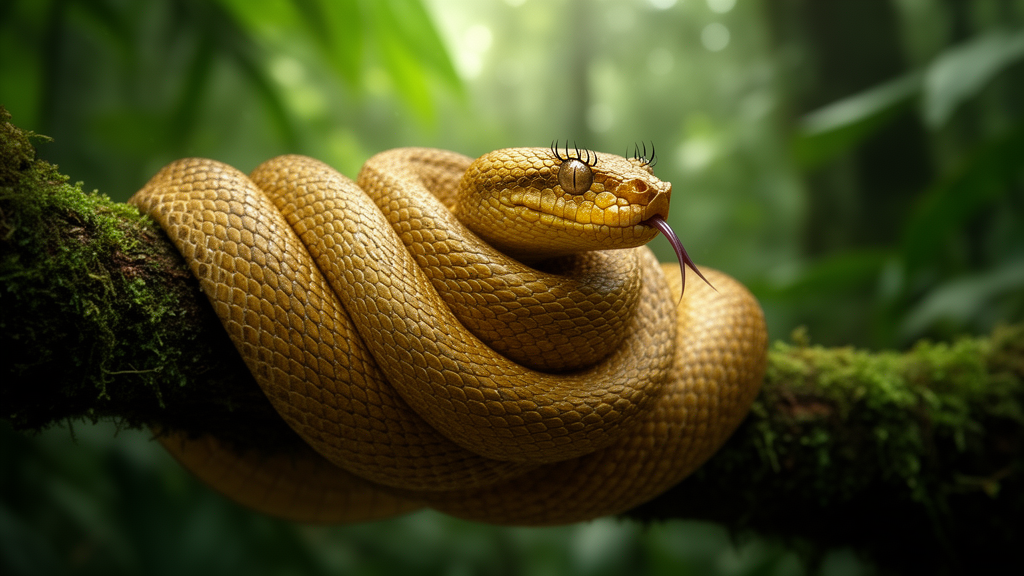
The eyelash palm pitviper, one of the most recognizable and beloved snakes in the American tropics, has become the center of an unusually sharp dispute over how scientists define a species. Earlier this year, a richly illustrated taxonomic review proposed that the wide-ranging, kaleidoscopically colored viper formerly known as Bothriechis schlegelii was in fact a complex of many species, describing five new ones and resurrecting three old names. That change nearly doubled the number of recognized species in the entire genus Bothriechis, the palm pitvipers of Central and northern South America. Now a new analysis, published in the journal Herpetozoa, argues that most of those newly minted species do not withstand scrutiny, and that the celebrated viper should once again be treated as essentially one broadly distributed animal, alongside two close relatives.
The original 2024 study used mitochondrial DNA sequences, along with a small amount of nuclear DNA and morphological measurements, to carve the eyelash viper’s range, which stretches over more than 3,000 kilometers from southern Mexico through Panama, Colombia and Ecuador, into eight separate lineages. The revision assigned those lineages species names, confining the nominal species B. schlegelii to Colombia’s Cordillera Central and elevating names such as B. khwargi, B. klebbai, B. rasikusumorum, B. hussaini, B. nitidus, B. rahimi and B. torvus. The reassessment, however, found that the underlying evidence was far thinner than the resulting taxonomy implied. The two nuclear genes in the original dataset, RAG1 and NT3, were missing for roughly 90 percent of the sampled individuals, meaning that only 12 individuals from five putative species actually contributed nuclear sequence data.
That matters because mitochondrial DNA, inherited as a single maternal package, is notoriously prone to telling only part of the story. Deep splits within a single species can arise from geographic isolation of populations that never became true species, from sex-biased dispersal, or from incomplete lineage sorting, in which ancestral genetic variants persist long after populations begin to interbreed. A single genetic locus cannot distinguish among these explanations. The nuclear genome, which recombines and is inherited from both parents, provides the critical test of whether mitochondrial lineages are exchanging genes. When the revised analysis examined the nuclear genes on their own, none of the proposed species formed a monophyletic group, and nearly every node in the resulting phylogeny received posterior probability support below 0.5, a statistical sign that the data contain essentially no signal separating the taxa.
The reanalysis also scrutinized the 4 percent threshold in the mitochondrial Cytb gene that the original authors used as a proxy for species status. Measured against the genus as a whole, that cutoff looks arbitrary: pairwise genetic divergences between clearly distinct Bothriechis species range from 6.3 to 20.3 percent, and the only pair below 7 percent was a comparison the original study treated as an exception. Within the eyelash viper group, most pairwise distances between the proposed species fell between roughly 2 and 6 percent, well below what separates established Bothriechis species. Only one putative species, B. rasikusumorum, showed consistently elevated divergence, above 5 percent in both Cytb and ND4, and even that lineage was nested inside the group in maximum likelihood analyses.
Visualization of the mitochondrial data reinforced the impression of a genetically continuous population gradient rather than a set of isolated lineages. A phylogenetic network built with SplitsTree showed less genetic differentiation among the proposed South American species than among populations within B. nigroadspersus, the Central American member of the group. The revised study’s authors interpret this pattern as clinal variation, a gradual shift in gene frequencies across geography, rather than evidence of independently evolving lineages. Meanwhile, Bayesian phylogenetic trees recovered the proposed species as monophyletic in most cases but with weak support, and one individual assigned to B. khwargi appeared nested within B. klebbai, an anomaly that may reflect a sample mix-up in GenBank submissions.
Formal species delimitation modeling added further doubt. Using the program DELINEATE, which applies a model of speciation to genetic data while allowing previously validated species to serve as fixed constraints, the reanalysis recognized only four candidate lineages rather than eight. B. khwargi merged with B. klebbai, and B. torvus, B. rahimi, B. hussaini and B. nitidus collapsed into a single taxon. Across the ten most probable phylogenetic trees, the estimated number of species within the group ranged from two to seven, underscoring the uncertainty. The analysis also comes with an important caveat: it relies on mitochondrial data that is not ideal input for such methods, so its results argue against the inflated taxonomy rather than affirming a precise count.
Morphology, the other pillar of the original revision, fared no better. Principal component analyses of the published character data, run separately for males and females and with several different standardizations of body measurements, produced overlapping clouds of points rather than distinct clusters for each proposed species. The original study listed 22 characters said to distinguish the species, but eight involved coloration, a famously variable trait in eyelash vipers, and none was exclusive to a single taxon. Of the ten scale-related traits, none proved diagnostic, with overlapping ranges for ventral scale counts and midbody scale rows in both sexes. Maximum body length varied inconsistently. Even venom potency, expressed as LD50 values, shows substantial variation within Bothriechis species, so it cannot serve as a species marker.
Perhaps the most striking re-evaluation concerns the hemipenis, the snake’s paired reproductive organ, which taxonomists often treat as a signature structure. The original revision emphasized basal hooks on the hemipenial body as a distinguishing feature, but sample sizes for most species were tiny, only B. schlegelii itself had more than three specimens. Prior work has shown that these hooks grow more prominent with age and vary within species, and that differences in preserved specimens can be artifacts of tissue preparation and incomplete eversion. What look like dramatically different structures in photographs may simply be organs inflated to different degrees, stained different colors by different techniques.
The revised paper concludes that only three names in the complex should stand as valid species: B. nigroadspersus, ranging from southern Mexico to the Panama-Colombia border; B. schlegelii in South America; and B. supraciliaris of the Pacific slopes of Costa Rica and western Panama. The genetic distances between these Central and South American lineages, 8.0 to 13.4 percent in Cytb and ND4, rival or exceed those between recognized Bothriechis species, suggesting genuine species-level divergence at that broad scale. Yet even these three could not be separated morphologically, so the author proposes treating B. hussaini, B. khwargi, B. klebbai, B. nitidus, B. rahimi, B. rasikusumorum and B. torvus as junior synonyms of B. schlegelii, and recommends that future work integrate comprehensive nuclear sequence data to test for cytonuclear discordance.
Beyond the fate of one snake, the dispute carries real consequences for conservation. Species counts are a headline metric of biodiversity, and naming new species from single-locus genetic splits can redirect scarce conservation funding toward lineages that may not be independently evolving, while also inflating the apparent richness of a region. The paper joins a growing chorus arguing for cautious, truly integrative taxonomy, one that tests whether candidate lineages are actually independent before splitting them, and points to the recognition of subspecies as a way to capture meaningful geographic diversity without triggering taxonomic inflation. For now, the eyelash viper’s many colors appear to belong to fewer species than a revision earlier this year suggested, and the episode stands as a cautionary tale about the seductive power of a single genetic threshold.
Subject of Research: Taxonomic reassessment of species boundaries in the Bothriechis schlegelii eyelash palm pitviper species group using nuclear and mitochondrial DNA and morphological data
Article Title: A revision of recent taxonomic changes to the eyelash palm pitviper, Bothriechis schlegelii ( Serpentes , Viperidae )
Article References: Reyes-Velasco, J. (2024). A revision of recent taxonomic changes to the eyelash palm pitviper, Bothriechis schlegelii (Serpentes, Viperidae). Herpetozoa, 37, 305-318. https://doi.org/10.3897/herpetozoa.37.e131965
Image Credits: AI Generated
DOI: 10.3897/herpetozoa.37.e131965
Keywords: Bothriechis schlegelii, taxonomy, species delimitation, mitochondrial DNA, nuclear DNA, pitvipers, Herpetozoa, phylogenetics, taxonomic inflation, morphology, Colombia, Ecuador
Cite Scienmag News
Juliet Wilcox. (October 19, 2026). Eyelash Viper Species Explosion Undone: Study Finds Genetic Evidence Was Overstretched. Scienmag. https://scienmag.com/eyelash-viper-species-explosion-undone-study-finds-genetic-evidence-was-overstretched/
Juliet Wilcox. "Eyelash Viper Species Explosion Undone: Study Finds Genetic Evidence Was Overstretched." Scienmag, 19 October 2026, https://scienmag.com/eyelash-viper-species-explosion-undone-study-finds-genetic-evidence-was-overstretched/. Accessed 19 October 2026.
Juliet Wilcox. "Eyelash Viper Species Explosion Undone: Study Finds Genetic Evidence Was Overstretched." Scienmag. October 19, 2026. https://scienmag.com/eyelash-viper-species-explosion-undone-study-finds-genetic-evidence-was-overstretched/


