


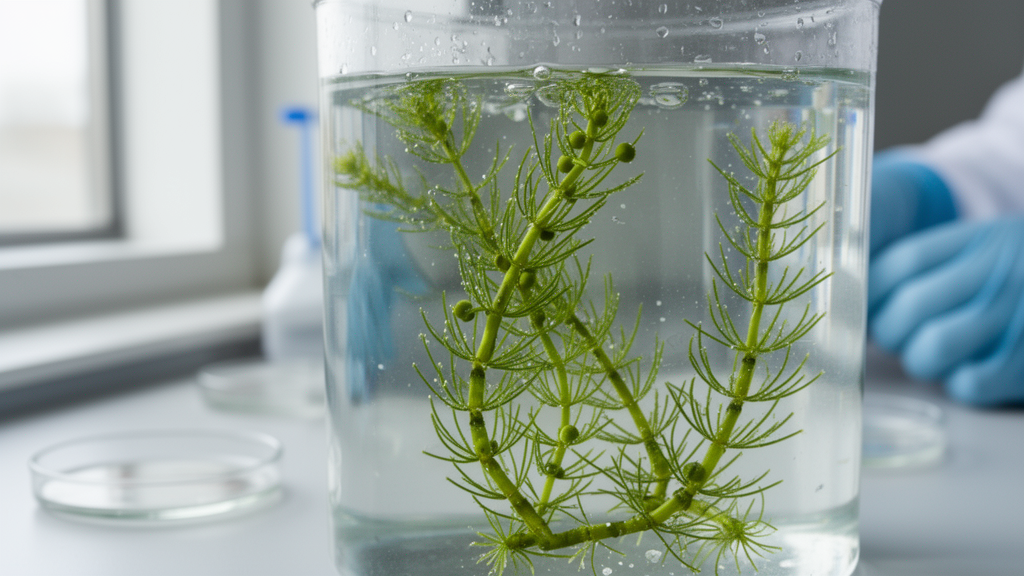
Beneath the surface of clear lakes, brackish lagoons and temporary pools grows a group of organisms so ancient, and so pivotal, that their story reaches back to the very origin of land plants. Charophytes, commonly known as stoneworts, are multicellular green algae of the family Characeae, and they occupy a remarkable position in the tree of life as close relatives of the ancestors from which all land plants descended. Yet despite more than a century and a half of scrutiny, the most basic facts of their existence, how they reproduce, how their seeds-like oospores sleep in the mud, and how they can be coaxed to grow in a laboratory, have remained scattered across a fragmentary and often contradictory literature. A new expanded review published in the journal One Ecosystem now pulls that scattered knowledge together, and in doing so reveals both how much is known and how much is still hidden.
The review, which combines decades of published studies with the author’s own doctoral research, focuses on four pillars of charophyte biology: the formation of the sexual organs and fertilisation, the dormancy of oospores, the induction of germination, and the cultivation of these algae under artificial conditions. The stakes are considerable. Characeae are sensitive indicators of clean water, and their decline under eutrophication has been documented across Europe and beyond. At the same time, their evolutionary position as part of the sister group to land plants makes every insight into their reproduction a potential window into how plants first conquered the terrestrial world. Understanding why these algae appear, disappear and return in aquatic systems, the review argues, requires a multidimensional approach that fuses morphology, anatomy, physiology, genetics, geobotany and ecology.
Sexual reproduction in charophytes is a spectacle in miniature. Male and female organs, the antheridia and oogonia, arise from short shoots formed at the nodes of branchlets. The male antheridium matures through a striking colour transformation, from green through pale yellowish-green to vivid orange, before releasing thousands of flagellated spermatozoids into the water. As long ago as 1967, researchers linked that orange hue to the accumulation of carotenoid-rich plastoglobuli. The female oogonium is an ovoid structure encircled by spiral cells, and its fertilisation was described in exquisite detail as far back as 1871 by Anton de Bary, who observed spermatozoids massing at five tube-like channels and threading through a narrowed funnel at the apex of the oocyte. What follows is the formation of a thickened cellulose layer around the zygote, a layer whose absence is thought to signal infertility.
Yet even this well-trodden path conceals one of the great mysteries of the field: nobody knows exactly when meiosis occurs in charophytes. Over more than a century, researchers have proposed at least four conflicting hypotheses, placing meiosis just before oospore germination, in the early stages of gametangia, during protonema development, or immediately after fertilisation. The problem is technical as much as conceptual. Oogonia and oospores are loaded with starch, which makes ultrathin sectioning for microscopy notoriously difficult. The review identifies establishing reliable sectioning methods for every developmental stage as one of the most important prerequisites for finally solving this puzzle, a reminder that even foundational cell biology can stall on the limitations of laboratory technique.
Genetics is beginning to fill gaps that morphology alone cannot. Studies of Chara globularis have revealed the presence of MIKC-type MADS box genes in both oogonia and antheridia, suggesting these key regulators of sex-specific cell differentiation existed before the major diversification of plant lineages. Immunofluorescence work has shown PIN2-like auxin transporters in antheridial filaments, along with polar auxin transport in internodal cells, features long thought to be hallmarks of land plants that evidently evolved far earlier. Cell wall chemistry tells a similar story: charophytes contain the same cellulose, pectin, hemicellulose, lignin and proteins as land plants, differing mainly in proportions, although recent work has found that some species lack hydroxyproline and arabinogalactan proteins that are ubiquitous in terrestrial flora.
Asexual reproduction adds a second, quieter strategy. Many charophytes propagate vegetatively through modified rhizoid or nodal cells, forming starch-filled bulbils that act as overwintering reserves, star-shaped in Nitellopsis obtusa, strawberry-shaped in Chara baltica, cardioid-shaped in Chara fragifera. These structures can regenerate new shoots after drought, fragmentation or the death of apical cells, ensuring population persistence when conditions are unfavourable for oospores. One species stands apart: Chara canescens has never been observed reproducing vegetatively and depends entirely on oospores, reproducing either sexually in dioecious populations or parthenogenetically, with genetically and chromosomally distinct female lines. Notably, the review reports that severing the rhizoid filaments connecting bulbils prevents new shoot development, hinting at unknown signalling pathways that modern molecular tools have yet to touch.
The oospore is the charophyte’s long-term insurance policy, a resting stage embedded in aquatic sediments that resists drought and mechanical stress far better than any vegetative fragment. Whether it germinates depends on a cascade of cues. The review maps these onto the biogeographic concept of zonobiomes, showing that the climate zone from which material originates predicts which dormancy-breaking treatment works: species of the warm-temperate zonobiome V generally respond to pre-treatment at 15 degrees Celsius, whereas species of zonobiome VI require cold storage. Cold treatment followed by irradiation with long-wave light emerges as the most broadly effective method, though species-specific exceptions abound, such as a New Zealand Nitella that prefers room-temperature storage. Freshly extracted oospores, it turns out, are more deeply dormant than those recovered from sediments, likely because abscisic acid is gradually degraded during storage.
Light, nutrients and chemistry complicate the picture further. Some studies find that light intensity and quality trigger germination; others find no effect at all, contradictions the review attributes to differences in geography, species and sample type. Purely inorganic culture media actually inhibit germination, while the addition of organic material, though critical for success, invites contamination by microbes and epiphytes. Desiccation matters too: drying oospores increased germination in some species but not others, and dried oospores of several Chara species germinated after freezing, chilling or warming across storage periods of up to four years. Sediment depth plays a role as well, with heavier Chara oospores germinating from deeper layers than lighter Nitella ones, a finding that underpins the emerging restoration science of so-called ghost ponds, where long-buried viable oospores can resurrect lost aquatic floras.
Perhaps the most practically significant contribution of the review is a new cultivation approach the author calls Eco-in-vitro-cultivation. Traditional laboratory media have long failed to induce the formation and maturation of gametangia in monoecious, diplostichous Chara species such as Chara hispida, with cultures instead succumbing to biofilm overgrowth and reproductive senescence. By combining environmental logger data from outdoor mesocosms at Rostock University, records of temperature, light intensity and light-dark cycles under which germination and gametangia development naturally occurred, with refined in-vitro techniques and a nutrient medium, the researchers achieved successful gametangia initiation and oospore maturation under fully artificial conditions. Because such cultures carry a drastically reduced microbiome, they should also make it easier to distinguish contaminant-specific and bacterial-specific gene sequences in future molecular work.
The broader significance is hard to overstate. Long-term, controlled cultures that complete the full life cycle would open the door to identifying the gene networks governing different modes of reproduction, resolving the timing of meiosis, and testing whether land-plant-like hormone responses in charophytes depend on uniport transporters capable of shuttling both nutrients and phytohormone conjugates. The review also highlights striking gaps, from the complete absence of studies on soil microbes in Chara meadows to the unknown function of mucilage on rhizoids and oospores. What emerges is a portrait of a scientifically glamorous group, central to one of evolution’s greatest transitions, whose everyday biology has been quietly understudied. With standardised, species-specific protocols now within reach, the humble stoneworts may finally give up their secrets, from the sleeping spores in the mud to the genes that first taught green cells to live on land.
Subject of Research: Reproduction, oospore dormancy, germination and cultivation of charophyte algae (Characeae)
Article Title: What we really know about the dormancy, reproduction, germination and cultivation of charophytes ( Characeae )
Article References: Holzhausen, A. (2024). What we really know about the dormancy, reproduction, germination and cultivation of charophytes (Characeae). One Ecosystem, 9, Article e117655. https://doi.org/10.3897/oneeco.9.e117655
Image Credits: AI Generated
Keywords: charophytes, Characeae, stoneworts, oospore dormancy, germination, sexual reproduction, asexual reproduction, gametangia, phytohormones, in-vitro cultivation, aquatic ecology, land plant evolution
Cite Scienmag News
Gavin Prescott. (October 19, 2026). Stoneworts Hold the Secrets of Plant Reproduction, and Scientists Are Finally Cracking Them. Scienmag. https://scienmag.com/stoneworts-hold-the-secrets-of-plant-reproduction-and-scientists-are-finally-cracking-them/
Gavin Prescott. "Stoneworts Hold the Secrets of Plant Reproduction, and Scientists Are Finally Cracking Them." Scienmag, 19 October 2026, https://scienmag.com/stoneworts-hold-the-secrets-of-plant-reproduction-and-scientists-are-finally-cracking-them/. Accessed 19 October 2026.
Gavin Prescott. "Stoneworts Hold the Secrets of Plant Reproduction, and Scientists Are Finally Cracking Them." Scienmag. October 19, 2026. https://scienmag.com/stoneworts-hold-the-secrets-of-plant-reproduction-and-scientists-are-finally-cracking-them/


