


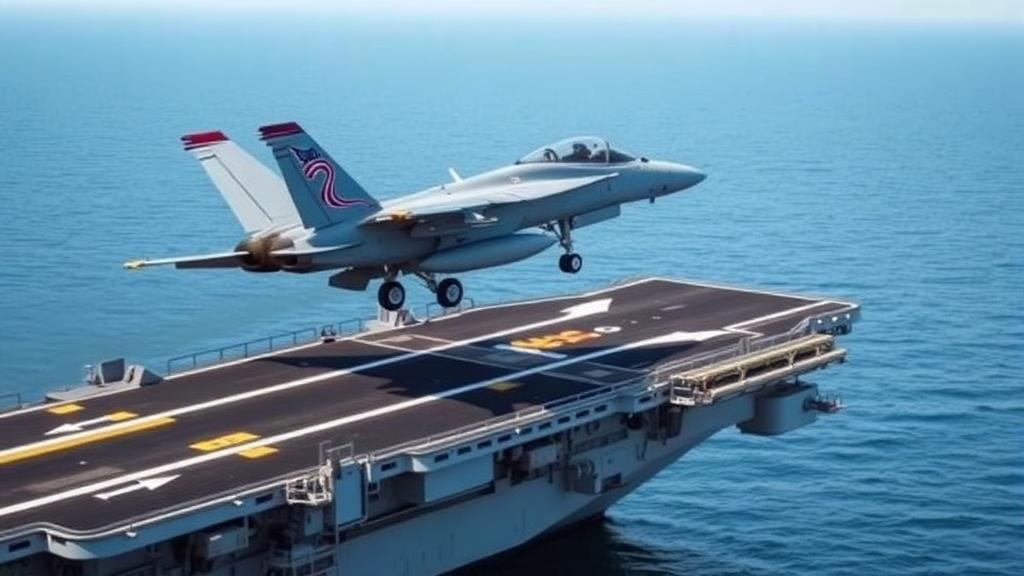
Landing a fighter jet on an aircraft carrier is widely regarded as one of the most demanding tasks in all of aviation. The deck pitches and heaves with the swell of the ocean, the ship’s superstructure churns the airflow into violent turbulence, and a single miscalculation can send a multi-ton aircraft crashing into the sea or into other aircraft parked along the deck. Now, a team of Chinese control engineers has unveiled a new fault-tolerant control scheme designed to make automatic carrier landings dramatically more reliable, even when the aircraft is battered by air-wake disturbances while simultaneously suffering failures in its own control surfaces.
The research, published in the International Journal of Aeronautical and Space Sciences by Qilong Wu of Huainan Normal University, Qidan Zhu of Harbin Engineering University, and their colleagues, including Lunpan Wei, Lipeng Wang, and Wenqiang Jiang of the China Ship Development and Design Center, tackles a problem that has long frustrated engineers: how to guarantee that a landing aircraft stays on its glide path within a strictly bounded error, and that it does so within a time window chosen in advance by the designer, regardless of where the aircraft starts its approach. The work was supported by the National Natural Science Foundation of China and other national and provincial funding bodies.
At the heart of the new scheme is what the authors call a predefined-time prescribed performance function, or PTPPF. Prescribed performance control is a technique that constrains the tracking error, the difference between where the aircraft should be and where it actually is, to remain inside a shrinking envelope. Think of it as a funnel around the ideal glide slope: the aircraft’s deviation is mathematically forbidden from escaping the funnel walls, and the funnel narrows as the aircraft nears the deck. What makes the new formulation distinctive is the predefined-time element. In many conventional designs, the convergence of the error depends on the initial conditions, meaning a jet that starts its approach far from the ideal path may take an unpredictable amount of time to settle. The PTPPF removes that dependency entirely, guaranteeing that the error converges within a time set by the control engineer before the mission even begins.
Guaranteeing a bounded error is only half the battle, however. The second pillar of the approach is a predefined-time sliding mode controller, or PTSMC. Sliding mode control is a well-established robust technique that drives a system’s state onto a chosen sliding surface and then forces it to slide along that surface toward the target, effectively ignoring matched uncertainties and external disturbances along the way. Its weakness has traditionally been the chattering phenomenon, in which the control signal oscillates rapidly, and the fact that classical finite-time versions offer convergence speeds that vary with initial conditions. The predefined-time variant designed by the team enhances robustness against the nonlinear uncertainties and external disturbances that plague carrier approaches, while ensuring that the sliding dynamics complete their work within the designer’s chosen deadline.
The third and perhaps most ingenious component is a prescribed-time extended state observer, or PTESO. Extended state observers are devices that treat all the unknown disturbances acting on a system, including unmodeled dynamics, wind gusts, and even actuator faults, as an additional augmented state to be estimated alongside the system’s physical states. Once estimated, these lumped disturbances can be cancelled out in real time within the control loop, a strategy known as active disturbance rejection. The prescribed-time version developed here goes further: it promises that its estimates of the combined disturbances and actuator faults become accurate within a prescribed time, allowing the controller to compensate for a failing elevator or a sudden shift in the ship’s turbulent wake almost as soon as it occurs, rather than gradually over the course of the approach.
To prove that this elaborate architecture is safe rather than merely plausible, the authors carried out a Lyapunov-based stability analysis. Lyapunov methods are the gold standard of nonlinear control theory: the designer constructs an energy-like function of the closed-loop system and demonstrates mathematically that this function decreases along the system’s trajectories, which implies that all signals remain bounded and that the tracking error behaves as intended. In this case, the analysis establishes two critical guarantees simultaneously: every closed-loop signal stays bounded, and the tracking error converges within the predefined time, no matter the initial conditions. That combination of boundedness and deadline-driven convergence is what separates this work from earlier prescribed performance designs, which typically offered only asymptotic or condition-dependent convergence.
The true test of any carrier landing control law comes in simulation that faithfully reproduces the hostile environment of a moving flight deck. The team’s carrier landing experiments incorporated three of the most punishing factors at once: the carrier air-wake, the turbulent and horizontally offset airflow generated by the ship’s island superstructure as it washes over the approaching aircraft; the deck motion, meaning the heave, pitch, and roll of the landing point as the ship responds to waves; and actuator faults, including partial loss of control effectiveness. These are precisely the coupled hazards that have caused past approaches to degrade, because a controller tuned for calm conditions can be overwhelmed when disturbances and hardware failures arrive together.
The results, according to the authors, show that the proposed method significantly improves transient performance, disturbance rejection, and landing accuracy compared with existing techniques. Transient performance matters enormously in this context: the moments right after the aircraft enters the glide path, or right after a fault occurs, are when deviations are largest and most dangerous. By confining the error inside the prescribed performance funnel from the very start and compensating disturbances through the observer in real time, the scheme keeps those dangerous excursions small and short-lived. The practical implication is a tighter, more predictable touchdown point on the deck, which translates directly into reduced structural stress on the airframe and lower risk of missing the arresting wires.
The significance of the predefined-time formulation becomes clearer when one considers the communication environment referenced in the study’s title. Carrier-based aircraft operate in data links with the ship, and guidance updates may arrive late or intermittently. A control law whose convergence time balloons when conditions are unfavorable offers no firm promise to the pilot or the mission planner. By contrast, a scheme in which the error is guaranteed to converge within a time fixed at design stage, independent of initial conditions, allows the entire approach to be choreographed against a known clock, which is essential when the landing window is dictated by the ship’s motion and the recovery schedule of the air wing.
The work also fits into a broader and rapidly accelerating research trend. Fixed-time and predefined-time control methods have recently swept through the control theory literature, with applications demonstrated for multiagent consensus, microgrid frequency regulation, hypersonic vehicles, spacecraft attitude stabilization, and quadrotor drones, including vehicles suffering actuator failures. Meanwhile, extended state observers have been combined with sliding mode and super-twisting techniques for carrier landing in a series of recent studies, and fault-tolerant control for carrier-based aircraft has evolved from fault reconstruction schemes to adaptive neural approaches. The new paper synthesizes these strands, wrapping a predefined-time prescribed performance function, a predefined-time sliding mode controller, and a prescribed-time extended state observer into a single fault-tolerant architecture with formal stability proofs.
For now, the results rest on simulation experiments rather than flight tests, and the authors note that the underlying code is not publicly available due to project confidentiality and institutional restrictions, though it can be requested from the corresponding author for academic purposes. The data supporting the findings are likewise available upon reasonable request with laboratory approval. Those caveats are standard for research at this stage, and the gap between simulated and real carrier operations remains a formidable one, involving sensor noise, actuator saturation limits, and the sheer unpredictability of the maritime environment. Nevertheless, the mathematical guarantees established in the paper, bounded closed-loop signals and deadline-driven error convergence under simultaneous air-wake disturbance, deck motion, and actuator faults, represent a meaningful step toward the long-sought goal of fully autonomous, fault-resilient carrier recoveries. If future flight validation confirms the simulation results, the technology could one day allow unmanned carrier-based aircraft, and perhaps crewed ones, to come aboard in conditions that today demand the finest human piloting skills in existence.
Subject of Research: Fault-tolerant predefined-time control for automatic aircraft carrier landing under air-wake disturbances and actuator faults
Article Title: Robust Predefined-Time Fault-Tolerant Prescribed Performance Control for Automatic Carrier Landing in Communication Environments Under Air-Wake Disturbances and Actuator Faults
Article References: Wu, Q., Zhu, Q., Wei, L., Wang, L., & Jiang, W. (2026). Robust Predefined-Time Fault-Tolerant Prescribed Performance Control for Automatic Carrier Landing in Communication Environments Under Air-Wake Disturbances and Actuator Faults. International Journal of Aeronautical and Space Sciences. https://doi.org/10.1007/s42405-026-01266-9
Image Credits: AI Generated
DOI: 10.1007/s42405-026-01266-9
Keywords: automatic carrier landing, fault-tolerant control, predefined-time control, sliding mode control, prescribed performance, extended state observer, air-wake disturbance, actuator faults, Lyapunov stability, carrier-based aircraft, flight control systems, disturbance rejection
Cite Scienmag News
Grant Pearson. (October 1, 2026). New Control System Promises Safer Landings on Heaving Aircraft Carriers. Scienmag. https://scienmag.com/new-control-system-promises-safer-landings-on-heaving-aircraft-carriers/
Grant Pearson. "New Control System Promises Safer Landings on Heaving Aircraft Carriers." Scienmag, 1 October 2026, https://scienmag.com/new-control-system-promises-safer-landings-on-heaving-aircraft-carriers/. Accessed 4 October 2026.
Grant Pearson. "New Control System Promises Safer Landings on Heaving Aircraft Carriers." Scienmag. October 1, 2026. https://scienmag.com/new-control-system-promises-safer-landings-on-heaving-aircraft-carriers/


