


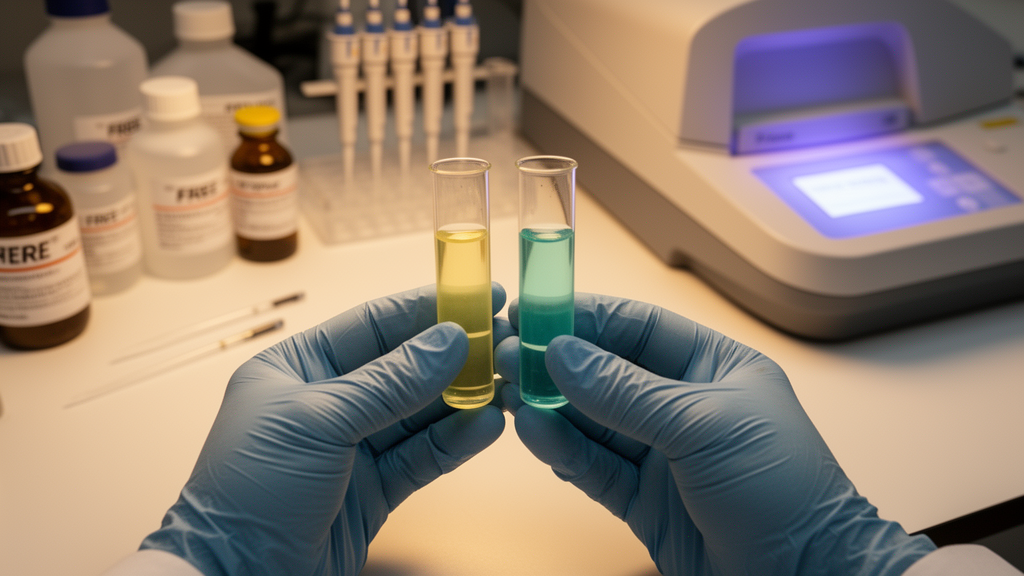
Researchers have developed and validated a colorimetric method that quantifies urea and ammonium simultaneously in a single 2 M KCl extract, addressing a long-standing practical gap in the study of urea hydrolysis. The work, published as an open-access research article in Chemical and Biological Technologies in Agriculture on 21 October 2026 by Marcos Benito, Araceli Pérez-Sanz and Juan J. Lucena, combines two well-established spectrophotometric reactions in one workflow: the diacetyl monoxime reaction for urea and the salicylate-Berthelot reaction for ammonium. Both analytes can then be read with standard UV–Vis spectrophotometry, avoiding the need to split samples or run separate assays on different aliquots.
The motivation is straightforward. Urea hydrolysis is a key process governing nitrogen availability and losses in agricultural systems, but assessing it accurately has been constrained by the lack of simple methodologies for measuring urea and ammonium together in one matrix. That limitation complicates the evaluation of urease activity and the efficiency of urease inhibitors, because researchers tracking the conversion of urea into ammonium must typically handle the substrate and the product separately. The new method enables integrated monitoring of nitrogen transformations directly in a single extract.
Analytical performance figures reported in the study are strong. The method showed excellent linearity, with R² values above 0.999 across the working range. Limits of detection were 0.7 mmol L−1 for urea and 0.3 mmol L−1 for ammonium. Validation experiments confirmed high accuracy and precision, with recoveries close to 100% and relative standard deviations below 3%. Importantly for a paired assay, no significant mutual interference between the two analytes was observed, meaning the presence of one compound did not distort measurement of the other.
A further check of robustness came from nitrogen mass balance. Across the validation experiments the method maintained a consistent nitrogen mass balance of 100 ± 7%, which the authors present as support for its reliability in monitoring urea hydrolysis over time. Because the substrate and the product of hydrolysis are measured in the same extract, the sum of nitrogen in both forms can be tracked directly, providing an internal consistency check as urea is converted to ammonium.
To demonstrate the method in practice, the team applied it to urease inhibitors tested in vitro. N-(n-butyl) thiophosphoric triamide, widely known as NBPT, and acetohydroxamic acid (AHA) produced strong inhibition of urea hydrolysis, reducing ammonium formation by up to 73–77% after 72 hours.
The screening also revealed a clear split among the other candidates. Potassium thiosulfate and pyoverdine exhibited only limited inhibition of urea hydrolysis under the test conditions. The authors note that further studies using interaction with agricultural soils are needed to establish how these inhibition profiles translate to real field conditions.
The significance of the analytical advance lies in what it makes routine. Because urea and ammonium are determined in the same extract, the method allows direct monitoring of substrate transformation and product formation in a single measurement cycle. For laboratories studying fertilizer breakdown, soil nitrogen cycling or inhibitor screening, this removes a bottleneck that previously required either separate extractions or parallel analytical procedures, and it does so with equipment as common as a UV–Vis spectrophotometer.
The authors describe the approach as simple, cost-effective and robust, and frame its application as facilitating the evaluation of urease inhibitors in vitro while supporting improved nitrogen management strategies. A measurement tool that follows both the fertilizer and its breakdown product in one matrix gives researchers and agronomists a clearer, faster picture of where nitrogen is heading.
As with any in vitro screening, the inhibitor results should be read within their scope. The assays were conducted in controlled extracts rather than in soil, and the authors themselves flag that studies involving interaction with agricultural soils are the necessary next step before conclusions can be drawn about field performance. The variable behavior of the Metschnikowia pulcherrima extracts in particular underscores that inhibition observed in a simplified matrix may not carry over directly to complex soil environments.
For now, the study delivers a validated analytical tool rather than an agronomic recommendation: a paired colorimetric assay with sub-millimolar detection limits, near-quantitative recoveries, tight precision and a closed nitrogen mass balance, demonstrated on a panel of urease inhibitors that ranged from strongly effective NBPT and AHA to the weaker performers potassium thiosulfate and pyoverdine. By making simultaneous urea and ammonium measurement routine in a single KCl extract, the method lowers the technical barrier to studying urea hydrolysis and offers a practical foundation for the larger soil-based experiments that will determine which inhibitors earn a place in sustainable nitrogen management.
Subject of Research: Development and validation of a colorimetric method for simultaneous determination of urea and ammonium in a single extract, applied to urease inhibitor testing
Article Title: Simultaneous determination of ammonium and urea in a single matrix using colorimetric methods: application to urease inhibitors
Article References: Benito, M., Pérez-Sanz, A., & Lucena, J. J. (2026). Simultaneous determination of ammonium and urea in a single matrix using colorimetric methods: application to urease inhibitors. Chemical and Biological Technologies in Agriculture. https://doi.org/10.1186/s40538-026-01111-x
Image Credits: AI Generated
DOI: 10.1186/s40538-026-01111-x
Keywords: urea, ammonium, colorimetric method, UV-Vis spectrophotometry, urease inhibitors, NBPT, acetohydroxamic acid, urea hydrolysis, nitrogen management, KCl extraction, soil nitrogen, agriculture
Cite Scienmag News
Alan Morgan. (October 28, 2026). New Colorimetric Method Measures Urea and Ammonium Together in One Extract. Scienmag. https://scienmag.com/new-colorimetric-method-measures-urea-and-ammonium-together-in-one-extract/
Alan Morgan. "New Colorimetric Method Measures Urea and Ammonium Together in One Extract." Scienmag, 28 October 2026, https://scienmag.com/new-colorimetric-method-measures-urea-and-ammonium-together-in-one-extract/. Accessed 28 October 2026.
Alan Morgan. "New Colorimetric Method Measures Urea and Ammonium Together in One Extract." Scienmag. October 28, 2026. https://scienmag.com/new-colorimetric-method-measures-urea-and-ammonium-together-in-one-extract/


