


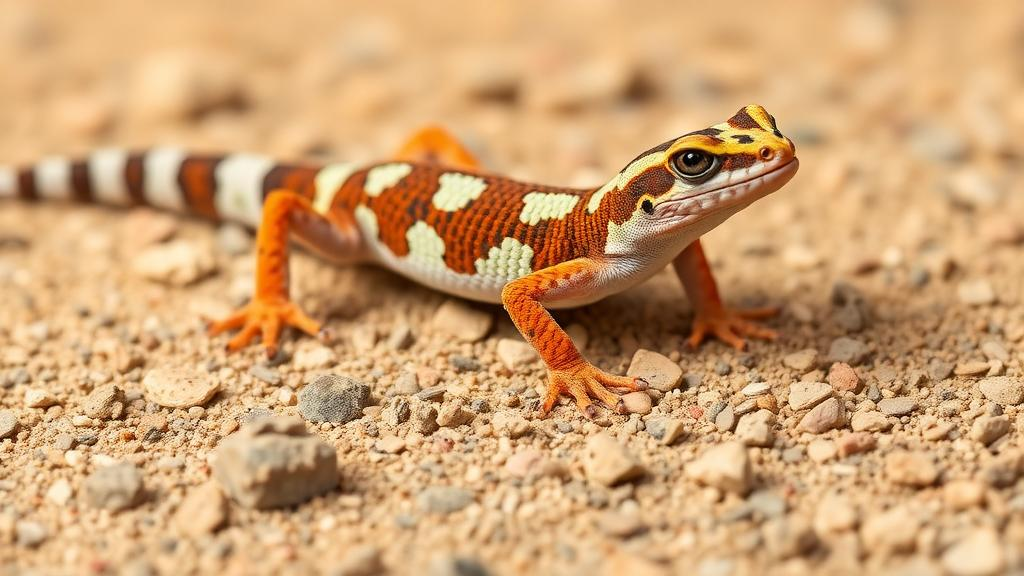
A new species of rock-dwelling gecko has been identified from dry-hot valleys in northwestern Sichuan Province, China, where genetic and anatomical evidence shows that it is distinct from every previously known member of the subgenus Japonigekko. The researchers named the animal Gekko tesselatus and proposed “Checkered Gecko” as its English common name. Its discovery, described in Zoosystematics and Evolution, raises the number of recognized Japonigekko species to 39, including 26 recorded in China, and brings the number known from Sichuan to seven.
The new gecko was discovered during field surveys conducted in the summer of 2025 in Heishui County, part of the Aba Tibetan and Qiang Autonomous Prefecture. Researchers collected animals at night on rocky slopes covered by low shrubs and grasses, documenting the type locality in Se’ergu Town at elevations from 1,827 to 2,047 metres. The specimens were deposited in collections at Qinghai University, the Museum of Biology at Sun Yat-sen University, and the Chengdu Institute of Biology. The work combined detailed measurements and scale counts with mitochondrial DNA analysis, an approach that has become increasingly important for resolving geckos whose appearances can be nearly indistinguishable.
Genetic analysis used fragments of the mitochondrial 16S ribosomal RNA and NADH dehydrogenase subunit 2 genes. Together, the two regions produced an alignment of 1,574 base pairs: 563 base pairs from 16S and 1,011 from ND2. Ten newly collected individuals were sequenced, and the researchers added comparative sequences from other members of Japonigekko. Maximum-likelihood analysis placed the Heishui animals in a strongly supported lineage within the subgenus, with SH-like approximate likelihood ratio test and ultrafast bootstrap values both reaching 100. Relationships among some of the more distant species remained less certain, but the distinctness of the new population was consistently supported.
The Heishui geckos were also genetically separated from their closest known relatives by substantial sequence distances. Their 16S sequences differed by at least 8.2% from Gekko liboensis, the closest sampled relative, and by at least 8.9% from all other congeners. In the more rapidly evolving ND2 gene, divergence reached at least 14.3% from G. fengshanensis and at least 14.9% from other species in the subgenus. These gaps, together with a distinct skeletal pattern and consistent external characters, provided the evidence required to recognize the population as a new species rather than a previously described or isolated population.
Among its closest relatives, the new species appears to occupy a notably different ecological niche. Gekko tesselatus inhabits heavily weathered rock faces in hot, dry valleys, sheltering in crevices more than two metres above the ground. Its four closest genetic relatives—G. fengshanensis, G. kwangsiensis, G. liboensis and G. paucituberculatus—are associated with warm limestone karst forests in southern China. The nearest known rock-dwelling relative, G. liboensis, occurs nearly 900 kilometres away. This stark separation in both geography and habitat suggests that environmental heterogeneity may have helped drive divergence within this evolutionary group.
The gecko is moderately sized, with a slender, relatively elongated body and a depressed head. The largest female in the type series had a snout–vent length of 65.3 millimetres, while the largest male measured 64.9 millimetres; a female reported in the species diagnosis reached 72.9 millimetres. Its tail is slightly longer than the body in the largest specimens, and its head is clearly separated from the neck. Vertical pupils with crenulated edges occupy relatively large eyes, and a small, obliquely oriented ear opening lies behind each eye. Males are distinguished by six to eight precloacal pores, whereas females lack them.
Its most immediately recognizable feature is a dorsal pattern of irregular dark transverse bands. The bands are faintly interrupted along the midline by a narrow vertebral line and become fragmented and interconnected toward the sides, producing a reticulated or checkerboard-like design. The scientific name tesselatus derives from the Latin word tessella, meaning a small square tile, and refers to this pattern. The body generally has a light greyish-brown ground colour with scattered brown and yellowish-brown spots, while the underside is creamy white. The tail bears 11 to 14 dark transverse bands. Although the body often becomes paler after capture, the researchers observed the original pattern gradually returning after several days in captivity.
Diagnostic features also include flattened dorsal tubercles extending from the rear of the head through the neck to the anterior portion of the tail, where they form 12 to 15 rows at midbody. The geckos have 98 to 106 scale rows around the middle of the body, 31 to 39 ventral scale rows, and 130 to 157 ventral scales between the mental scale and the cloacal slit. Two enlarged postmentals are usually present beneath the head, although one specimen had only one. There is no webbing between the fingers or toes, and the digits carry undivided subdigital lamellae: seven to ten beneath the first finger, nine to 12 beneath the fourth finger, seven to nine beneath the first toe, and nine to 12 beneath the fourth toe.
Field observations indicate that this gecko is closely tied to particular geological surfaces. Individuals were usually encountered on heavily weathered slopes with abundant crevices and were rarely seen on less fractured terrain. Even within the same valley, the highest collection site, at 2,047 metres, yielded only one animal despite extensive rock weathering. No traces were detected at higher elevations, and the researchers suggest that the species’ actual range may not extend beyond about 2,100 metres because cooler conditions at greater heights may be unsuitable. A banded wolf snake, Lycodon multizonatus, was recorded in the same habitat and may be one of the gecko’s principal natural predators.
Human disturbance may also shape the species’ distribution. Although some collection sites lay near villages, the geckos were not observed around homes or other developed structures. Even at sites adjoining settlements, individuals remained on undeveloped rocky slopes. This behavior contrasts with the apparent tolerance of human-modified environments shown by Sichuan’s other known Japonigekko species, which can occupy buildings, bridges and concrete embankments. Because population size, trends and distribution remain poorly documented, the authors recommend classifying Gekko tesselatus as Data Deficient under the IUCN Red List criteria rather than assigning it a threatened category. Broader field surveys are now needed to determine whether the new species is restricted to a few isolated valleys or has a wider but overlooked distribution across the region’s rocky slopes.
Subject of Research: The description of Gekko tesselatus as a new rock-dwelling gecko species from northwestern Sichuan, China.
Article Title: A new rock-dwelling gecko of the subgenus Japonigekko ( Squamata , Gekkonidae , Gekko ) from northwestern Sichuan Province, China
Article References: Xu, Y., Ma, S., Cai, B., Qi, S., Matsukoji, T., Poyarkov, N. A., Sun, F., Weng, S., Gu, T., Tian, K., Zhang, D., Jiang, J., & Peng, L. (2025). A new rock-dwelling gecko of the subgenus Japonigekko (Squamata, Gekkonidae, Gekko) from northwestern Sichuan Province, China. Zoosystematics and Evolution, 101(4), 2221-2242. https://doi.org/10.3897/zse.101.175246
Image Credits: AI Generated
Keywords: Gekko tesselatus, Japonigekko, new gecko species, Sichuan Province, Heishui County, integrative taxonomy, mitochondrial phylogeny, dry-hot valley, biodiversity conservation, rock-dwelling, gecko, subgenus
Cite Scienmag News
Margaret Porter. (October 19, 2026). New checkered gecko discovered in Sichuan’s dry-hot valleys. Scienmag. https://scienmag.com/new-checkered-gecko-discovered-in-sichuans-dry-hot-valleys/
Margaret Porter. "New checkered gecko discovered in Sichuan’s dry-hot valleys." Scienmag, 19 October 2026, https://scienmag.com/new-checkered-gecko-discovered-in-sichuans-dry-hot-valleys/. Accessed 19 October 2026.
Margaret Porter. "New checkered gecko discovered in Sichuan’s dry-hot valleys." Scienmag. October 19, 2026. https://scienmag.com/new-checkered-gecko-discovered-in-sichuans-dry-hot-valleys/


