


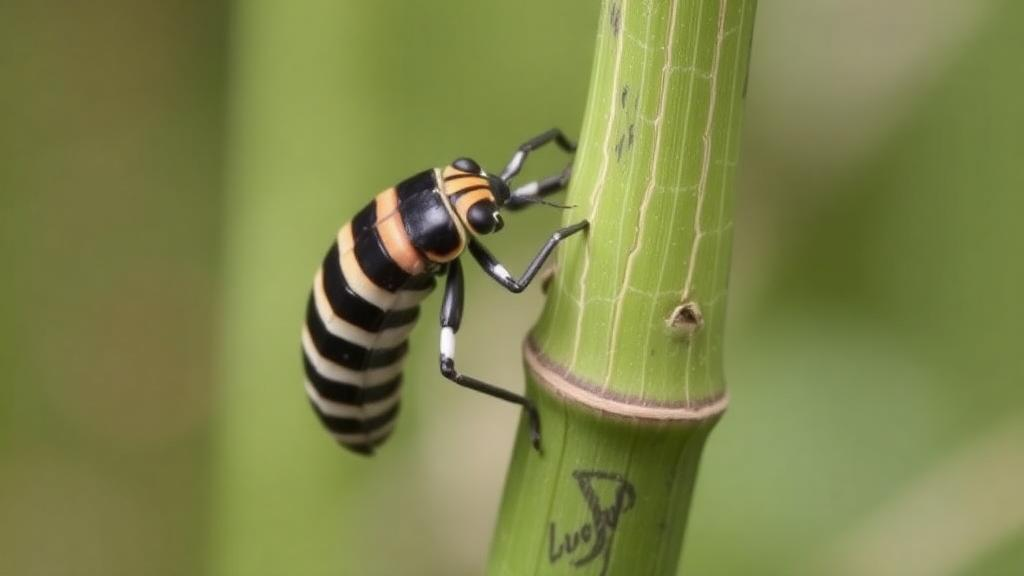
A beetle that had long been regarded as a one-off arrival with imported bamboo has produced a strikingly different picture in Europe. A study led by biodiversity researchers and supported by observations from amateur naturalists documents 13 new records of the Asian bamboo borer, Chlorophorus annularis, across seven countries. Two of those records were the first confirmed sightings in Belgium, while another established the Netherlands as a new country on the beetle’s European list. The findings show how observations uploaded by the public can reveal the distribution of overlooked non-native species, particularly insects small enough and similar enough to European counterparts to escape routine identification.
Chlorophorus annularis is a longhorn beetle in the family Cerambycidae, a group of more than 40,000 described species that feed on plants, wood or decaying plant material. It originates in temperate and subtropical parts of Southeast Asia and has been introduced far beyond its native range. The beetle has been intercepted in North and South America, Africa, the Middle East, Australasia and Europe. Its principal economic importance comes from bamboo, which it damages and contaminates as a product. Outside Asia, reported hosts span 14 plant families, but bamboo is the material most closely associated with the pest and the usual source of international transport.
Until now, the European evidence for the species consisted largely of isolated individuals linked to imported bamboo products such as furniture, poles, brooms and decorative sticks. That pattern supported the prevailing view that the beetle was repeatedly arriving in trade shipments without becoming established. Yet a sequence of encounters without an obvious connection to imported material—including beetles found alive in a car, a house and a German garden—raises a different possibility. The new records strengthen the case that the species may be settling into European landscapes rather than merely passing through them.
The Belgian finds were especially notable. A living specimen was discovered in a car in Genk on 31 July 2019, but investigators could not associate it with a host plant. A second beetle emerged inside a house in Torhout on 30 December 2020, again without an apparent link to bamboo or another host. Both animals were identified by Belgian experts and deposited with the Royal Belgian Institute of Natural Sciences. The Netherlands also joined the distribution map when a living beetle was found beneath a pile of bamboo sticks purchased from a garden centre in Wageningen on 18 August 2011 and reported through the Dutch observation platform waarneming.nl.
Citizen-science platforms supplied most of the new information. Researchers searched iNaturalist, the British iRecord system, the Czech Entomologické Fórum and waarneming.nl for records of C. annularis, then checked observations of related Chlorophorus species to reduce the risk of confusing it with similar beetles. Social media groups also proved valuable, allowing images and specimens to be circulated to naturalists and professional entomologists for identification. This combination of broad public participation and specialist review transformed isolated encounters into a continent-scale monitoring effort without requiring a large conventional field-survey team.
Some of the most striking evidence came from imported bamboo that was already in use. In Obříství, Czech Republic, residents found adults and larvae in broken bamboo poles between 2016 and 2018, while other beetle families were present in the same material. Seven adults emerged from Vietnamese bamboo sticks in Hesselager, Denmark, in 2016. In France, multiple beetles hatched from an Indonesian bamboo bed in 2008, leaving visible exit holes, and another emerged from a bamboo broomstick in 2014 at a workshop in Le Crès. These observations demonstrate that imported material can function as a concealed nursery, allowing beetles to develop indoors before adults emerge and disperse.
The recent UK records point to the same risk from goods stored away from their original import route. A beetle found alive in Braintree in 2018 was suspected to have come from bamboo sold by a horticultural supplier. Another was photographed on a window at the Think Tank in Lincoln in 2019, most likely after emerging from bamboo sticks stored in an office. A third appeared in a garage in Stirchley in 2020, where bamboo was kept. The first Danish occurrence in Hesselager, the first Dutch occurrence in Wageningen and the first Belgian records all add locations to a pattern in which the insect can be encountered far from ports, airports and inspection facilities.
Perhaps the clearest indication of a changing status came from Hamburg, where a beetle was found alive on a wooden fence near a 15-year-old ornamental bamboo plant on 23 August 2020. Unlike most European records, the animal was not associated with a recently imported commodity. It was the city’s third record and its first in 55 years, indicating how rarely the species has been encountered. The Belgian examples lack a host connection, while the Hamburg beetle was found beside live bamboo. Together, these observations cannot establish that a breeding population has formed, but they weaken the assumption that every European occurrence is a transient import and are consistent with possible local establishment.
The researchers caution that the true number of imported and established beetles is probably underestimated. The species resembles several native European longhorn beetles, so a small individual may be overlooked, misidentified or dismissed without careful examination. Official controls at harbors and airports, together with international standards for imported products and wood packaging, cannot eliminate every accidental introduction. Some shipments are detected only years after arrival, giving the species time to establish. The absence of records from Portugal, Ireland, Switzerland, the Scandinavian Peninsula, the Balkans and parts of central and eastern Europe should therefore not be read as proof that the beetle is absent; the bamboo trade makes introductions plausible across much of the continent.
Climate change may further complicate the outlook. If host plants are available and conditions become more suitable, southern European cities could provide favorable environments for establishment. Existing reports in Sicily and in the Hérault and Var departments of southern France therefore warrant additional attention. The authors propose directing public reporting toward designated non-native species, then routinely extracting and reviewing flagged records from platforms such as iNaturalist and iRecord. This would combine high-density observation with taxonomic verification, potentially turning citizen science into an early-warning system. The bamboo borer’s newly expanded European record shows that such systems can detect ecological change that conventional inspection alone may miss.
Subject of Research: Citizen-science documentation of the Asian bamboo borer’s expanding European distribution
Article Title: Citizen scientists significantly improve our knowledge on the non-native longhorn beetle Chlorophorus annularis (Fabricius, 1787) ( Coleoptera , Cerambycidae ) in Europe
Article References: Seidel, M., Lüttke, M., Cocquempot, C., Potts, K., Heeney, W. J., & Husemann, M. (2021). Citizen scientists significantly improve our knowledge on the non-native longhorn beetle Chlorophorus annularis (Fabricius, 1787) (Coleoptera, Cerambycidae) in Europe. BioRisk, 16, 1-13. https://doi.org/10.3897/biorisk.16.61099
Image Credits: AI Generated
Keywords: Citizen science, Asian bamboo borer, Chlorophorus annularis, Biological invasions, Insect monitoring, Europe, iNaturalist, Bamboo pests, Longhorn beetles, Non-native species, Citizen, scientists
Cite Scienmag News
Patricia Pace. (October 19, 2026). Citizen Scientists Reveal Expanding European Range of Bamboo Borer. Scienmag. https://scienmag.com/citizen-scientists-reveal-expanding-european-range-of-bamboo-borer/
Patricia Pace. "Citizen Scientists Reveal Expanding European Range of Bamboo Borer." Scienmag, 19 October 2026, https://scienmag.com/citizen-scientists-reveal-expanding-european-range-of-bamboo-borer/. Accessed 19 October 2026.
Patricia Pace. "Citizen Scientists Reveal Expanding European Range of Bamboo Borer." Scienmag. October 19, 2026. https://scienmag.com/citizen-scientists-reveal-expanding-european-range-of-bamboo-borer/


