


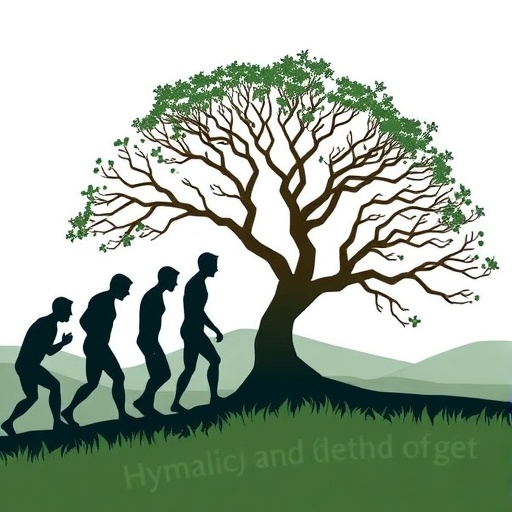
In recent decades, evolutionary biology has often been portrayed through simplified narratives that categorize species along a linear hierarchy, labeling some as “primitive” and others as “advanced.” Such interpretations, while intuitive to the layperson, distort the complexity of evolutionary processes and obscure the intricate relationships among the diverse forms of life on Earth. University of Maryland, Baltimore County biologist Kevin Omland addresses this pervasive misconception in his new book, Understanding the Tree of Life, bringing forth a compelling, genomics-informed reframing of how evolution operates. Published by Cambridge University Press as part of the “Understanding Life” series, this work dismantles outdated views that place humans at the narrative apex, instead depicting evolution as an ongoing, branching phenomenon that connects all organisms through shared ancestry.
Omland’s approach is deeply rooted in decades of empirical research and pedagogical experience. He highlights how evolution should be conceived not as a ladder striving toward complexity or superiority, but as an intricate tree whose branches represent continuous diversification and adaptation. The book synthesizes cutting-edge data from genomic studies, fossil records, and behavioral analyses, weaving them into a coherent framework accessible to both scientists and the general audience. This integrative perspective emphasizes that every species, whether a microbe or a mammal, occupies a unique position on the tree shaped by a dynamic interplay of ancient traits and novel innovations.
One of the core arguments Omland advances is that the notion of a species’ evolutionary “progress” is inherently misleading. He elucidates how all lineages have been subject to evolution for approximately the same length of time since their last common ancestors. This temporal parity underscores that “primitive” species are not relics frozen in time but are actively evolving entities tailored to their ecological niches. Leveraging genomic data, he demonstrates that processes such as mutation, selection, and genetic drift continuously shape every genome, thereby contesting any hierarchy that elevates one group over another.
A striking example featured in the book is the platypus, a monotreme often misconstrued as a primitive mammal because it lays eggs rather than giving live birth. Contrary to this reductive view, the platypus exhibits a suite of sophisticated adaptations including electroreception—allowing it to detect electrical signals from prey underwater—and venomous spurs employed for defense. This nuanced understanding challenges anthropocentric value judgments and illustrates how evolutionary developments must be contextualized within species-specific environments. Through such case studies, Omland encourages readers to reject simplistic binaries and appreciate the complexity and innovation inherent in all life forms.
Omland’s insights extend beyond anatomy and physiology to encompass behavioral evolution, particularly in avian species. His research into bird plumage and song evolution has yielded landmark findings, including evidence that female birdsong once existed in the common ancestor of all songbirds. This discovery overturned longstanding assumptions that female song was a derived trait or uncommon, revealing instead that many modern species have independently lost this behavior. Such pattern of gain and loss across evolutionary histories illustrates the non-linear, multifaceted nature of trait evolution, defying definitions that equate advancement with increased complexity or permanence.
The book further challenges the narrow dictionary definition of evolution as a mere accumulation of complexity. Instead, Omland presents a model where evolutionary history involves the gain, modification, and sometimes, the loss of traits. This is exemplified in tetrapods—four-limbed vertebrates—that evolved legs early on, only for some descendants like snakes and whales to lose them secondarily. Such evolutionary reversals reveal that adaptation is not a one-way trajectory towards greater sophistication but a dynamic process responsive to environmental pressures and organismal needs.
Central to Omland’s thesis is the idea of universal kinship, underscoring that humans are not the pinnacle but one of the countless branches diverging from ancient common ancestors. He poignantly reminds us that even our most distant human relatives are recent cousins in evolutionary terms, while our kinship with organisms as disparate as trees and bacteria extends over billions of years. This bio-centric worldview holds profound ethical implications—it urges humanity to recognize our interconnectedness with all life and to adopt a more respectful stewardship of the planet’s biodiversity.
Kevin Omland’s background as a dedicated educator is evident throughout Understanding the Tree of Life. The book is a direct response to the misconceptions he encountered among students grappling to reconcile everyday perceptions with scientific realities. These experiences motivated Omland to craft a narrative that dismantles erroneous hierarchical perspectives and replaces them with an appreciation for the tree’s branching diversity. By blending scientific rigor with accessible prose, the book invites readers to engage critically and empathetically with the evolutionary story.
Fellow evolutionary biologists endorse Omland’s contribution as both timely and transformative. Jonathan Losos, a distinguished scholar at Washington University in St. Louis, praises the book for its elegant fusion of evolutionary adaptations with the scientific methods that uncover life’s history. Similarly, David A. Baum from the University of Wisconsin–Madison commends Omland for clarifying and correcting widespread misinterpretations, both within professional circles and the public sphere. Stacey D. Smith of the University of Colorado Boulder echoes these sentiments, highlighting the book’s ability to reveal the beauty and complexity underlying phylogenetic trees and evolutionary narratives.
Understanding the Tree of Life stands out in its seamless integration of genomics with traditional evolutionary concepts. It elucidates how genome sequencing technologies have revolutionized our capacity to map phylogenetic relationships and unravel the origins of traits. This modern toolkit allows scientists to move beyond static classifications toward a dynamic understanding of life’s diversification, revealing unexpected connections and hidden histories. Omland’s exposition of these advances is meticulous yet accessible, enabling a wide audience to appreciate the sophistication of contemporary evolutionary biology.
In sum, Kevin Omland’s Understanding the Tree of Life challenges entrenched ideas about evolution’s directionality and human exceptionalism. It calls on readers to rethink the narrative of life not as a hierarchical ladder but a complex, ever-evolving network. This paradigm shift has broad implications for education, conservation, and our collective worldview. By embracing the scientific truths illuminated by genomics, fossil evidence, and behavioral studies, the book fosters a deeper respect for biodiversity and a renewed sense of kinship across all branches of life.
The book is now available globally through Cambridge University Press, major retailers, and independent bookstores. It promises to be a transformative resource for students, educators, naturalists, and scientists alike—inviting all who engage with it to see life through an enlightened, interconnected lens.
News Publication Date: Not specified in source content
Web References:
- Understanding Life series, Cambridge University Press
- Understanding the Tree of Life book page
- Amazon listing
- Omland’s paper on bird plumage and song evolution (2014)
- Omland’s research on bird evolution
Cite Scienmag News
Gavin Prescott. (September 18, 2025). New Book Debunks Common Misconceptions About Evolution and Humanity’s Role in the Tree of Life. Scienmag. https://scienmag.com/new-book-debunks-common-misconceptions-about-evolution-and-humanitys-role-in-the-tree-of-life/
Gavin Prescott. "New Book Debunks Common Misconceptions About Evolution and Humanity’s Role in the Tree of Life." Scienmag, 18 September 2025, https://scienmag.com/new-book-debunks-common-misconceptions-about-evolution-and-humanitys-role-in-the-tree-of-life/. Accessed 3 September 2026.
Gavin Prescott. "New Book Debunks Common Misconceptions About Evolution and Humanity’s Role in the Tree of Life." Scienmag. September 18, 2025. https://scienmag.com/new-book-debunks-common-misconceptions-about-evolution-and-humanitys-role-in-the-tree-of-life/


