


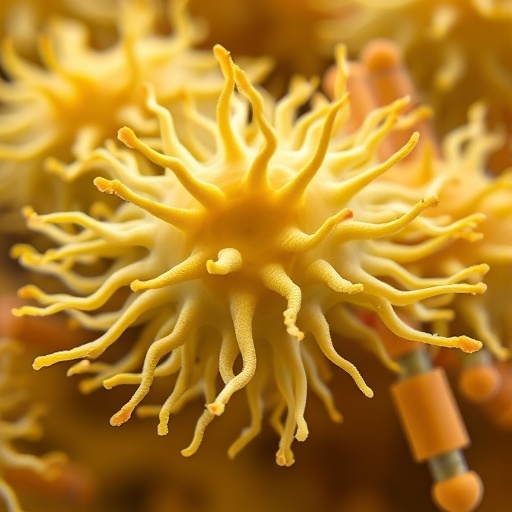
In the world of sustainable energy and environmental conservation, one of the most pressing challenges is the recycling of lithium-ion batteries. These batteries power everything from smartphones to electric vehicles and their rapid proliferation leads to a growing accumulation of spent batteries that pose both environmental and resource management challenges. Boston College researchers have unveiled a remarkable breakthrough leveraging a naturally occurring bacterium to address this twin crisis of battery proliferation and waste.
The bacterium, Acidithiobacillus ferrooxidans (Atf), is not your everyday microbe but rather an extremophile that thrives in highly acidic environments. What makes Atf extraordinary is its metabolic ability to generate protons that can effectively leach metals from spent batteries. This property opens up exciting avenues for bio-assisted recycling processes that could be self-sufficient and environmentally benign. By using Atf in cultures fueled by materials derived directly from spent batteries, researchers have demonstrated a novel, sustainable approach to recover valuable cathode materials.
Professor Dunwei Wang, a physical chemist specializing in clean energy, and Associate Professor Babak Momeni, whose expertise in microbial ecology and biological modeling complements the chemistry, led the research team. Their collective inquiry was focused on whether Atf could survive, grow, and perform its leaching functions using iron extracted from the batteries themselves. Iron is typically used as a casing in batteries, making it an abundant and practical food source for the bacterium in this context. Their findings confirmed that Atf not only thrives on iron-based substrates but that the resulting bio-leachate exhibits high activity in recycling cathode components.
One major hurdle in bioleaching has traditionally been the dependence on sulfate ions, which often require transportation and usage of hazardous chemicals on a large scale. The novel research challenges this paradigm by revealing that the metabolic activity of Atf does not significantly rely on sulfate presence. This reduction or elimination of sulfate dependence represents a significant step towards safer and more feasible biological recycling methods that minimize toxic byproducts and logistic complexities.
In an intriguing development, the research team investigated the use of stainless steel, a more common battery casing material in real-world applications, as a substrate for bacterial growth. Contrary to initial expectations, the complex mixture of metals and alloys in stainless steel actually enhanced bacterial activity more than pure iron substrates. This unexpected finding elevates the practical applicability of the method since stainless steel is widespread, potentially streamlining the bacterial recycling approach for diverse battery types.
Efforts to upcycle lithium-ion battery cathode materials have often been plagued by energy-intensive processes or the generation of harmful waste streams. This bio-driven leaching approach sidesteps these issues by harnessing Atf’s natural chemistry to selectively extract valuable metals under mild conditions, such as ambient temperature and pressure. The ability to cultivate bacteria directly on spent battery components turns waste into a growth medium, effectively marrying microbial metabolism and environmental stewardship.
Beyond the initial proof-of-concept, the team is pushing boundaries by attempting to evolve Atf strains with enhanced leaching efficiencies. Genetic and adaptive engineering strategies aim to boost the bacteria’s metabolic rate and metal tolerance, which could exponentially improve recycling yields. Their ambitious goal also includes constructing prototype batteries using recycled cathode materials sourced via the bacterial method, to verify that these biologically reclaimed components match or exceed the performance of virgin materials.
This research occupies a critical intersection of microbiology, materials science, and environmental chemistry, emphasizing an interdisciplinary approach to complex sustainability problems. By treating battery disposal as an opportunity for bioeconomic regeneration rather than a waste disposal challenge, the Boston College scientists pave the way for circular economies in battery manufacturing and recycling industries.
The implications extend far beyond laboratory benches. With electric vehicles and renewable energy storage systems projected to multiply in the coming decades, scalable and eco-friendly recycling methods are urgently needed. The Atf-based bioleaching technique reveals a promising path forward, potentially diminishing the environmental footprint of battery lifecycle management while sustaining resource availability for future innovations.
In summary, the breakthrough bacterium Acidithiobacillus ferrooxidans, with its unique metabolic capability to utilize battery materials as a food source and its independence from sulfate ions, offers a pioneering biological solution to lithium-ion battery recycling. The surprising efficacy of stainless steel substrates further empowers its real-world applicability. The ongoing enhancements in bacterial strains and prototype battery development hint at a near future where self-sufficient, clean, and efficient recycling of spent batteries becomes a reality.
This discovery signals a paradigm shift in how science approaches resource recovery, emphasizing symbiosis between technology and nature. It stands as a testament to the power of cross-disciplinary research in tackling the urgent demands of electrification and environmental responsibility in the 21st century.
Keywords
Acidithiobacillus ferrooxidans, lithium-ion battery recycling, bioleaching, sustainable resource management, microbial metabolism, cathode materials, stainless steel, environmental chemistry, clean energy, circular economy, microbial ecology, green technology
Cite Scienmag News
Morgan Morrow. (October 22, 2025). New Bacterium Harnesses Spent Battery Waste, Paving the Way for Self-Sufficient Battery Recycling. Scienmag. https://scienmag.com/new-bacterium-harnesses-spent-battery-waste-paving-the-way-for-self-sufficient-battery-recycling/
Morgan Morrow. "New Bacterium Harnesses Spent Battery Waste, Paving the Way for Self-Sufficient Battery Recycling." Scienmag, 22 October 2025, https://scienmag.com/new-bacterium-harnesses-spent-battery-waste-paving-the-way-for-self-sufficient-battery-recycling/. Accessed 5 September 2026.
Morgan Morrow. "New Bacterium Harnesses Spent Battery Waste, Paving the Way for Self-Sufficient Battery Recycling." Scienmag. October 22, 2025. https://scienmag.com/new-bacterium-harnesses-spent-battery-waste-paving-the-way-for-self-sufficient-battery-recycling/


