


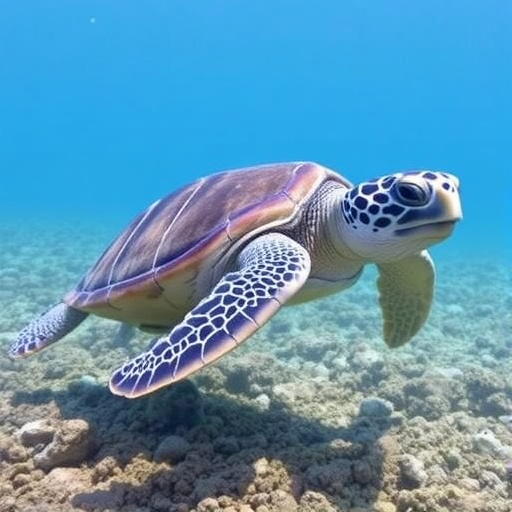
The conservation status of the Atlantic Ocean’s leatherback turtle populations has reached a critical juncture, prompting a groundbreaking international response. A newly formed coalition of leading researchers and conservation specialists, the Wilkes Atlantic Leatherback Turtle Alliance (WALTA), spearheaded by the University of Exeter, has emerged as a coordinated force dedicated to reversing the alarming decline of these ancient marine titans. This alliance unites over 50 partner organizations spanning 25 Atlantic-bordering nations, signaling an unprecedented level of global commitment to leatherback preservation.
Leatherback turtles (Dermochelys coriacea) are renowned for their vast migrations and unique biological traits, yet despite their formidable presence in marine ecosystems, they face escalating threats across the Atlantic. Globally classified as “vulnerable” by the International Union for Conservation of Nature (IUCN), the regional assessments paint a grimmer portrait. Sub-populations in the northwest Atlantic are deemed “endangered,” the southwest Atlantic leatherbacks suffer the “critically endangered” label, and the southeast Atlantic populations remain “data deficient,” underscoring gaps in crucial information. These designations underscore an urgent necessity for updated, comprehensive assessments that will inform strategic conservation priorities and interventions.
At the heart of WALTA’s initiative lies a commitment to filling critical knowledge voids by integrating ecological data with socio-economic considerations across the ocean basin. Their multidisciplinary approach will involve three pivotal assessments: first, a reassessment of leatherback nesting sites throughout the Atlantic to capture recent trends and fluctuations; second, an ocean-wide evaluation of fisheries bycatch — a predominant driver of mortality caused by entanglement in industrial and artisanal fishing gear; and third, the development of a scientifically grounded prioritization framework that guides targeted conservation measures based on threat severity and population vulnerability.
Professor Annette Broderick of Exeter’s Centre for Ecology and Conservation highlights the necessity of this endeavor, noting the previous resilience of Atlantic leatherback populations compared to their Pacific counterparts, which have experienced decades of decline. However, recent signals suggest that Atlantic populations are no longer insulated from similar pressures. A comprehensive understanding of how distinct regional populations respond to conservation practices and face anthropogenic threats is vital. This knowledge base will enable conservationists to deploy resources efficiently, safeguard key nesting grounds, and mitigate bycatch impacts where they are most pronounced.
Exeter’s researchers bring decades of experience studying leatherbacks in all regions of the Atlantic, collaborating intimately with local conservation entities, coastal communities, and governmental bodies. The alliance’s collaborative ethos extends across Europe, Africa, and the Americas, fostering a network capable of addressing leatherback conservation challenges from multiple political, ecological, and economic perspectives. Co-leader Professor Brendan Godley emphasizes the alliance’s timeliness, especially in an era marked by shrinking international research funding. WALTA aims to catalyze urgent conservation interventions by maintaining high-quality science while fostering political will and public engagement.
The leatherback turtles of the Atlantic confront a complex mosaic of threats beyond fisheries bycatch. Coastal development imperils nesting beaches through habitat destruction and fragmentation. The illegal harvesting of adult turtles and eggs, although more localized, compounds population declines. Climate change presents pervasive challenges by altering oceanic currents, nesting site temperatures, and sex ratios of hatchlings due to temperature-dependent sex determination. Additional hazards include vessel strikes, plastic pollution, and broader ecosystem degradation, all of which cumulatively jeopardize the species’ survival prospects.
Adrian Wilkes, representative of the Wilkes Sea Turtle Protection Fund, expresses grave concern that leatherbacks face the specter of extinction after surviving millions of years on Earth. His funding support underscores the alliance’s mission not merely to document leatherbacks’ decline but to implement actionable policies that ensure their survival. The alliance’s work, therefore, serves as a clarion call, urging governments, coastal communities, and the global fishing industry to align conservation actions with scientific evidence before irreversible losses occur.
Strategically, WALTA’s mission is explicit: to advance Atlantic leatherback protection through collaborative research, strategic action planning, and evidence-based advocacy. This approach acknowledges that conservation in a transoceanic, multinational context requires harmonized efforts grounded in the best available science and proactive policy frameworks. The alliance’s inclusive philosophy invites stakeholders from fishers to policymakers and donors, emphasizing that leatherback conservation transcends disciplinary and political boundaries.
The alliance is poised to leverage technological innovations, such as satellite telemetry to track migration routes, genetic analyses to identify population structure, and advanced modeling techniques to predict bycatch hotspots. This integration of novel methodologies will enhance the resolution and effectiveness of conservation strategies. Equally important is community engagement, which ensures that conservation plans are viable, culturally sensitive, and supported by those inhabiting leatherback coastal habitats.
As the world observes World Sea Turtle Day, the launch of WALTA represents a beacon of hope and a blueprint for marine species conservation that balances scientific rigor with collaborative action. The alliance’s proactive stance embodies a paradigm shift from reactive to anticipatory conservation, aiming to reverse declines and stabilize leatherback populations for future generations. The hope is that this united front will galvanize coordinated responses and generate the momentum necessary to safeguard these emblematic marine reptiles across the Atlantic basin.
In sum, the Wilkes Atlantic Leatherback Turtle Alliance emerges not only as a scientific consortium but as a strategic platform integrating multidisciplinary research, international cooperation, and community involvement. This holistic approach is essential to address the multifaceted perils leatherbacks face in the Atlantic Ocean. By prioritizing data-driven interventions and fostering shared responsibility among nations and stakeholders, WALTA stands as a critical driver in the global effort to save one of the ocean’s most iconic species from impending extinction.
News Publication Date: Announced on World Sea Turtle Day, 2024.
Web References: https://www.iucnredlist.org/species/6494/43526147
Cite Scienmag News
Drew Townsend. (June 16, 2026). New Alliance Formed to Safeguard Atlantic Leatherback Turtles on World Sea Turtle Day. Scienmag. https://scienmag.com/new-alliance-formed-to-safeguard-atlantic-leatherback-turtles-on-world-sea-turtle-day/
Drew Townsend. "New Alliance Formed to Safeguard Atlantic Leatherback Turtles on World Sea Turtle Day." Scienmag, 16 June 2026, https://scienmag.com/new-alliance-formed-to-safeguard-atlantic-leatherback-turtles-on-world-sea-turtle-day/. Accessed 3 September 2026.
Drew Townsend. "New Alliance Formed to Safeguard Atlantic Leatherback Turtles on World Sea Turtle Day." Scienmag. June 16, 2026. https://scienmag.com/new-alliance-formed-to-safeguard-atlantic-leatherback-turtles-on-world-sea-turtle-day/


