


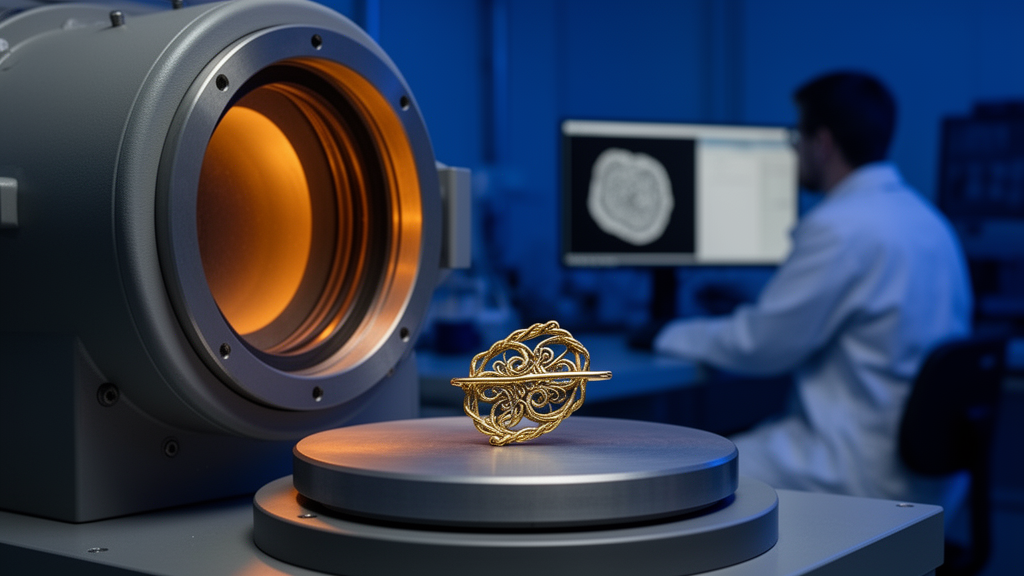
A 13th-century processional cross kept in the Museo del Duomo in Milan carries gilded silver filigree whose manufacturing secrets have now been probed with an unusual combination of tools: high-resolution neutron computed tomography, scanning electron microscopy with energy dispersive spectroscopy, and particle-transport simulations. In a study published in Discover Physics, researchers led by Klaudiusz Jakubowski of ANSTO and collaborators in Italy and Australia report a workflow that converts a segmented tomographic reconstruction of a filigree fragment from the Chiaravalle Cross directly into a Geant4 simulation geometry, and then uses that model to ask a deliberately modest question: how much mercury-rich material could hide inside the gilding without contradicting the measured neutron attenuation?
The fragment, roughly one by 0.5 centimetres and about 1.2 millimetres thick, was imaged at the Dingo thermal neutron imaging beamline at the Australian Centre for Neutron Scattering. The team used the PSI Neutron Microscope detector, coupling a high-numerical-aperture objective to a CMOS camera and a gadolinium oxysulphide scintillator screen, achieving an estimated radiographic resolution of approximately 6 to 8 micrometres depending on depth. The volume was reconstructed from 307 projections with an iterative algorithm, and the wire, solder joint and residual gilding were segmented in cropped regions of interest and exported as surface meshes without smoothing. Notably, the sapphire filter normally used to suppress fast neutrons was omitted, because it would have cut the thermal flux by roughly 45 percent and nearly doubled an acquisition that already took 4.5 days.
The central interpretive challenge is that attenuation values extracted from reconstructed tomography volumes are not simple material constants. They depend on partial-volume mixing at the voxel scale, on the heterogeneity of thickness within each region of interest, on the incident neutron spectrum, on scattered neutrons that still reach the detector, and on the energy-dependent response of the scintillator. These dependencies become acute for thin coatings such as fire gilding, in which a gold-mercury amalgam is applied to silver and heated to drive off most of the mercury. Residual mercury can persist in micron-scale regions, and because mercury has a far larger thermal-neutron capture cross section than gold, even small amounts can disproportionately raise attenuation.
To handle this, the authors first validated their pipeline on regions where the answer is comparatively simple. They computed spectrum-averaged effective attenuation coefficients from the simulations and compared them with ranges derived from 30 sampled regions of interest per component in the reconstruction. For the wire, the simulated value of 2.4 per centimetre fell within the measured range of 2.3 to 2.5 per centimetre; for the solder joint, the simulated 1.9 per centimetre matched the measured 1.9 to 2.1 per centimetre. After propagating composition, density, thickness and finite-count uncertainties, both regions agreed with the tomographic values within the combined uncertainty. Because the gadolinium-based scintillator’s energy-dependent efficiency was not modelled, the comparison carries a residual, unquantified systematic weighting, which the authors flag explicitly.
A two-factor decomposition then asked what drives the difference in attenuation between the wire and the solder joint, whose elemental compositions are broadly similar. By independently swapping geometry and composition across four simulation configurations, the team found a total difference of 0.543 per centimetre, of which the composition term contributed only minus 0.030 per centimetre, about minus 5.5 percent, while the geometry term contributed 0.572 per centimetre, about 105.5 percent. The two contributions act in opposite directions: the solder joint’s greater geometric heterogeneity and porosity dominate the contrast, while its slightly different composition partially offsets it. In other words, the wire–solder contrast is almost entirely a matter of shape, not chemistry.
The gilding is where the analysis becomes genuinely novel. Scanning electron microscopy on a related fragment from the same restoration revealed strong micro-scale compositional variability, including mercury-rich zones typical of amalgam gilding, with measured regions ranging from Au-rich, low-mercury compositions to areas containing roughly 50 percent mercury by weight. But those measurements come from a different fragment and are not co-registered with the imaged volume; they bound plausible compositions rather than describe the material along any given beam path. Moreover, the gold-mercury layer and the underlying silver-rich zone span a single continuous intensity range in the reconstruction and were segmented as one gilding volume, so partial-volume mixing with the substrate is unavoidable.
The team’s candidate compositions, each applied uniformly across the tomography-derived beam-direction path length of the gilding region, produced simulated attenuation coefficients spanning roughly 2.6 to 5.5 per centimetre. The measured gilding values, by contrast, cluster in a narrower interval of 3.1 to 3.8 per centimetre, a pattern consistent with voxel-scale averaging in a thin, discontinuous coating only two to three resolution elements thick. To quantify what that averaging could conceal, the authors built a patch-mixture forward model: the gilding region is treated as a two-component mixture of a low-mercury baseline and a mercury-rich endmember, whose transmissions combine linearly in the patch area fraction. They verified the linearity assumption with simplified slab simulations and then inverted the model against the measured attenuation range.
Using the Au-rich, low-mercury gilding composition as the baseline and a mercury-rich amalgam residue as the endmember, the model crosses the empirical upper edge of the measured interval at a patch fraction of 13.8 percent, with a 95 percent Monte Carlo endpoint-resampling interval of 11.7 to 15.8 percent. As a deliberately conservative sensitivity test, the comparison level was raised by one region-of-interest standard deviation, giving a conservative model-based bound of 24.3 percent. Under this endmember model, mercury-rich residues occupying up to roughly a quarter of the analysed surface-adjacent gilding region would remain compatible with the observed attenuation. The authors stress that this is not a formal confidence limit: the baseline-only case already reproduces the measurement, so no mercury-rich patches are required by the data, and the inversion is one-sided.
The bound is also conditional in ways the paper enumerates carefully. It depends on the chosen endmember pair; of six technologically motivated pairings tested, only two were admissible, and four baseline compositions already exceeded the comparison level before any mercury was added. Endmember, segmentation, detector-response and scattering systematics were not jointly propagated, and no independent layer-thickness measurement such as micro-XRF was available to constrain the path lengths. What the result establishes is a detectability limit rather than a detection: enrichment at this level, were it present, would remain masked by region-averaged attenuation statistics. The authors argue that Monte Carlo modelling of heritage objects is most robust when used for exactly this kind of sensitivity analysis and bounding, rather than for attempting a unique inversion of composition from averaged tomography data, and their CT-to-mesh-to-Geant4 workflow offers a reusable template for other dense metallic artefacts whose chemically heterogeneous surface layers sit at or below the limits of tomographic resolution.
Subject of Research: Monte Carlo modelling of neutron attenuation to bound mercury-rich amalgam gilding in a medieval filigree fragment
Article Title: Monte Carlo bounds on Hg-rich amalgam gilding in high-resolution neutron tomography of medieval filigree
Article References: Jakubowski, K., Vigorelli, L., Salvemini, F., Marcucci, G., Cucini, C., Riccardi, M. P., Di Martino, D., & Safavi-Naeini, M. (2026). Monte Carlo bounds on Hg-rich amalgam gilding in high-resolution neutron tomography of medieval filigree. Discover Physics, 2(1), Article 16. https://doi.org/10.1007/s44418-026-00016-w
Image Credits: AI Generated
DOI: 10.1007/s44418-026-00016-w
Keywords: neutron tomography, Monte Carlo simulation, Geant4, cultural heritage, amalgam gilding, mercury, Chiaravalle Cross, filigree, SEM-EDS, attenuation coefficient, partial-volume effects, ANSTO Dingo beamline
Cite Scienmag News
Katie Riggs. (October 27, 2026). Neutron Tomography and Simulations Bound Hidden Mercury in Medieval Gilded Filigree. Scienmag. https://scienmag.com/neutron-tomography-and-simulations-bound-hidden-mercury-in-medieval-gilded-filigree/
Katie Riggs. "Neutron Tomography and Simulations Bound Hidden Mercury in Medieval Gilded Filigree." Scienmag, 27 October 2026, https://scienmag.com/neutron-tomography-and-simulations-bound-hidden-mercury-in-medieval-gilded-filigree/. Accessed 27 October 2026.
Katie Riggs. "Neutron Tomography and Simulations Bound Hidden Mercury in Medieval Gilded Filigree." Scienmag. October 27, 2026. https://scienmag.com/neutron-tomography-and-simulations-bound-hidden-mercury-in-medieval-gilded-filigree/


