


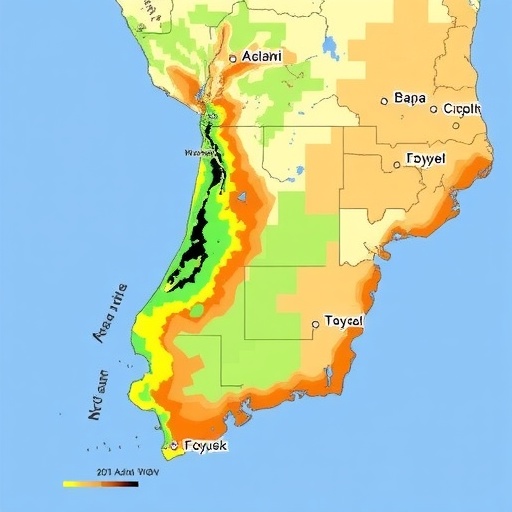
Along the Atlantic and Gulf coasts of the United States, marshes are disappearing at the edges—one collapsing bank, drowned grass platform and retreating shoreline at a time. Yet their loss may be doing more than reshaping beaches and estuaries. A new study by C.A. Di Vittorio, C. Braneon, A. Romanou and colleagues examines how erosion moves carbon out of coastal marshes, revealing why the climate importance of these ecosystems cannot be measured simply by counting the carbon stored in their soils. The research, published in Communications Earth & Environment, focuses on a process known as net lateral carbon export: the movement of carbon sideways from marsh landscapes into adjoining waters and sediments as coastlines erode.
Coastal marshes are widely celebrated as “blue carbon” ecosystems because they remove carbon dioxide from the atmosphere through photosynthesis and bury a portion of the resulting organic matter in waterlogged soils. Unlike many terrestrial soils, marsh sediments can preserve plant-derived carbon for centuries or longer because oxygen is limited below the surface. That apparent climate benefit, however, depends on whether the carbon remains buried. When storms, rising seas, tidal currents and gradual shoreline retreat tear apart a marsh, carbon-rich soil is exposed, transported and transformed. Some of it may settle in nearby estuaries, while some may be carried offshore or converted into gases that eventually return carbon to the atmosphere.
The distinction between carbon storage and carbon export is crucial. A marsh can contain enormous quantities of carbon in its soil while simultaneously losing part of that stock through erosion. Traditional “blue carbon” accounting often emphasizes vertical burial—the accumulation of new sediment and organic matter from the surface downward. But marshes are also three-dimensional, dynamic landscapes. Carbon enters from the atmosphere and plants, moves downward into sediment, and travels laterally through creeks, tidal channels and eroding shorelines. The new study centers on that overlooked horizontal pathway, asking how much carbon is being displaced as marshes along the U.S. Atlantic and Gulf coasts retreat.
The researchers’ focus covers two of the country’s most extensive and environmentally significant coastal regions. Atlantic and Gulf Coast marshes include salt marshes, tidal wetlands and low-lying estuarine habitats that sit at the boundary between land and sea. These landscapes are exposed to different combinations of sea-level rise, wave action, hurricanes, river discharge, tidal range and human disturbance. Their vulnerability is also shaped by the availability of sediment. If incoming sediment can keep pace with rising water levels, a marsh may build upward or migrate inland. If the shoreline erodes faster than the ecosystem can expand, the carbon-rich platform can be progressively dismantled.
When marsh soil is eroded, the carbon it contains does not follow a single path. Larger fragments of roots and plant debris may be deposited nearby, where they can remain buried under low-oxygen conditions. Fine particles can be suspended in the water column and transported through tidal channels. Dissolved organic carbon may travel invisibly with the flow, while microbial activity can convert some organic material into carbon dioxide or methane. The ultimate fate of exported carbon depends on its chemical form, how long it remains in storage, where it is deposited and whether it is exposed to oxygen. For climate accounting, these distinctions determine whether erosion represents a temporary relocation of carbon or a pathway toward long-term atmospheric release.
That complexity makes the study’s regional perspective especially important. Measuring one eroding marsh can reveal the mechanics of carbon loss, but it cannot by itself establish the climate consequences of erosion across thousands of kilometers of coastline. A regional assessment must connect marsh area, soil carbon density, rates of shoreline retreat and the movement of sediment and organic matter through coastal waters. By examining Atlantic and Gulf Coast marshes together, the researchers place individual erosion events within a broader carbon budget. The approach highlights a central challenge in Earth-system science: a process that looks local on the ground can become globally relevant when repeated across a vast and densely populated coastline.
The findings also complicate the popular image of marshes as straightforward climate solutions. Protecting wetlands remains valuable for many reasons. Marshes reduce wave energy, provide habitat for fish and birds, filter pollutants, store water and help shield communities from flooding. Their vegetation can also capture carbon from the atmosphere. But the study’s emphasis on net lateral export shows that carbon benefits are not permanent or automatic. A wetland may continue absorbing carbon while its edges release older, previously buried carbon into the coastal system. The balance between these opposing flows determines whether the marsh is functioning as a net carbon sink, a weaker sink or, under some conditions, a source.
The research has implications for how governments and conservation organizations evaluate coastal restoration. Projects that plant vegetation without addressing shoreline instability may improve habitat while leaving the underlying carbon store vulnerable. More durable strategies can include restoring sediment delivery, reconnecting wetlands with natural tidal flows, conserving undeveloped land behind marshes so ecosystems can migrate inland, and using living shorelines to reduce wave energy without sealing the coast behind hard infrastructure. Such measures do not eliminate sea-level rise or storms, but they may slow the erosion that mobilizes buried carbon and give marshes more time to adjust.
The study also arrives as coastal carbon accounting is becoming increasingly important in climate policy. Nations, states and companies are seeking reliable ways to quantify nature-based climate benefits, but carbon moved through coastal waters is difficult to track. Satellite imagery can reveal changing marsh boundaries, field measurements can estimate soil carbon, and hydrological and biogeochemical models can simulate transport. Yet uncertainty remains over how much exported carbon is redeposited, how quickly it decomposes and how much ultimately reaches the atmosphere. By identifying net lateral export as a measurable component of coastal carbon budgets, Di Vittorio and colleagues point toward more complete assessments of wetland climate services—assessments that account not only for what marshes capture, but also for what erosion carries away.
The broader message is both urgent and scientifically nuanced: saving coastal marshes is not just about preserving green landscapes at the water’s edge. It is about protecting a living carbon system whose stores, flows and climate effects are constantly being rearranged by tides, storms, sediment and rising seas. The Atlantic and Gulf Coast marshes are laboratories of that transformation, and their retreat offers a visible warning of what happens when carbon-rich ecosystems lose ground. As erosion accelerates in vulnerable locations, understanding the carbon exported from marshes will be essential for honest climate accounting—and for deciding which coastal ecosystems can still be protected before their buried carbon becomes part of the ocean’s rapidly changing carbon cycle.
Cite Scienmag News
Violet Maxwell. (August 13, 2026). Net Carbon Export from Eroding U.S. Atlantic and Gulf Coast Marshes. Scienmag. https://scienmag.com/net-carbon-export-from-eroding-u-s-atlantic-and-gulf-coast-marshes/
Violet Maxwell. "Net Carbon Export from Eroding U.S. Atlantic and Gulf Coast Marshes." Scienmag, 13 August 2026, https://scienmag.com/net-carbon-export-from-eroding-u-s-atlantic-and-gulf-coast-marshes/. Accessed 4 September 2026.
Violet Maxwell. "Net Carbon Export from Eroding U.S. Atlantic and Gulf Coast Marshes." Scienmag. August 13, 2026. https://scienmag.com/net-carbon-export-from-eroding-u-s-atlantic-and-gulf-coast-marshes/


