


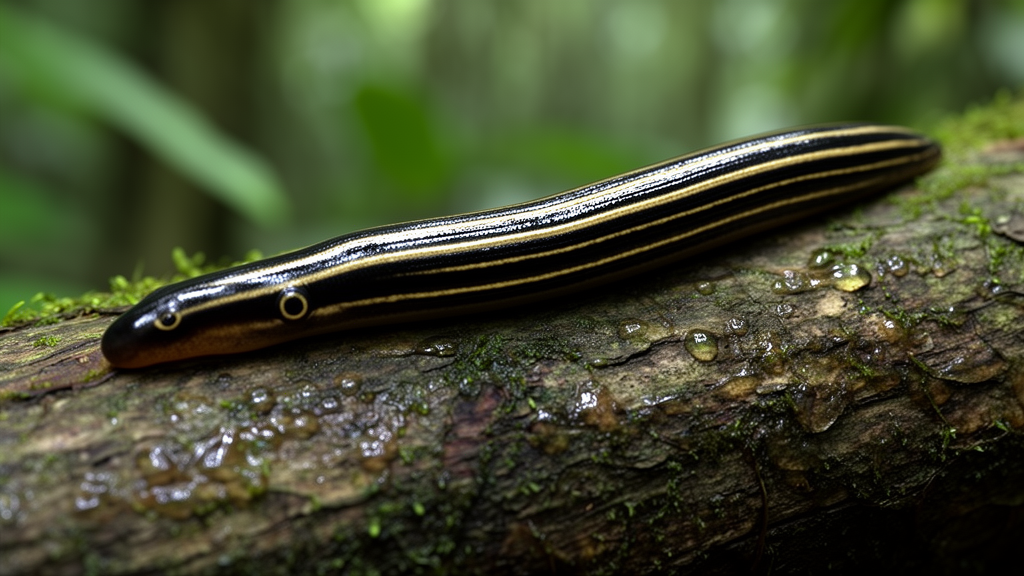
In the damp leaf litter of southern Brazil’s gardens and forest edges lives a flatworm that can rebuild itself from pieces. A new study published in Neotropical Biology and Conservation has examined, for only the second time in nearly a century, how a Neotropical land planarian regenerates its body after being cut in two, and the results suggest these soil-dwelling predators are far more resilient than their exclusively sexual lifestyle would predict.
Planarians, a group of flatworms in the order Tricladida, are famous in biology classrooms and regeneration laboratories alike for their ability to regrow missing body parts. Freshwater species have been studied intensively for decades, and the secret lies in neoblasts, a population of pluripotent stem cells scattered throughout the parenchyma, the loose tissue filling the body. These cells allow many freshwater planarians to regenerate a complete organism from tiny fragments, a capacity so dramatic that it has made them model organisms for studying stem cells and tissue patterning.
Land planarians, the family Geoplanidae, are the sister group of the freshwater planarians most commonly used in regeneration research. Yet their regenerative abilities remain poorly documented. Charles Darwin himself noted in 1844 that land planarians could regrow missing parts when cut in half, and some invasive species such as Bipalium kewense reproduce asexually by fission, relying on regeneration to complete each new individual. But Neotropical land planarians, the subfamily Geoplaninae native to Central and South America, have never been observed reproducing asexually, leading researchers to expect a diminished regenerative capacity compared with their fission-prone relatives.
To test this expectation, researchers collected specimens of Luteostriata abundans, a land planarian common in human-disturbed habitats in the state of Rio Grande do Sul, Brazil. The species reproduces only sexually, making it an ideal candidate to probe whether regeneration depends on asexual reproductive habits. In the laboratory, 35 animals were used: nine were left intact as controls, and 26 were cut transversely with a razor blade at three different points along the body, producing anterior and posterior fragments with and without key organs such as the pharynx, the feeding organ, and the gonopore.
The pieces were monitored twice a week for 50 days. The researchers measured each animal’s length and width while creeping and calculated body size as the area of an ellipse, a reasonable approximation that kept comparisons consistent across groups. Each specimen received two neotropical woodlice as food after every measurement. Statistical analyses included Kruskal-Wallis tests for group comparisons, Kaplan-Meier survival curves with log-rank tests for survival and feeding timing, and Cox proportional hazards regression to account for initial size.
The results revealed a clear pattern of asymmetry along the body’s length. Anterior fragments survived better than posterior ones, with every piece cut behind the gonopore but retaining the head end surviving the full 50 days, while only two of the smallest posterior tail pieces lived that long. Cox regression showed that survival was explained by treatment group rather than initial size alone, hinting that position along the anteroposterior axis matters independently of how large a fragment is. This aligns with a well-known trend in many planarian groups, where regenerative capacity declines toward the posterior end, particularly the ability to regenerate a head.
Feeding behavior told a subtler story. Anterior fragments that retained the pharynx continued to eat normally, essentially as intact animals. Posterior fragments that kept the pharynx, however, lost its function temporarily, and half of them went the entire 50 days without ingesting food. The researchers attribute this to the loss of the head ganglia, the nerve centers that appear to control pharyngeal function, a pattern also documented in freshwater planarians of the families Dugesiidae and Planariidae. Interestingly, the pharynx itself was retained rather than shed and rebuilt, distinguishing Luteostriata from the Chilean species Pseudogeoplana pulla studied by Goetsch in 1933, where posterior pieces discarded the organ and constructed a new one.
Perhaps the most striking finding concerned the pieces that lost both mouth and pharynx entirely. Anterior mouthless fragments regenerated these structures significantly faster than posterior fragments, consistent with the idea that the pharynx, one of the few planarian organs lacking resident neoblasts, must be rebuilt by stem cells migrating from elsewhere in the body and then integrated with the nervous system to function. By the end of the monitoring period, the relative position of the mouth along the body had returned to values close to those of intact animals in all surviving regenerating pieces, suggesting that every fragment, anterior or posterior, retained the blueprint needed to reconstitute a proportionally complete organism.
Growth rates across the 50 days were statistically similar among all groups, but the largest fragments, those containing the head, mouth, and gonopore, showed the greatest proportional size increase in the first 26 days, likely because they needed to regenerate only a small tail region before resuming normal growth. The authors note that their study is preliminary, limited to a single cut per animal and external observation of live specimens, but the implications are considerable. If Luteostriata abundans can regenerate a whole organism from both anterior and posterior fragments despite reproducing only sexually, then high regenerative capacity may be a shared trait of the superfamily Geoplanoidea, which unites land planarians with their freshwater dugesiid relatives, rather than a specialization of asexual species.
The findings also raise evolutionary questions about why Neotropical land planarians never evolved fission despite possessing the cellular machinery for remarkable regeneration. Understanding whether their neoblast distribution differs from that of asexual species, or whether differentiated tissues provide the patterning cues that constrain or enable rebuilding, could clarify how regeneration and reproductive strategy interact. For now, the humble garden flatworm of southern Brazil joins a small but growing roster of land planarians demonstrating that the famous planarian superpower extends well beyond the laboratory aquarium, thriving quietly under logs and leaf litter where few have thought to look.
Subject of Research: Regeneration capacity of the Neotropical land planarian Luteostriata abundans
Article Title: Regeneration in a Neotropical land planarian ( Platyhelminthes , Tricladida )
Article References: Boll, P. K., Rossi, I., Amaral, S. V. D., & Leal-Zanchet, A. M. (2023). Regeneration in a Neotropical land planarian (Platyhelminthes, Tricladida). Neotropical Biology and Conservation, 18(3), 163-176. https://doi.org/10.3897/neotropical.18.e103357
Image Credits: AI Generated
DOI: 10.3897/neotropical.18.e103357
Keywords: planarians, regeneration, Luteostriata abundans, land planarians, neoblasts, flatworms, Geoplanidae, Neotropical biology, stem cells, pharynx regeneration, asexual reproduction, Brazil
Cite Scienmag News
Drew Townsend. (October 19, 2026). Neotropical Land Planarian Reveals Surprising Regeneration Powers. Scienmag. https://scienmag.com/neotropical-land-planarian-reveals-surprising-regeneration-powers/
Drew Townsend. "Neotropical Land Planarian Reveals Surprising Regeneration Powers." Scienmag, 19 October 2026, https://scienmag.com/neotropical-land-planarian-reveals-surprising-regeneration-powers/. Accessed 19 October 2026.
Drew Townsend. "Neotropical Land Planarian Reveals Surprising Regeneration Powers." Scienmag. October 19, 2026. https://scienmag.com/neotropical-land-planarian-reveals-surprising-regeneration-powers/


