


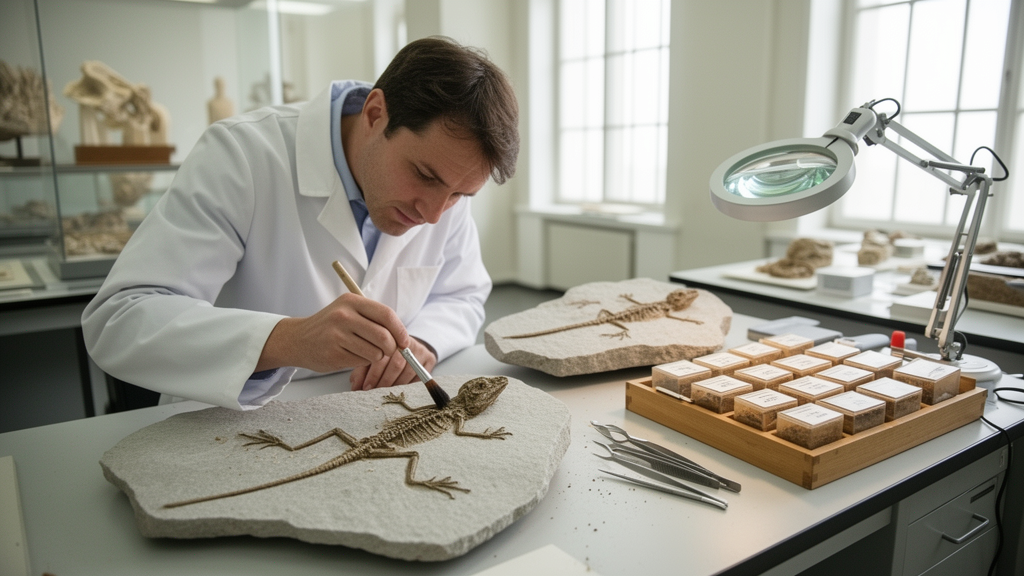
A collection of lizard fossils that paleontologists long believed to be lost has resurfaced and been reanalyzed, reshaping what scientists know about the earliest days of Europe’s Cenozoic ecosystems. The material comes from Walbeck, a fissure filling in Sachsen-Anhalt, Germany, excavated in 1939, when roughly fifteen tons of sediment yielded about 15,000 vertebrate specimens from a single small karstic pocket. Walbeck remains the only known Paleocene fossil site in Germany and one of the very few in Europe, making it a rare window into a poorly documented chapter of Earth history roughly 60 million years ago.
The mammal fauna at Walbeck allows the vertebrate assemblage to be correlated with the middle Selandian age, corresponding to the European Paleogene mammal reference interval MP 5. The fossil-bearing sediments were reworked by a transgressing Oligocene sea and deposited in protected fissures within Muschelkalk limestone. Although some reworking occurred, all previous studies concluded that the continental vertebrates are genuinely Paleocene in age. Because the pocket was fully excavated and cannot be recollected, every surviving specimen carries outsized scientific weight.
In 1940, Otto Kuhn described several lizard taxa from this material, including an isolated dentary he named aff. Parasauromalus paleocenicus, which he assigned to the iguanians, and another form he called aff. Glyptosaurus walbeckensis, which he placed among the anguimorphs. Kuhn did not use collection numbers, figured only a few specimens, and provided limited descriptions, so the identity and allocation of his specimens remained murky. The collection was widely considered lost for decades, yet it continued to be cited in the literature because of its importance for understanding the Paleocene.
The new study, published in the journal Fossil Record, reports the rediscovery and reexamination of part of Kuhn’s original material, now housed at the Institut für Geologische Wissenschaften und Geiseltalmuseum of the Martin-Luther-Universität Halle-Wittenberg. Using high-resolution digital light microscopy, micro-computed tomography, and a large morphological data matrix analyzed with maximum parsimony, the researchers reassessed the anatomy and relationships of these enigmatic jaws. The results overturn both of Kuhn’s original assignments and clarify the roots of modern European lizard faunas.
The first major finding concerns aff. Parasauromalus paleocenicus. The dentary on which the name was based, specimen MLU.GeoS.4059, clearly does not belong to an iguanian. Instead, it exhibits hallmark features of the family Lacertidae, including a well-developed sulcus dentalis and the characteristic lateral overlap of the dentary by the coronoid. Its teeth are heterodont, shifting from monocuspid anteriorly to bicuspid posteriorly, with weak striations and sometimes a faint lingual cusp, a pattern typical of lacertids. Because the original material cannot be confidently diagnosed, the name is now treated as a nomen dubium, but the specimen itself stands as strong evidence that lacertids were already present in Europe around MP 5, consistent with molecular clock estimates placing the origin of crown lacertids in the Paleocene or near the Cretaceous-Paleogene boundary.
The second taxon proved even more consequential. Aff. Glyptosaurus walbeckensis, originally thought to be a glyptosaurid and later variously interpreted as a lacertid or a possible amphisbaenian, turns out to be identical to Camptognathosaurus parisiensis, a form described in 2013 from slightly younger French localities such as Rivecourt-Petit Pâtis and Cernay-lès-Reims. Under the principle of priority of the International Code of Zoological Nomenclature, Kuhn’s 1940 name takes precedence, so the French species becomes a junior synonym and the animal now bears the new combination Camptognathosaurus walbeckensis. Because the specimen Kuhn figured could not be relocated among the surviving material, the team designated a neotype, an almost complete left dentary catalogued as MLU.GeoS.4045.
The anatomy of Camptognathosaurus is striking. The dentaries bear ten to twelve robust, blunt, amblyodont teeth that increase in size toward the rear of the jaw, lack an angle at the mandibular symphysis, and carry five or six labial foramina. The maxillae show a long posteroventral process and possibly a jugal, features unknown in modern amphisbaenians. Taken together, these traits contradict an amphisbaenian identity: modern worm lizards typically have fewer teeth, a kinked symphyseal margin, shallowly pleurodont implantation, and their largest crushing teeth positioned anteriorly rather than posteriorly. The mandibular lever mechanics of Camptognathosaurus instead resemble those of durophagous lacertids such as the Oligocene Dracaenosaurus and Pseudeumeces.
Phylogenetic analysis reinforced this reinterpretation. In the parsimony analysis, Camptognathosaurus walbeckensis was consistently recovered as a lacertid, never as an amphisbaenian, emerging as sister to the extant Canary Island lizard Gallotia atlantica, though the authors caution that support values are low and the taxon is known only from jaw fragments. The analysis also placed the Eocene Messel form Cryptolacerta hassiaca as sister to Lacerta, further supporting the view that early Paleogene Europe hosted a genuine radiation of pan-lacertids, a mixture of stem and crown members, rather than only archaic lineages distantly related to the modern family.
Ecologically, the amblyodont dentition of Camptognathosaurus points to a durophagous specialist, likely crushing hard-shelled invertebrates, although such teeth do not necessarily indicate an exclusively mollusk-based diet. This is notable because no living lacertid possesses amblyodont dentition today. The finding suggests that early members of the clade experimented with a far broader range of ecological roles than their modern descendants, from semifossorial forms like Cryptolacerta to large terrestrial species, before most of these lineages went extinct and only the crown group survived to radiate in the Neogene.
The Walbeck assemblage also yielded two maxillae provisionally assigned to Scincoidea, the clade containing skinks and their relatives, identified by transversely bicuspid teeth whose lingual cusps are framed by broad cristae. Isolated dorsal vertebrae were likewise referred to Lacertidae, and the authors note that Kuhn’s original identification of a vertebra as the varanoid Saniwa aff. ensidens cannot be upheld, pushing the oldest European record of Saniwa forward to the earliest Eocene locality of Dormaal. Overall, the fauna shows low diversity compared with earliest Eocene sites, supporting the view that squamates were rare and poorly diverse during the Paleocene, while confirming that lacertids, not amphisbaenians, likely dominated the European Paleocene lizard fauna. Together with French occurrences of the same genus, the distribution of Camptognathosaurus hints that northern France and Germany may have formed a single paleogeographic unit at the time, although overwater dispersal, well documented in lizards, cannot be excluded.
Subject of Research: Taxonomic revision of Paleocene lizard fossils from Walbeck, Germany, and their implications for early European lacertid evolution
Article Title: Roots of the European Cenozoic ecosystems: lizards from the Paleocene (~MP 5) of Walbeck in Germany
Article References: Čerňanský, A., & Vasilyan, D. (2024). Roots of the European Cenozoic ecosystems: lizards from the Paleocene (~MP 5) of Walbeck in Germany. Fossil Record, 27(1), 159-186. https://doi.org/10.3897/fr.27.109123
Image Credits: AI Generated
DOI: 10.3897/fr.27.109123
Keywords: Paleocene, Walbeck, lizards, Lacertidae, Camptognathosaurus, Amphisbaenia, paleontology, Germany, Fossil Record, taxonomy, Cenozoic, durophagy
Cite Scienmag News
Violet Maxwell. (October 19, 2026). Lost Fossil Lizards from a German Paleocene Site Rewritten After Eight Decades. Scienmag. https://scienmag.com/lost-fossil-lizards-from-a-german-paleocene-site-rewritten-after-eight-decades/
Violet Maxwell. "Lost Fossil Lizards from a German Paleocene Site Rewritten After Eight Decades." Scienmag, 19 October 2026, https://scienmag.com/lost-fossil-lizards-from-a-german-paleocene-site-rewritten-after-eight-decades/. Accessed 19 October 2026.
Violet Maxwell. "Lost Fossil Lizards from a German Paleocene Site Rewritten After Eight Decades." Scienmag. October 19, 2026. https://scienmag.com/lost-fossil-lizards-from-a-german-paleocene-site-rewritten-after-eight-decades/


