


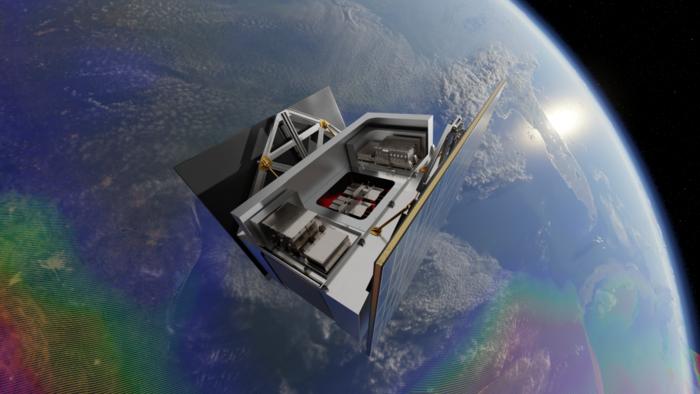
NASA has selected a team of University of Florida aerospace engineers to pursue a groundbreaking $12 million mission aimed at improving the way we track changes in Earth’s structures, such as tectonic plates and oceans.

Credit: Simon Barke/UF
NASA has selected a team of University of Florida aerospace engineers to pursue a groundbreaking $12 million mission aimed at improving the way we track changes in Earth’s structures, such as tectonic plates and oceans.
The mission, titled “GRATTIS” (Gravitational Reference Advanced Technology Test in Space), was the sole proposal selected in a national competition.
GRATTIS will demonstrate the performance of state-of-the-art sensors that measure nanometer-scale gravitational changes from space to monitor movements on the Earth’s surface and interior.
“UF is committed to being a leader in space exploration, and this is a perfect example of how our researchers are advancing humanity’s understanding of the world and the larger universe,” said UF President Ben Sasse. “We’re thrilled to support our research team as they push the limits of human curiosity and innovation.”
Over the next few years, the team led by principal investigator John Conklin, Ph.D., a professor in the Department of Mechanical and Aerospace Engineering, will focus on finalizing the sensor technology and integrating it into the spacecraft. The launch is anticipated to occur around 2027 aboard a SpaceX Falcon 9 rocket, with subsequent operations managed by UF’s mission operations team.
“Our technology will provide vital insights into the movement of water and ice across the planet,” Conklin said. “This data is essential for monitoring droughts, assessing groundwater reserves, and understanding the impact of melting ice sheets on sea levels.”
The project marks a significant milestone for UF’s aerospace program, which also has spearheaded advancements in areas like space propulsion and gravitational wave instrumentation. It closely aligns with the vision for the new UF Space Institute, which is working to advance space science by harnessing the university’s vast array of space-related research from across academic disciplines.
“The GRATTIS mission builds on prior successes and underscores the university’s role as a leader in space science and engineering,” said Forrest Masters, Ph.D., interim dean of the Herbert Wertheim College of Engineering.
Conklin said the GRATTIS mission involves a collaborative effort with several key partners.
“This mission is a testament to the dedication and collaboration of researchers at the University of Florida, Texas A&M University, Embry-Riddle Aeronautical University, and industry partners such as CrossTrac Engineering, BAE Systems, Fibertek Inc., and Apex Space,” he said.
GRATTIS is poised to pave the way for future NASA Earth science missions, with implications extending well into the coming decades.
“We are excited to see our work transition from the lab to space and contribute to advancing our understanding of Earth’s dynamic processes,” Conklin said.
NASA has selected a team of University of Florida aerospace engineers to pursue a groundbreaking $12 million mission aimed at improving the way we track changes in Earth’s structures, such as tectonic plates and oceans.
The mission, titled “GRATTIS” (Gravitational Reference Advanced Technology Test in Space), was the sole proposal selected in a national competition.
GRATTIS will demonstrate the performance of state-of-the-art sensors that measure nanometer-scale gravitational changes from space to monitor movements on the Earth’s surface and interior.
“UF is committed to being a leader in space exploration, and this is a perfect example of how our researchers are advancing humanity’s understanding of the world and the larger universe,” said UF President Ben Sasse. “We’re thrilled to support our research team as they push the limits of human curiosity and innovation.”
Over the next few years, the team led by principal investigator John Conklin, Ph.D., a professor in the Department of Mechanical and Aerospace Engineering, will focus on finalizing the sensor technology and integrating it into the spacecraft. The launch is anticipated to occur around 2027 aboard a SpaceX Falcon 9 rocket, with subsequent operations managed by UF’s mission operations team.
“Our technology will provide vital insights into the movement of water and ice across the planet,” Conklin said. “This data is essential for monitoring droughts, assessing groundwater reserves, and understanding the impact of melting ice sheets on sea levels.”
The project marks a significant milestone for UF’s aerospace program, which also has spearheaded advancements in areas like space propulsion and gravitational wave instrumentation. It closely aligns with the vision for the new UF Space Institute, which is working to advance space science by harnessing the university’s vast array of space-related research from across academic disciplines.
“The GRATTIS mission builds on prior successes and underscores the university’s role as a leader in space science and engineering,” said Forrest Masters, Ph.D., interim dean of the Herbert Wertheim College of Engineering.
Conklin said the GRATTIS mission involves a collaborative effort with several key partners.
“This mission is a testament to the dedication and collaboration of researchers at the University of Florida, Texas A&M University, Embry-Riddle Aeronautical University, and industry partners such as CrossTrac Engineering, BAE Systems, Fibertek Inc., and Apex Space,” he said.
GRATTIS is poised to pave the way for future NASA Earth science missions, with implications extending well into the coming decades.
“We are excited to see our work transition from the lab to space and contribute to advancing our understanding of Earth’s dynamic processes,” Conklin said.
Cite Scienmag News
Grant Pearson. (May 9, 2024). NASA selects UF mission to better track the Earth’s water and ice. Scienmag. https://scienmag.com/nasa-selects-uf-mission-to-better-track-the-earths-water-and-ice/
Grant Pearson. "NASA selects UF mission to better track the Earth’s water and ice." Scienmag, 9 May 2024, https://scienmag.com/nasa-selects-uf-mission-to-better-track-the-earths-water-and-ice/. Accessed 5 September 2026.
Grant Pearson. "NASA selects UF mission to better track the Earth’s water and ice." Scienmag. May 9, 2024. https://scienmag.com/nasa-selects-uf-mission-to-better-track-the-earths-water-and-ice/

