

Sunday, July 26, 2026
Science
No Result
View All Result
  • Login
  • HOME
  • SCIENCE NEWS
  • CONTACT US
  • HOME
  • SCIENCE NEWS
  • CONTACT US
No Result
View All Result
Scienmag
No Result
View All Result
Home Science News Technology and Engineering

Multifunctional Titanium Oxynitride Layers Power High-Performance Perovskite-Silicon Tandem Solar Cells

July 26, 2026
in Technology and Engineering
Reading Time: 2 mins read
0
Multifunctional Titanium Oxynitride Layers Power High-Performance Perovskite-Silicon Tandem Solar Cells

Multifunctional Titanium Oxynitride Layers Power High-Performance Perovskite-Silicon Tandem Solar Cells

65
SHARES
587
VIEWS
Share on FacebookShare on Twitter
ADVERTISEMENT

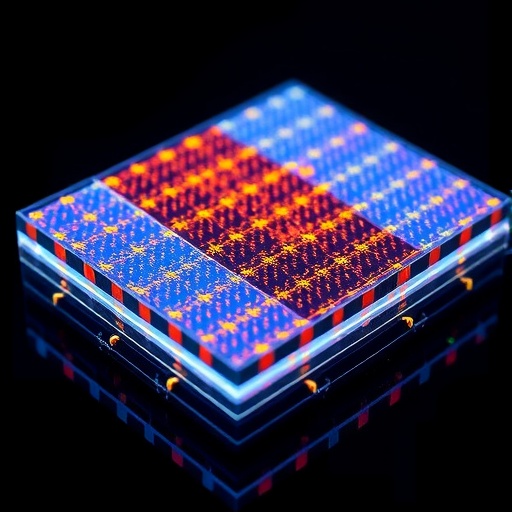
Monolithic perovskite/silicon tandem solar cells are widely viewed as a route to eclipse the efficiency ceilings of single-junction photovoltaics. Yet turning laboratory breakthroughs into durable, scalable modules hinges on a single thin layer: the recombination interconnect between the subcells. This layer must simultaneously promote rapid charge recombination, remain optically transparent for incoming light, and form a chemically robust interface that resists degradation over time.

A persistent challenge is that many high-performing indium-containing transparent conductive oxides (TCOs) raise cost and sustainability concerns, while silicon-based tunnel junctions can introduce parasitic optical losses. In a new study in Nature Energy, researchers report an alternative strategy built on titanium oxynitride, TiOxNy, designed to unify electrical, optical, and chemical functions in one material.

The key idea is to use conductive TiOxNy as a multifunctional recombination layer that improves charge transport in the vertical direction while suppressing unwanted lateral leakage. This matters for tandem stability because incomplete or inefficient recombination can increase carrier accumulation, degrade interfaces, and accelerate performance loss under continuous operation.

Beyond conductivity, the team emphasizes interfacial chemistry. TiOxNy provides anchoring sites for self-assembled monolayers (SAMs), achieved through a tridentate binding configuration. Those SAMs help engineer the energy landscape at the interface, strengthening contact selectivity and reducing recombination pathways that would otherwise waste photogenerated carriers.

Optically, the approach is engineered to keep the interconnect sufficiently transparent so that the perovskite and silicon subcells can harvest light efficiently. By balancing electrical recombination with optical clarity, the recombination layer avoids the trade-offs that typically force designers to choose between performance and manufacturability.

The results are striking. The researchers achieved power conversion efficiencies (PCEs) of 33.3% in 1.0-cm² perovskite/silicon tandem devices. More importantly for industrial translation, they scaled to an area of 207.87 cm² and still reached 30.6% PCE, indicating that the recombination layer concept tolerates the structural and processing complexity of large-area fabrication.

Operational durability also improved, supporting the claim that TiOxNy not only performs electrically but also stabilizes interfacial chemistry against the stresses that degrade tandem stacks. In practical terms, this suggests a path toward longer-lived, high-yield manufacturing rather than fragile, lab-only prototypes.

With indium-free materials and minimal optical penalty, TiOxNy could become a scalable interconnection choice for next-generation tandem photovoltaics. If further validated across manufacturing lines, it may help accelerate the move from record efficiencies toward technology that can be deployed widely.

Subject of Research: Perovskite/silicon tandem solar cells; recombination layers
Article Title: High-performance perovskite/silicon tandem solar cells enabled by multifunctional titanium oxynitride recombination layers.
Article References: Cao, F., Li, Y., Wang, S. et al. Nat Energy (2026). https://doi.org/10.1038/s41560-026-02116-4
DOI: https://doi.org/10.1038/s41560-026-02116-4
Keywords: titanium oxynitride; TiOxNy; perovskite/silicon tandem; recombination layer; indium-free interconnect; self-assembled monolayers; SAM anchoring; operational stability

Tags: charge recombination optimization in tandem solar cellschemical stability of recombination layersdurability and degradation resistance in tandem moduleshigh-performance perovskite-silicon solarinterfacial engineering with self-assembled monolayersmultifunctional conductive coatings for photovoltaicsperovskite silicon tandem solar cellsscalable perovskite-silicon tandem module fabricationsuppression of lateral leakage in photovoltaic devicestitanium oxynitride recombination layertransparent conductive oxides alternatives
Share26Tweet16
Previous Post

Kilometer-Scale Jovian Moon Characterized for Potential JUICE Flyby

Next Post

Non-Epitaxial Perovskite Polariton Laser Diode Runs Continuously on Direct Current

Related Posts

Non-Epitaxial Perovskite Polariton Laser Diode Runs Continuously on Direct Current
Medicine

Non-Epitaxial Perovskite Polariton Laser Diode Runs Continuously on Direct Current

July 26, 2026
Physics Pairing Enables Label-Free 3D Tracking of Lipid Droplet Motility
Technology and Engineering

Physics Pairing Enables Label-Free 3D Tracking of Lipid Droplet Motility

July 26, 2026
Self-Deploying Reinforced Concrete Buildings Could Speed Construction and Reduce Labor
Technology and Engineering

Self-Deploying Reinforced Concrete Buildings Could Speed Construction and Reduce Labor

July 26, 2026
Topological Jackiw-Rebbi States in Photonic Van der Waals Heterostructures
Technology and Engineering

Topological Jackiw-Rebbi States in Photonic Van der Waals Heterostructures

July 19, 2026
Neonatal Monocyte Iron Handling Drives Immunometabolic Responses in Sepsis
Technology and Engineering

Neonatal Monocyte Iron Handling Drives Immunometabolic Responses in Sepsis

July 18, 2026
Carbonation-Empowered Offshore Deep Cement Mixing Enables Undredged Land Reclamation
Technology and Engineering

Carbonation-Empowered Offshore Deep Cement Mixing Enables Undredged Land Reclamation

July 18, 2026
Next Post
Non-Epitaxial Perovskite Polariton Laser Diode Runs Continuously on Direct Current

Non-Epitaxial Perovskite Polariton Laser Diode Runs Continuously on Direct Current

  • Mothers who receive childcare support from maternal grandparents show more

    Mothers who receive childcare support from maternal grandparents show more parental warmth, finds NTU Singapore study

    27656 shares
    Share 11059 Tweet 6912
  • University of Seville Breaks 120-Year-Old Mystery, Revises a Key Einstein Concept

    1061 shares
    Share 424 Tweet 265
  • Bee body mass, pathogens and local climate influence heat tolerance

    682 shares
    Share 273 Tweet 171
  • Researchers record first-ever images and data of a shark experiencing a boat strike

    546 shares
    Share 218 Tweet 137
  • Groundbreaking Clinical Trial Reveals Lubiprostone Enhances Kidney Function

    531 shares
    Share 212 Tweet 133
Science

Embark on a thrilling journey of discovery with Scienmag.com—your ultimate source for cutting-edge breakthroughs. Immerse yourself in a world where curiosity knows no limits and tomorrow’s possibilities become today’s reality!

RECENT NEWS

  • Biochar Assessment Should Focus on Soil Performance, Not Lab Appearance
  • Could a Robot Tutor Provide Too Much Help?
  • From Cuts and Folds to New Linkages in Science Breakthrough
  • FDA Sodium Targets Show No Clear Impact on Public Health Outcomes

Categories

  • Agriculture
  • Anthropology
  • Archaeology
  • Athmospheric
  • Biology
  • Biotechnology
  • Blog
  • Bussines
  • Cancer
  • Chemistry
  • Climate
  • Earth Science
  • Editorial Policy
  • Marine
  • Mathematics
  • Medicine
  • Pediatry
  • Policy
  • Psychology & Psychiatry
  • Science Education
  • Social Science
  • Space
  • Technology and Engineering

Subscribe to Blog via Email

Enter your email address to subscribe to this blog and receive notifications of new posts by email.

Join 5,146 other subscribers

© 2025 Scienmag - Science Magazine

Welcome Back!

Login to your account below

Forgotten Password?

Retrieve your password

Please enter your username or email address to reset your password.

Log In
No Result
View All Result
  • HOME
  • SCIENCE NEWS
  • CONTACT US

© 2025 Scienmag - Science Magazine

Discover more from Science

Subscribe now to keep reading and get access to the full archive.

Continue reading
