Wednesday, October 28, 2026
Science
No Result
View All Result
  • Login
  • HOME
  • SCIENCE NEWS
  • CONTACT US
  • HOME
  • SCIENCE NEWS
  • CONTACT US
No Result
View All Result
Scienmag
No Result
View All Result
Home Science News Medicine

Multi-paradigm EEG signals and AI enable reliable biometric authentication

October 28, 2026
in Medicine, Technology and Engineering
Blake Davidson
By Blake Davidson Scienmag Editorial Profile - Data Science
Reading Time: 3 mins read
0
Multi-paradigm EEG signals and AI enable reliable biometric authentication

Multi-paradigm EEG signals and AI enable reliable biometric authentication

65
SHARES
587
VIEWS
Share on FacebookShare on Twitter
ADVERTISEMENT

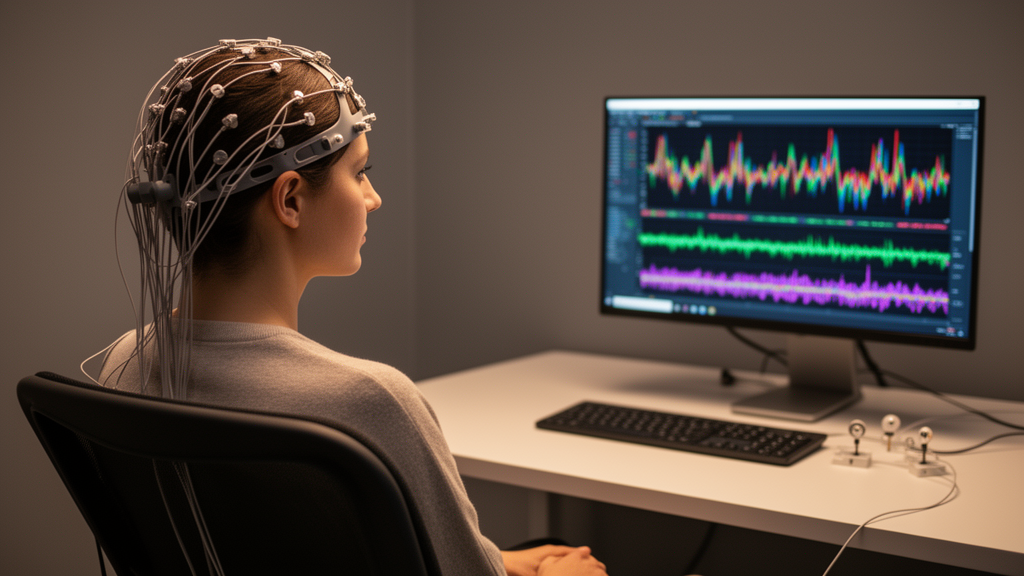
Electroencephalography, the recording of the brain’s electrical activity through electrodes on the scalp, has long been viewed as a promising biometric modality. EEG is considered a promising biometric modality because of the inherent uniqueness of neural signals and their resistance to spoofing attacks. A new study identifies a key obstacle to reliable EEG-based authentication: brain signals are highly non-stationary and vary across cognitive states, so a signature captured in one cognitive condition may not hold in another.

To address this, researchers developed a multi-paradigm measurement protocol designed to capture stable, subject-specific EEG signatures across diverse brain conditions. Rather than recording from a single task, the protocol gathers signals during six complementary paradigms: eyes-open and eyes-closed resting states, left- and right-hand motor tasks, working-memory encoding, steady-state visual evoked potentials, and steady-state auditory evoked potentials. The aim is to build an identity template that holds up regardless of what the brain is doing at the moment of authentication.

The recorded signals were preprocessed and segmented into two-second epochs with 50 percent overlap. From each channel the team extracted 28 quantitative descriptors spanning four domains: time, frequency, time-frequency, and nonlinear features. This feature set was then fed to several decision models, including Mahalanobis distance-based template matching, logistic regression, support vector machines, random forests, and a one-dimensional convolutional neural network.

Performance was assessed under both single-paradigm and multi-paradigm configurations using cross-session validation, a demanding test because it requires the system to recognize individuals across separate recording sessions. The multi-paradigm protocol reduced the equal error rate by 2 percent compared with single-paradigm systems, indicating that combining diverse cognitive states yields more stable neural measurements than any one state alone.

The best results came from a surprisingly simple model. Logistic regression achieved an equal error rate of 1.6 percent, with a 95 percent confidence interval of 1.48 to 1.73. At a false acceptance rate of 1 percent, the false rejection rate was 2.06 percent; tightening security to a 0.1 percent false acceptance rate raised the false rejection rate to 9.01 percent. These figures suggest a workable trade-off between convenience and security, though the confidence interval and the cross-session design should be kept in view when interpreting the headline number.

Feature analysis pointed to which signals carry identity information most reliably.

The study’s authors conclude that multi-paradigm EEG acquisition improves the stability of neural measurements across cognitive states and enables reliable biometric authentication in dynamic conditions.

Several caveats remain. The reported results come from a controlled measurement protocol evaluated with cross-session validation, and the paper is being shared early as a peer-reviewed, accepted version subject to further edits. Nonetheless, the finding that mixing cognitive paradigms lowers error rates offers a concrete design principle for EEG biometrics: identity lives not in a single brain state but in how a person’s brain behaves across many.

Subject of Research: EEG-based biometric authentication using multi-paradigm neural recordings and machine learning decision models

Article Title: EEG-biometric authentication system using multi-paradigm neurophysiological measurements and artificial intelligence

Article References: Rakshe, C., Kumar, P. S., Thomas, C. B., Kalathe, M., Sreeraj, V. S., Venkatasubramanian, G., Thomas, J., Rajamanickam, Y., Kumar, D., & Ronickom, J. F. A. (2026). EEG-biometric authentication system using multi-paradigm neurophysiological measurements and artificial intelligence. Brain Informatics. https://doi.org/10.1186/s40708-026-00337-7

Image Credits: AI Generated

DOI: 10.1186/s40708-026-00337-7

Keywords: EEG, biometric authentication, electroencephalography, machine learning, logistic regression, equal error rate, neural signals, cross-session validation, Hjorth mobility, SSVEP, SSAEP, convolutional neural network

Cite Scienmag News

Blake Davidson. (October 28, 2026). Multi-paradigm EEG signals and AI enable reliable biometric authentication. Scienmag. https://scienmag.com/multi-paradigm-eeg-signals-and-ai-enable-reliable-biometric-authentication/

Blake Davidson. "Multi-paradigm EEG signals and AI enable reliable biometric authentication." Scienmag, 28 October 2026, https://scienmag.com/multi-paradigm-eeg-signals-and-ai-enable-reliable-biometric-authentication/. Accessed 28 October 2026.

Blake Davidson. "Multi-paradigm EEG signals and AI enable reliable biometric authentication." Scienmag. October 28, 2026. https://scienmag.com/multi-paradigm-eeg-signals-and-ai-enable-reliable-biometric-authentication/


Tags: AI decision models for EEG authenticationbiometric authenticationbrain activity during resting and task statesbrain biometric securitycognitive state variabilityconvolutional neural networkcross-session validationEEGEEG feature extractionEEG-based biometric authenticationelectroencephalographyequal error rateHjorth mobilitylogistic regressionMachine learningmulti-paradigm EEG measurementneural signal uniquenessneural signalsnon-stationary brain signalsSSAEPSSVEPstable EEG signaturessteady-state visual and auditory evoked potentialstime-frequency and nonlinear EEG features
Share26Tweet16
Previous Post

Plasma exchange cuts amyloid plaques in aged Alzheimer’s model mice

Next Post

IL-33/ST2 pathway linked to allergic rhinitis severity in Chinese cross-sectional study

Related Posts

Systematic review maps end-of-life psychosocial and spiritual needs in physical disability
Medicine

Systematic review maps end-of-life psychosocial and spiritual needs in physical disability

October 28, 2026
Text Message Campaign Reached Only a Third of Patients Overdue for Colorectal Cancer Screening
Medicine

Text Message Campaign Reached Only a Third of Patients Overdue for Colorectal Cancer Screening

October 28, 2026
FOXO1 Emerges as Candidate Regulator and Biomarker in Hip Dysplasia
Medicine

FOXO1 Emerges as Candidate Regulator and Biomarker in Hip Dysplasia

October 28, 2026
Regulators, developers and clinicians in Shenzhen voice concerns over medical AI governance
Medicine

Regulators, developers and clinicians in Shenzhen voice concerns over medical AI governance

October 28, 2026
CO2-Rich Fluids Alter How Sandstone Permeability Responds to Stress in Lab Tests
Earth Science

CO2-Rich Fluids Alter How Sandstone Permeability Responds to Stress in Lab Tests

October 28, 2026
Friction Stir Processing Refines AZ41 Magnesium Alloy Grains and Slows Biocorrosion in Simulated Body Fluid
Technology and Engineering

Friction Stir Processing Refines AZ41 Magnesium Alloy Grains and Slows Biocorrosion in Simulated Body Fluid

October 28, 2026
Next Post
IL-33/ST2 pathway linked to allergic rhinitis severity in Chinese cross-sectional study

IL-33/ST2 pathway linked to allergic rhinitis severity in Chinese cross-sectional study

  • Mothers who receive childcare support from maternal grandparents show more optimized

    Mothers who receive childcare support from maternal grandparents show more parental warmth, finds NTU Singapore study

    27656 shares
    Share 11059 Tweet 6912
  • University of Seville Breaks 120-Year-Old Mystery, Revises a Key Einstein Concept

    1061 shares
    Share 424 Tweet 265
  • Bee body mass, pathogens and local climate influence heat tolerance

    682 shares
    Share 273 Tweet 171
  • Researchers record first-ever images and data of a shark experiencing a boat strike

    546 shares
    Share 218 Tweet 137
  • Groundbreaking Clinical Trial Reveals Lubiprostone Enhances Kidney Function

    531 shares
    Share 212 Tweet 133
Science

Embark on a thrilling journey of discovery with Scienmag.com—your ultimate source for cutting-edge breakthroughs. Immerse yourself in a world where curiosity knows no limits and tomorrow’s possibilities become today’s reality!

RECENT NEWS

  • Systematic review maps end-of-life psychosocial and spiritual needs in physical disability
  • Text Message Campaign Reached Only a Third of Patients Overdue for Colorectal Cancer Screening
  • FOXO1 Emerges as Candidate Regulator and Biomarker in Hip Dysplasia
  • Regulators, developers and clinicians in Shenzhen voice concerns over medical AI governance

Categories

  • Agriculture
  • Anthropology
  • Archaeology
  • Athmospheric
  • Biology
  • Biotechnology
  • Blog
  • Bussines
  • Cancer
  • Chemistry
  • Climate
  • Earth Science
  • Editorial Policy
  • Marine
  • Mathematics
  • Medicine
  • Pediatry
  • Policy
  • Psychology & Psychiatry
  • Science Education
  • Science News
  • Social Science
  • Space
  • Technology and Engineering

Subscribe to Blog via Email

Enter your email address to subscribe to this blog and receive notifications of new posts by email.

Join 5,151 other subscribers

© 2025 Scienmag - Science Magazine

Welcome Back!

Login to your account below

Forgotten Password?

Retrieve your password

Please enter your username or email address to reset your password.

Log In
No Result
View All Result
  • HOME
  • SCIENCE NEWS
  • CONTACT US

© 2025 Scienmag - Science Magazine

Discover more from Science

Subscribe now to keep reading and get access to the full archive.

Continue reading