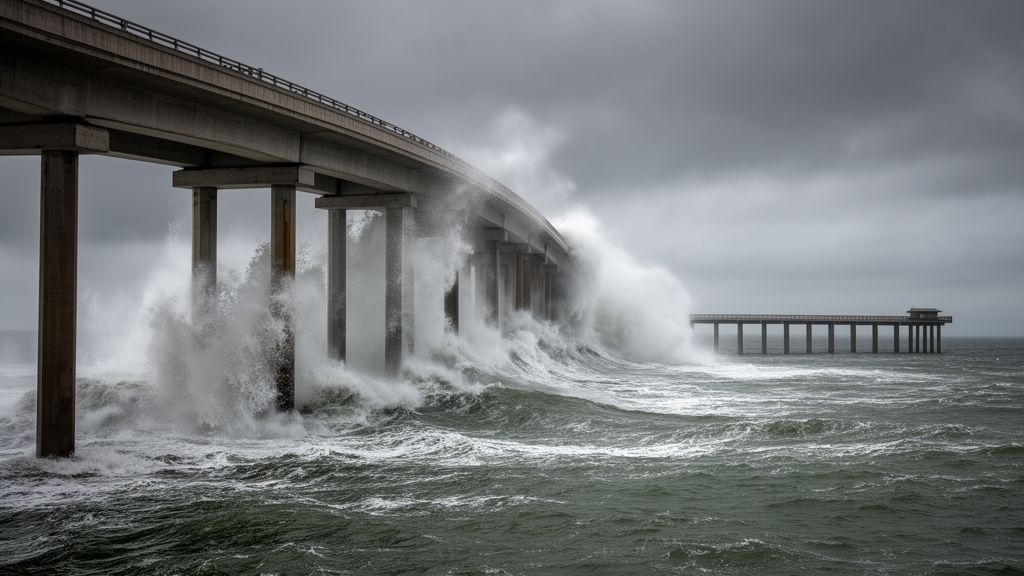
When a tsunami surge slams into a bridge, the shape of the substructure matters more than most design codes currently assume. A new numerical study published in Advances in Bridge Engineering shows that a three-column bridge bent transmits at least 25% more total force to its foundation than an equivalent single-column pier, and that treating the wave load as a static force can seriously underestimate how damaging the transient impact really is. The authors, S. M. Hadi Moosavian, Shooka Karimpour and Stavroula J. Pantazopoulou, propose a dynamic amplification factor tied to the surge Froude number, ranging from 1.0 to 2.0, that engineers could apply to existing static hydrodynamic load formulations when a full dynamic analysis is not feasible.
Structural engineering research has historically concentrated on seismic loading and earthquake-resistant bridge design, yet intense transient surge waves such as tsunamis and flash floods represent a major hazard to bridge systems and their foundations. Major tsunami events in Indonesia in 2004, Chile in 2010 and Tohoku, Japan in 2011 caused widespread fatalities and substantial infrastructure damage. Research on tsunami-induced loading intensified after the 2011 Great East Japan Earthquake and Tsunami, during which more than 300 nearshore bridges were destroyed, severely hindering rescue operations and emergency medical response. A comprehensive review of 1,254 bridge failures from 1980 to 2012 found that more than 47% were attributable to hydrodynamic demands, a category that includes the sudden increases in water depth and flow velocity, soil scouring and debris impact that characterize tsunami events.
The study set out to close two specific research gaps. Most hydrodynamic investigations had modeled only single-column piers, even though multi-column bents are more representative of practical bridge configurations, and they typically treated the structure as a rigid, fixed body, which prevents any assessment of structural response. From the structural side, hydrodynamic loads were usually applied as static forces evaluated in static analysis, an approach that may be reasonable for steady flows but can underestimate the transient effects of surge waves. The new work integrates three-dimensional hydrodynamic simulations with structural analyses of the pier-foundation-soil system, and, notably, incorporates the hydrodynamic forces as time-varying dynamic loads in step-by-step time-history structural analyses, an aspect the authors say had not been addressed in previous studies.
On the hydrodynamic side, the team simulated dam-break waves on a wet bed, which have been shown to exhibit hydrodynamic similarity with field-scale tsunamis. The bridge structure was assumed to undergo negligible deformation, so the pier was modeled as a sequence of rigid, massless piles with square cross sections. The simulations solved the full nonlinear Navier-Stokes equations, including continuity and three-dimensional momentum equations, using OpenFOAM with a Large Eddy Simulation approach, which explicitly resolves the large-scale turbulent structures that time-averaged Reynolds-Averaged Navier-Stokes models cannot adequately represent in unsteady transient flows. A Volume of Fluid approach captured the free surface. The structured hexahedral mesh with adaptive refinement comprised 3,949,920 cells in total, of which 3,317,760 were concentrated in the region where surge wave-pier interaction occurs. The reservoir length was set to 200 meters to prevent negative wave reflections before the bore reached the pier, the dam stood 30 meters from the central pier, and the channel was 10 meters wide.
The wave scenarios were calibrated against tsunami hazard assessments. Because no official tsunami hazard map exists for Canada, the authors drew on the Government of Canada’s referenced assessment by Leonard and colleagues, which developed probabilistic tsunami hazard maps expressing the probability of exceedance for 1.5-meter and 3-meter run-up heights over 50-year periods. For a 1.5-meter run-up, the probability of exceedance over 50 years is less than 1% for the Arctic coast and 15% for the Atlantic coast, rising to about 60% for the Pacific coast, with corresponding minimum recurrence intervals of 5,000, 330 and 80 years. For a 3-meter run-up, the probability is at most 2% for the Arctic and Atlantic coasts but approximately 20% for the Pacific coast. ASCE/SEI 7-22 defines the maximum considered tsunami as an event with a 2% probability of exceedance in 50 years, equivalent to a 1:2475 annual probability. The study adopted run-up values in the range of 1.7 to 4 meters while maintaining surge Froude numbers greater than 2, consistent with values reported for breaking surge waves in the literature, and emphasized that the methodology can be applied to site-specific scenarios from local hazard assessments.
The comparison between single- and multi-column systems revealed the importance of pier interaction. In a demonstration case, the first two force peaks on the leading pier of the multi-column bent matched those of the single-column pier, at 36 and 46 kilonewtons, indicating that upstream conditions were largely unaffected in the initial stages. But the third peak was affected by pier interactions: the single-column pier reached 52 kilonewtons while the leading pier in the multi-column case reached only 47 kilonewtons. In the pseudo-steady phase, defined as the average force over the final 5 seconds of simulation, the single column experienced 40 kilonewtons while the leading pier of the bent experienced 33 kilonewtons, an 18% reduction. The sheltering effect grew stronger downstream: the second pier peaked at 15.7 kilonewtons with a pseudo-steady force of only 2 kilonewtons, and the third pier peaked at 15 kilonewtons with a pseudo-steady force of 11 kilonewtons.
Crucially, because the surge wave arrives at each column at a different time and is interrupted by the leading piers, the individual forces do not peak simultaneously. When the forces on all three columns were summed, the maximum accumulated force reached 66 kilonewtons, which is 40% higher than the peak force on the leading pier of the bent and 25% higher than the peak on the single-column pier. The pseudo-steady total averaged 47 kilonewtons, a 17% increase over the single-column case. Since all columns typically share the same foundation, this total transmitted force is the quantity that matters for design, and it exceeds the maximum force on any individual pier or on the single-column system.
Column spacing also proved significant. Comparing configurations with 1, 2 and 3 meters of clear spacing between columns, the peak overturning moment on the leading pier barely changed, at 60, 63 and 62 kilonewton-meters respectively. But the downstream piers responded strongly to spacing: the second pier’s peak moment rose from 9 kilonewton-meters at 1-meter spacing to 23 kilonewton-meters at 3-meter spacing, and its pseudo-steady moment climbed from 1 to 11 kilonewton-meters. The third pier’s peak moment increased from 6.2 to 21 kilonewton-meters. In the conclusions, the authors quantify this trend as raising the load on the farthest pier by up to 340% when spacing increases from 1 to 3 meters, while the leading pier experienced a 10% force reduction compared to a single-column system.
The structural half of the study used a three-dimensional finite element model of the pier and adjacent soil built in Abaqus, with the concrete pier treated as elastic and the emphasis on nonlinear soil behavior modeled with Mohr-Coulomb plasticity combined with a non-associated flow rule based on the Drucker-Prager plastic potential. The soil was represented as a continuous nonlinear medium rather than discrete springs, with contact elements at the soil-foundation interface using hard contact in the normal direction and a penalty friction coefficient of 0.5 tangentially. For each of eight wave intensities, two analyses were run: a dynamic one applying the full time history of the wave-induced load, and a static one applying only the maximum load. The displacement at the top of the pier showed that the dynamic-to-static response ratio exceeded one in all cases, confirming dynamic amplification across the board, with the peak ratio increasing with wave intensity and reaching approximately 1.7 in the most intense case. The authors note that structural motion remained small relative to flow scales, with a maximum pier displacement of 0.09 meters against a flow depth of around 4 meters and a maximum structural velocity of 0.02 meters per second against an incoming flow velocity above 13 meters per second, justifying a one-way coupling approach.
Soil nonlinearity increased with wave intensity and appears to damp post-impact vibrations. Comparing the lowest and highest intensity cases, the maximum lateral plastic strain in the soil rose from approximately 0.016 to 0.112, an increase of about 600%, while vertical plastic strain rose about 62% and plastic shear strain about 22%, concentrated near the foundation edges where overturning moments produced non-uniform soil pressures. From these results the team derived a dynamic amplification coefficient as a linear function of the surge Froude number between 2.4 and 8, held at 1.0 below that range and capped at 2.0 above a Froude number of 8, bounds justified by structural dynamics theory for ideal single-degree-of-freedom systems. Two additional cases with circular pier sections showed about a 50% reduction in hydrodynamic force compared with square sections, yet the dynamic amplification differed by less than 3% at lower intensity and about 5% at higher intensity, suggesting pier shape has an insignificant effect on the amplification factor. The authors caution that a broader range of simulations is required to establish a general equation, but the necessity of incorporating a dynamic factor when full dynamic analysis is not feasible is, they conclude, evident from the computed results.
Subject of Research: Hydrodynamic and structural simulation of tsunami surge loads on multi-column bridge bents and a proposed dynamic amplification factor for design
Article Title: Tsunami loads on bridge bents: pier interaction and dynamic amplification
Article References: Moosavian, S. M. H., Karimpour, S., & Pantazopoulou, S. J. (2026). Tsunami loads on bridge bents: pier interaction and dynamic amplification. Advances in Bridge Engineering, 7(1), Article 35. https://doi.org/10.1186/s43251-026-00223-6
Image Credits: AI Generated
DOI: 10.1186/s43251-026-00223-6
Keywords: tsunami, bridge engineering, surge waves, hydrodynamic forces, dynamic amplification factor, soil-structure interaction, bridge piers, overturning moment, dam-break waves, Froude number, OpenFOAM, structural analysis
Cite Scienmag News
Denise Maddox. (October 28, 2026). Multi-column bridge bents face at least 25% higher tsunami forces than single piers. Scienmag. https://scienmag.com/multi-column-bridge-bents-face-at-least-25-higher-tsunami-forces-than-single-piers/
Denise Maddox. "Multi-column bridge bents face at least 25% higher tsunami forces than single piers." Scienmag, 28 October 2026, https://scienmag.com/multi-column-bridge-bents-face-at-least-25-higher-tsunami-forces-than-single-piers/. Accessed 28 October 2026.
Denise Maddox. "Multi-column bridge bents face at least 25% higher tsunami forces than single piers." Scienmag. October 28, 2026. https://scienmag.com/multi-column-bridge-bents-face-at-least-25-higher-tsunami-forces-than-single-piers/