


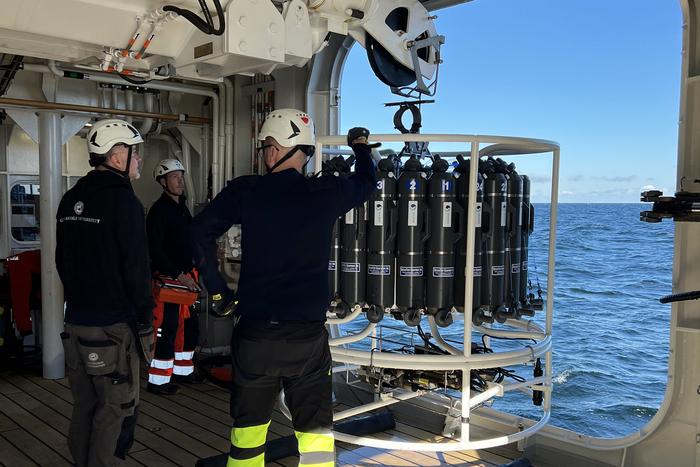
Much of the methane released into the southern Baltic Sea from the Nord Stream gas pipeline has remained in the water. This is shown by measurements taken by researchers from the University of Gothenburg.

Credit: Adele Maciute
Much of the methane released into the southern Baltic Sea from the Nord Stream gas pipeline has remained in the water. This is shown by measurements taken by researchers from the University of Gothenburg.
At the end of September 2022, the Nord Stream gas pipeline on the bottom of the Baltic Sea exploded east of Bornholm and one of the largest unnatural methane gas emissions ever was a fact. The methane gas from the pipeline created large bubbles at the water surface and measurements showed elevated levels of methane in the atmosphere.
Expedition within a week
But much of the methane never reached the surface and dissolved in the water instead. This is according to a scientific study published in Scientific Reports.
“Thanks to fortunate circumstances, we were able to organise an expedition to the area of the leak in less than a week. Based on what we measured, we estimate that between 10,000 and 50,000 tonnes of methane remained in the sea in dissolved form,” says Katarina Abrahamsson, professor of marine chemistry at the University of Gothenburg.
The methane was spread over large areas and has dissolved in the water, where some is taken care of by bacteria. Methane is also normally present in the water, formed during the decomposition of organic material in the bottom sediments.
Different isotopes
“In our study, we have been able to distinguish the methane coming from the Nord Stream leak from that naturally present in the water, thanks to the fact that the methane from the gas pipeline has a different isotopic composition than that which seeps up from the bottom sediments. This is a strength of our study,” says Katarina Abrahamsson.
The water in the sea normally lies in different layers due to differences in temperature and salinity. Despite the fact that the methane leaked out of the gas pipeline at great speed and in large quantities, the researchers could not observe any major mixing in the water masses. The stratification that normally occurs at the end of September was stable. The levels of the leaked methane therefore varied greatly in the water. The researchers assume that the methane was diluted in a larger body of water later in the autumn when the water was remixed due to falling water temperature.
Unclear biological impact
It is too early to say what impact the increased methane levels will have on biological life in the southern Baltic Sea.
“The expedition also included researchers who took plankton samples in the affected area, the analyses of which are not yet complete,” says Katarina Abrahamsson.
Three months after the first expedition, a return visit was made to the area and new measurements were taken. Preliminary results show that bacterial activity has been high during these three months. The researchers do not yet know how the phytoplankton and zooplankton have been affected by this.
Journal
Scientific Reports
Method of Research
Observational study
Article Title
Methane plume detection after the 2022 Nord Stream pipeline explosion in the Baltic Sea
Article Publication Date
19-Jun-2024
Cite Scienmag News
Violet Maxwell. (June 23, 2024). Much of the Nord Stream gas remained in the sea. Scienmag. https://scienmag.com/much-of-the-nord-stream-gas-remained-in-the-sea/
Violet Maxwell. "Much of the Nord Stream gas remained in the sea." Scienmag, 23 June 2024, https://scienmag.com/much-of-the-nord-stream-gas-remained-in-the-sea/. Accessed 3 September 2026.
Violet Maxwell. "Much of the Nord Stream gas remained in the sea." Scienmag. June 23, 2024. https://scienmag.com/much-of-the-nord-stream-gas-remained-in-the-sea/

