


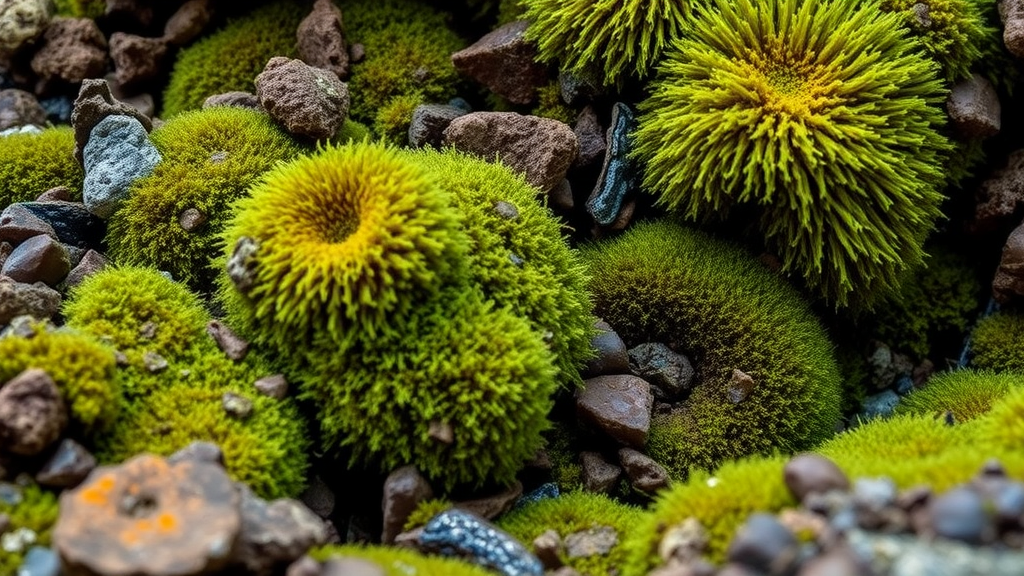
In the eroded, rock-strewn landscapes of southwestern China, where shallow soils cling precariously to fractured carbonate bedrock, land degradation has long seemed almost irreversible. Karst rocky desertification strips hillsides of vegetation, leaches away nutrients at extraordinary speed, and leaves behind soils so fragmented that natural recovery can stretch across decades or even centuries. A new open-access study in Environmental Earth Sciences now reports that a deceptively simple ecological engineering trick—sowing the ground with locally collected moss and native algae together—can jump-start the entire recovery process in as little as ninety days, transforming barren ground into a functioning photosynthetic community with rebuilt carbon and nitrogen cycles.
The research team, led by Zixu Chen and Pei Wang of the Institute of Hydrobiology at the Chinese Academy of Sciences, together with colleagues from the Institute of Karst Geology and other Chinese institutions, set out to test whether biological soil crusts, the living skins of cyanobacteria, algae, mosses, fungi and bacteria that blanket soil surfaces in the world’s drylands, could be deliberately induced on degraded karst soils. These crusts are celebrated among ecologists as ecosystem engineers: their filamentous networks and sticky extracellular polymeric substances bind soil particles, curb erosion, fix atmospheric carbon through photosynthesis, and pump bioavailable nitrogen into the ground via biological nitrogen fixation. But in karst terrain, with its shallow regolith, high calcium carbonate content and relentless hydrological instability, natural crust development stalls almost completely.
The experiment combined controlled laboratory work in Wuhan with a field trial at the Maocun Experimental Base in Guilin, part of the UNESCO-affiliated International Research Center on Karst. The team isolated two native algal strains from local degraded sites: one belonging to the genus Geminocystis, and a filamentous, nitrogen-fixing cyanobacterium identified as Leptolyngbya. The dominant local moss, Homomallium incurvatum, was surface-sterilized and propagated on half-strength Murashige and Skoog medium before inoculation. Four treatments were compared under both indoor and field conditions: an untreated control, algae alone, moss alone, and a combined moss–algae co-inoculation, with soil samples taken at 0, 30, 60 and 90 days to track the full cascade of chemical and biological change.
The headline result was unambiguous: co-inoculation outperformed every single-organism treatment across virtually every measured variable. Chlorophyll a, the standard proxy for photosynthetic biomass, climbed dramatically in the mixed treatment. Indoors, the co-inoculated soils reached 6.5 micrograms per square centimeter by day 90, nearly ten times the level of untreated controls and well above either moss-only or algae-only plots. Outdoors the same ranking held, with co-inoculation reaching 4.49 micrograms per square centimeter, a 74 percent increase over the control. Field photographs told the same visual story: control plots stayed dry, cracked and gray, while co-inoculated plots developed dense, vibrant green moss cover, more extensive than in moss-only treatments.
Underneath the green surface, the chemistry of the soil was changing just as fast. By day 90, nitrate concentrations in indoor co-inoculated plots had reached 11.68 milligrams per kilogram, roughly five times the control level, while ammonium rose by about 126 percent indoors and 188 percent in the field. Nitrite followed the same pattern, increasing nearly fivefold. Total and organic carbon climbed by roughly 61 to 162 percent in the mixed treatment compared with bare soil. The authors attribute this carbon gain to photosynthetic fixation by the developing crust and the incorporation of crust biomass and excreted polymers into stable soil organic matter pools—effectively the first stages of new soil formation on ground that had been functionally sterile.
Enzyme activity measurements provided the mechanistic bridge between these pools. Urease, which drives organic nitrogen mineralization, rose by 41 percent indoors and 43 percent in the field under co-inoculation, closely matching the concurrent surge in ammonium and nitrate. Sucrase, an indicator of carbon-cycling intensity, increased by about 39 percent, and alkaline phosphatase by around 21 to 24 percent, signaling heightened microbial demand for phosphorus in these naturally phosphorus-poor soils. The coordinated rise of all three enzymes pointed to a re-coupling of the carbon, nitrogen and phosphorus cycles—precisely the decoupling that earlier work has identified as the hallmark of dysfunction in degraded drylands.
Fluorescence spectroscopy of dissolved organic matter added a subtler layer of evidence. Using excitation–emission matrix analysis and parallel factor modeling, the team identified two humic-like and two protein-like fluorescent components in the soil solutions. Inoculated treatments showed elevated biological and freshness indices, indicating that the dissolved organic pool was increasingly dominated by fresh, microbially produced, labile compounds, while rising humification indices in moss and co-inoculation plots hinted at the earliest stages of stable humus formation. In other words, the crusts were not merely adding organic matter; they were shifting its composition toward forms that feed soil food webs and, eventually, lock carbon into the ground.
The microbial community itself underwent a striking succession. Photosynthetic communities began dominated by unicellular Synechococcales, typical of nutrient-starved early successional states, and shifted within ninety days toward filamentous, nitrogen-fixing Nostocales and Leptolyngbyales, the very taxa that confer structural stability to mature biocrusts. Fungal richness more than doubled, with saprotrophic Ascomycota becoming dominant and FUNGuild-based functional predictions showing increased decomposition activity alongside declining pathotrophs. Bacterial functional profiling through FAPROTAX revealed enrichment of nitrate reduction, nitrate respiration, nitrite ammonification and complex carbon degradation pathways such as cellulolysis and ligninolysis. Together these shifts describe the assembly of an integrated decomposer-fixer network where only a fragmented microbial web had existed before.
The practical implications are considerable. Unlike conventional restoration approaches such as spraying exogenous soil, which demand heavy machinery and repeated inputs, moss–algae co-inoculation relies on locally collected, self-regenerating biological material that progressively builds soil structure and fertility with minimal intervention. The authors caution that their trial covered only ninety days at a single site under relatively stable weather, so the resilience of these young crusts to droughts, frosts and other climatic extremes during the fragile establishment window remains untested. Still, within a single season the technique demonstrably accelerated nutrient accumulation, enzyme activation, organic matter humification and microbial reorganization—a positive feedback loop linking surface stabilization, carbon input and nutrient cycling. For the millions of hectares of degraded karst in China and around the world, deliberately cultivated living crusts may offer one of the fastest, cheapest and most self-sustaining paths back to functional soil.
Subject of Research: Induced composite biological soil crusts for early-stage restoration of karst rocky desertification soils
Article Title: Construction of composite biological soil crusts accelerates early-stage soil restoration in karst rocky desertification areas
Article References: Chen, Z., Li, T., He, X., Yang, H., Huang, F., Cao, J., Wang, P., & Wang, G. (2026). Construction of composite biological soil crusts accelerates early-stage soil restoration in karst rocky desertification areas. Environmental Earth Sciences, 85(15), Article 400. https://doi.org/10.1007/s12665-026-13121-x
Image Credits: AI Generated
DOI: 10.1007/s12665-026-13121-x
Keywords: karst rocky desertification, biological soil crusts, moss, algae, co-inoculation, soil restoration, carbon-nitrogen coupling, cyanobacteria, soil enzymes, dissolved organic matter, microbial communities, ecological engineering
Cite Scienmag News
Violet Maxwell. (September 12, 2026). Moss and Algae Team Up to Rebuild Dead Karst Soils Fast. Scienmag. https://scienmag.com/moss-and-algae-team-up-to-rebuild-dead-karst-soils-fast/
Violet Maxwell. "Moss and Algae Team Up to Rebuild Dead Karst Soils Fast." Scienmag, 12 September 2026, https://scienmag.com/moss-and-algae-team-up-to-rebuild-dead-karst-soils-fast/. Accessed 4 October 2026.
Violet Maxwell. "Moss and Algae Team Up to Rebuild Dead Karst Soils Fast." Scienmag. September 12, 2026. https://scienmag.com/moss-and-algae-team-up-to-rebuild-dead-karst-soils-fast/


