


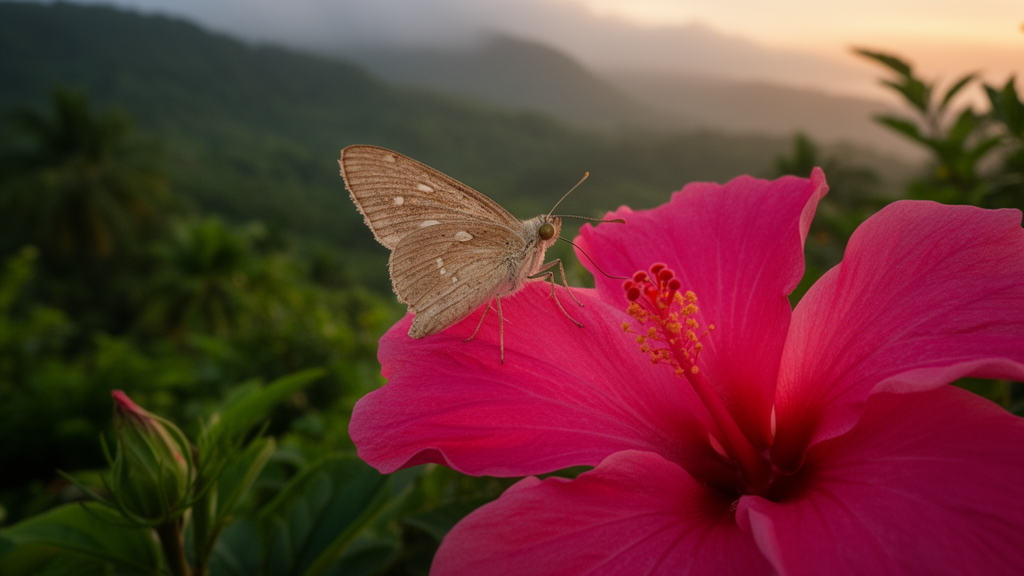
A taxonomic study of moth specimens collected in Japan’s Ogasawara Islands identified a new species of the leaf-mining genus Bucculatrix, named Bucculatrix flavimaculata. The finding was based on adult morphology, including male and female genitalia, observations of larval biology, and analysis of partial mitochondrial cytochrome c oxidase subunit I DNA barcode sequences. The species was found feeding on the endemic Malvaceae plant Hibiscus glaber on Chichijima and Hahajima islands, with feeding traces attributed to it also observed on Anijima and Mukohjima.
The genus contains mostly leaf-mining moths, with approximately 300 species known globally. First- and second-instar Bucculatrix larvae generally form short, narrow, tortuous or spiral mines. Later instars feed externally on the leaf and leave a skeletonized trace in which the epidermis is consumed while the veins remain. Before moulting, the larvae spin a cocoon-shaped web termed a cocoonet. DNA barcode studies of the genus have been concentrated mainly in Europe and the United States, leaving comparatively few Asian species represented in GenBank or BOLD.
The new species was encountered during a survey of the Ogasawara Islands, where Hibiscus glaber is widely distributed. In addition to a known unknown gracillariid moth feeding on the plant, investigators observed small mines and skeletonized feeding traces associated with an unrecognized Bucculatrix. Specimens were collected by rearing larvae from the host plant or by sweeping adults on Chichijima and Hahajima, and the material was deposited at the Entomological Laboratory of Kyushu University.
Adults of B. flavimaculata have a wingspan of 3.8–6.6 millimetres across 16 examined specimens, with no observed sexual dimorphism. The fuscous forewings carry four yellowish-cream to dark-yellow markings at or near the costal margin, a feature that helps distinguish the species from other Bucculatrix in surrounding biogeographic regions. Its scientific name combines the Latin flavus, meaning “yellowish,” and macula, meaning “spots,” in reference to the forewing colour and markings.
The male genitalia include an elongated socius, a broad valva and an elongated vinculum, resembling those of B. firmianella. The new species differs in having a trapezoid rather than triangular valva and a small ovate scale sac rather than a large one. Its female genitalia share an elongated ductus bursae with B. firmianella, but its broad lamella antevaginalis bears several horizontal wrinkles. The genitalia also resemble those of B. serratella, although B. flavimaculata lacks a juxta in males and has a longer ductus bursae in females.
For the DNA analysis, the researchers extracted DNA from specimen abdomens and amplified the partial mitochondrial COI region with either the LCO1490/HCO2198 or LepF1/LepR1 primer sets. Bidirectional Sanger sequencing produced barcode sequences that were deposited in GenBank and uploaded to the BOLD public dataset DS-BUCBONIN. Uncorrected pairwise distances and a Neighbor Joining tree were calculated in MEGA 7.0.26. A preliminary maximum-likelihood phylogeny was generated with IQ-TREE using RY coding for heterogeneous third codon positions, with Ogmograptis scribula as the outgroup.
Among six sequenced specimens of B. flavimaculata, uncorrected intraspecific distances ranged from 0 to 2.74%. The largest differences, measuring 2.43–2.74%, separated two specimens from Chichijima, assigned to BOLD bin AFB6292, from six Hahajima specimens, assigned to BOLD bin AFB5723. The closest barcode match outside the Ogasawara population was an unidentified Bucculatricidae specimen from Selangor on the Malay Peninsula, with 6.46% pairwise divergence. The authors considered the island-level barcode variation, which may warrant assessment for cryptic species, but retained the specimens as one species.
The maximum-likelihood tree placed B. flavimaculata closest to B. firmianella, although support for that pairing was limited, with 86% ultrafast bootstrap and 24.2% SH-aLRT support. The two species occurred in a larger clade containing two unidentified Malaysian species, B. hamaboella, B. regaella and the Boraginaceae-feeding B. cordiaella; this larger grouping had 97.1% SH-aLRT support. The authors also noted that the Japanese Malvaceae feeders did not cluster with B. magnella, consistent with morphological differences, and concluded that Malvaceae feeding appears to have arisen independently at least twice within Bucculatrix.
Larvae were observed feeding on Hibiscus glaber. Eggs were mainly laid on the upper leaf surface and occasionally on the underside, near a vein or leaf edge. Mines began in a serpentine form and became simple and linear before the larvae exited to feed externally and produce skeletonized traces. Cocoonets were typically beneath the leaf. Larvae were pale green except in the final instar, which had dorsal fuscous and cream horizontal stripes and two lateral white markings on each segment. Adults and larvae were observed from mid- to late June, and the collections suggest that the species may be multivoltine, although the study did not directly document the number of generations per year.
Subject of Research: Taxonomic identification of a new Hibiscus-feeding Bucculatrix moth in Japan’s Ogasawara Islands using morphology, life-history observations and DNA barcoding
Article Title: A new Hibiscus -feeding species of Bucculatrix ( Bucculatricidae ) from the Ogasawara Islands, Japan
Article References: Yagi, S., Oku, J., & Hirowatari, T. (2024). A new Hibiscus-feeding species of Bucculatrix (Bucculatricidae) from the Ogasawara Islands, Japan. Nota Lepidopterologica, 47, 29-42. https://doi.org/10.3897/nl.47.107485
Image Credits: AI Generated
DOI: 10.3897/nl.47.107485
Keywords: Bucculatrix flavimaculata, new moth species, Ogasawara Islands, Hibiscus glaber, DNA barcoding, taxonomy, leaf-mining moth, Lepidoptera, Bucculatricidae, phylogenetics, Hibiscus, feeding
Cite Scienmag News
Patricia Pace. (October 20, 2026). Morphology and DNA barcoding identify a new Hibiscus-feeding Bucculatrix species in Japan’s Ogasawara Islands. Scienmag. https://scienmag.com/morphology-and-dna-barcoding-identify-a-new-hibiscus-feeding-bucculatrix-species-in-japans-ogasawara-islands/
Patricia Pace. "Morphology and DNA barcoding identify a new Hibiscus-feeding Bucculatrix species in Japan’s Ogasawara Islands." Scienmag, 20 October 2026, https://scienmag.com/morphology-and-dna-barcoding-identify-a-new-hibiscus-feeding-bucculatrix-species-in-japans-ogasawara-islands/. Accessed 20 October 2026.
Patricia Pace. "Morphology and DNA barcoding identify a new Hibiscus-feeding Bucculatrix species in Japan’s Ogasawara Islands." Scienmag. October 20, 2026. https://scienmag.com/morphology-and-dna-barcoding-identify-a-new-hibiscus-feeding-bucculatrix-species-in-japans-ogasawara-islands/


