


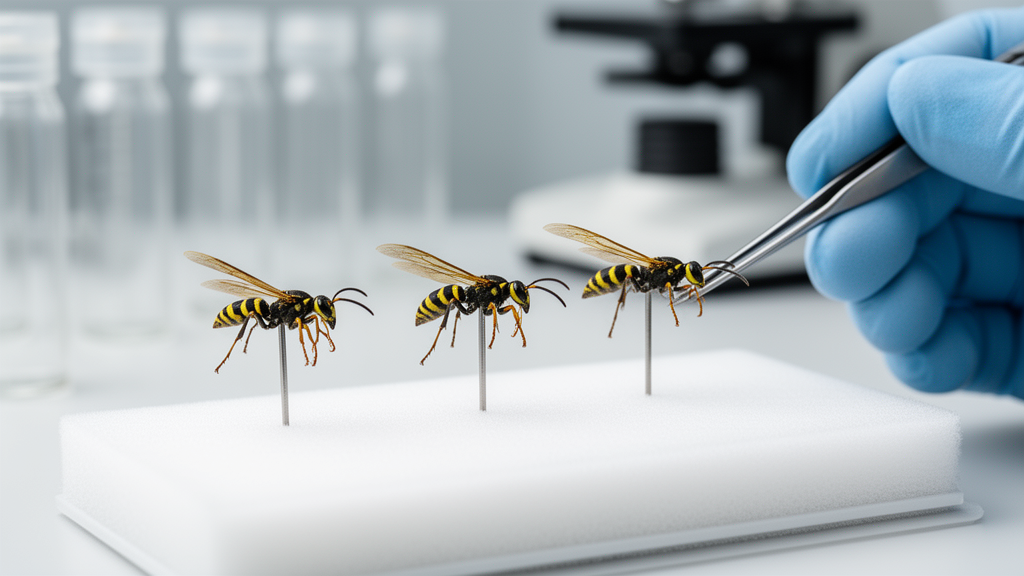
A specimen-based morphological taxonomy study described three new species of the crabronid wasp genus Psen from China: Psen scabristriatus, P. spinitarsalis and P. rhyssothoracicus. The researchers also reported P. brinchangensis from China for the first time and described its male for the first time.
The research examined Psen specimens held by Yunnan Agricultural University in Kunming, China. It was a descriptive taxonomic study based on external morphology, measurements and male genital characters rather than a population survey or field experiment. The authors assigned type material, diagnosed the new taxa, illustrated them with color photographs, provided separate identification keys for the female and male species known from China and produced a distribution map. The specimens were photographed with a Keyence VHX-5000 stereomicroscope equipped with a digital microscopic system, and the image plates were processed in Adobe Photoshop 2020. Morphological terminology largely followed Bohart and Menke (1976).
Psen scabristriatus was established from a female holotype and five male paratypes collected in Yunnan and Hunan. The female measured 8.6 mm in body length, and the males measured 8.1–8.5 mm. The species resembles P. nitidus but differs in the numerous long, oblique striae on the anterior acetabular carina, dense midsized to large punctures over most of the scutum, a longitudinal depression on the scutellum, a conspicuously convex episcrobal area and a broadly triangular pygidial plate. Males have a row of slender yellow spines on the outer surface of the hind tibia. The recorded Chinese distribution includes Hunan and Yunnan.
Psen spinitarsalis was described from a female holotype, two female paratypes and nine male paratypes collected in Hubei, Hunan, Guangdong and Guizhou. One female paratype had the same data as the holotype, while the other was collected at Nanling Nature Reserve in Guangdong. The female measured 12 mm, while males ranged from 10.7–11.7 mm. Diagnostic features include an incomplete marginal ridge on the propodeal enclosure, a propodeal pad bearing dense, slender, oblique longitudinal rugae, and a mid basitarsus with mid-length spines on the externoventral surface and a long spine at the apex. Males also have elliptical excavations beneath antennal articles V–XIII. The specific name refers to the spined basal mid tarsomere.
Psen rhyssothoracicus was described from a female holotype and 55 paratypes: 39 females and 16 males. All type material came from Yadong County in Shigatse, Tibet, at an elevation of 3,591 m. Females measured 9.7–12.0 mm and males 9.2–10.8 mm. The species resembles P. seminitidus but differs in the densely, obliquely rugose propodeal pad, short rugae and fine punctures on the lateral propodeum, and linear tyloids beneath male antennal articles IV–VII. Its name refers to the rugose thoracic and propodeal structures. The authors described this taxon as a typical Palearctic species and noted its relatively large, slender, uniformly dark body.
The study also examined five female and seven male specimens of P. brinchangensis collected in Yunnan. This species had previously been recorded from Malaysia, so the Chinese specimens represented its first national record. The newly described male measured 8.1–8.2 mm and had a cylindrical petiole without lateral carinae or depressions, a smooth dorsal petiole and a propodeal pad with sparse, inconspicuous, irregular rugae. Gold fasciculate setae occurred along the posterior margins of gastral sterna III and IV. With the new records and descriptions, the authors reported that 32 species and six subspecies of Psen had been documented in China.
According to the paper’s distribution summary, Chinese Psen species were concentrated in eastern, southeastern and southwestern China. Taiwan had 14 species and two subspecies, Zhejiang had 11 species, Yunnan had 10 and Sichuan had seven; most other provinces hosted one to three species. The authors reported 15 endemic Chinese species and two endemic subspecies, representing 15.4% of the genus’s global diversity in their accounting. These figures are taxonomic tallies based on recorded species and subspecies, not measurements of abundance, population trends or ecological density.
For the high-altitude P. rhyssothoracicus, the authors observed a relatively large and slender body, dark coloration, a coriaceous surface and stable morphological traits across the extensive type series. They proposed that the coloration and body form might be adaptations to high-altitude conditions, citing hypotheses that darker pigmentation can improve heat absorption and that melanin in the cuticle may protect against increased ultraviolet-B radiation. These explanations were presented as hypotheses; the taxonomic study did not experimentally test either mechanism.
Overall, the work expands the recognized diversity of Psen in China and clarifies the morphological limits of three newly described species and one newly recorded taxon. The conclusions are bounded by the specimens examined, their sex coverage and their collection localities. The paper does not provide population estimates, quantitative ecological-sampling estimates or experimental evidence that the proposed high-altitude traits are adaptive.
Subject of Research: Morphological taxonomy of new Psen crabronid wasp species from China
Article Title: Taxonomic update of Psen Latreille, 1796 ( Hymenoptera , Crabronidae ), with descriptions of three new species from China
Article References: Deng, Y., Ma, L., & Li, Q. (2025). Taxonomic update of Psen Latreille, 1796 (Hymenoptera, Crabronidae), with descriptions of three new species from China. Journal of Hymenoptera Research, 98, 971-1003. https://doi.org/10.3897/jhr.98.155469
Image Credits: AI Generated
Keywords: Psen, taxonomy, new species, Crabronidae, Hymenoptera, China, morphology, insect diversity, Tibet, Taxonomic, update, Latreille
Cite Scienmag News
Gavin Prescott. (October 20, 2026). Morphological study describes three new Psen species from China. Scienmag. https://scienmag.com/morphological-study-describes-three-new-psen-species-from-china/
Gavin Prescott. "Morphological study describes three new Psen species from China." Scienmag, 20 October 2026, https://scienmag.com/morphological-study-describes-three-new-psen-species-from-china/. Accessed 20 October 2026.
Gavin Prescott. "Morphological study describes three new Psen species from China." Scienmag. October 20, 2026. https://scienmag.com/morphological-study-describes-three-new-psen-species-from-china/


