


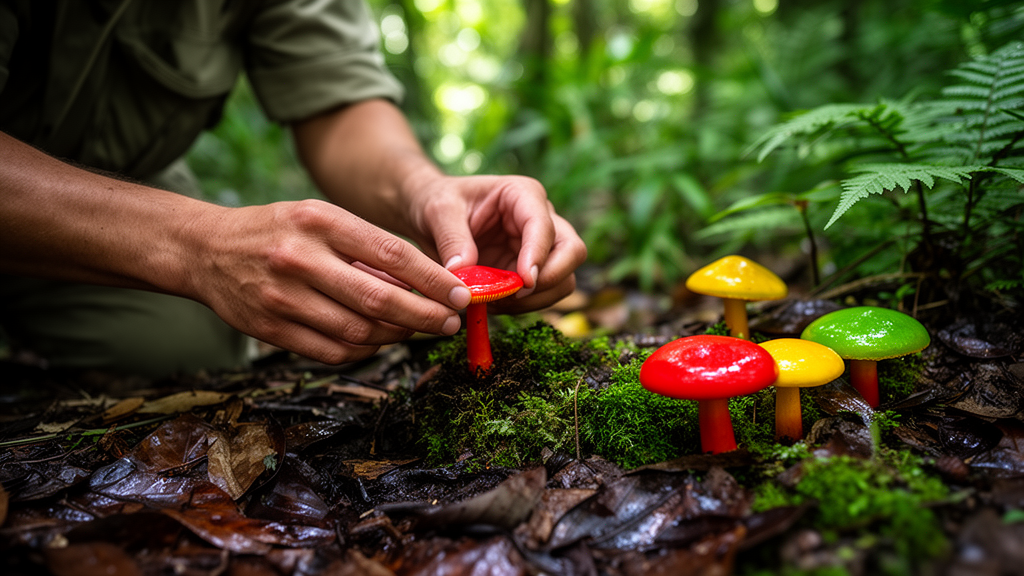
A morphological and phylogenetic study of waxcap fungi in the Dominican Republic identified and formally described seven new species of Hygrocybe subgenus Hygrocybe and one new variety. The new taxa are H. citrinonigrescens, H. jarabacoensis, H. parabolica, H. perdomoi, H. pseudohypohaemacta, H. variecolor and H. xerophila, together with H. xerophila var. floridana.
The research combined descriptions of fresh and dried specimens with DNA sequence analysis. Macroscopic observations covered basidioma, habitat and associated vegetation, while microscopic measurements examined spores, basidia, cystidia and tissue structures. The researchers amplified and sequenced the nuclear ribosomal internal transcribed spacer and large-subunit regions and generated 20 nrITS and eight nrLSU sequences.
The combined nrITS and nrLSU dataset contained 77 sequences and 1,838 characters. Maximum-likelihood and Bayesian analyses produced the same tree topology. Four well-supported main clades were recovered within H. subgenus Hygrocybe, designated /acutoconica, /appalachianensis, /conica and /hypohaemacta, and the new taxa occurred in each of these lineages.
H. perdomoi was placed in the /acutoconica clade, H. jarabacoensis in the /appalachianensis clade, and H. citrinonigrescens, H. parabolica and H. xerophila in the /conica clade. H. pseudohypohaemacta and H. variecolor were assigned to the /hypohaemacta clade. The study used Hygroaster albellus and Hygroaster sp. identified as H. nodulisporus as outgroup taxa.
The seven new species were supported by combinations of macroscopic, microscopic and ribosomal-sequence differences. H. citrinonigrescens has a vivid lemon-yellow pileus and blackens strongly with age or handling. H. jarabacoensis has greenish to reddish-green coloration, a long stipe and strongly dimorphic spores and basidia. H. parabolica is small and orange-red, with a parabolic pileus and slow, faint blackening. H. perdomoi has slimy-viscid basidiomata and differs from H. acutoconica in size, surface features and spore shape.
H. pseudohypohaemacta has scarlet-red or orange coloration, a yellow pileus margin, a thick transparent glutinous layer on the stipe, and dimorphic spores and basidia. H. variecolor also has dimorphic spores and basidia, but differs in habitat, spore dimensions and shape, the rarity of pseudocystidia, and ribosomal-sequence divergence. The authors considered it possibly rare globally, but emphasized that it was represented by one collection and that further collections may reveal greater variation.
The new Florida variety, H. xerophila var. floridana, differs from the Dominican type variety in its redder pileus, larger macrospores, smaller microspores, geographic range and a single-nucleotide polymorphism in the ITS region. Despite these micromorphological differences, the Dominican and Florida collections did not separate clearly in the phylogenetic analyses and differed by only three nucleotides in nrITS, leading the authors to treat them as varieties of one species.
Several limitations constrain the findings. Some newly described species were represented by few collections, and the authors stated that additional material may clarify their variation. An unclassified Dominican specimen morphologically overlapping H. pseudohypohaemacta had a low genetic distance but a comparatively high proportion of gaps, so its taxonomic status remains uncertain pending further collections and sequences. The study also excluded previously published Belize sequences attributed to H. hypohaemacta because they showed high similarity to Termitomyces sequences and were interpreted as contaminants.
Subject of Research: Taxonomic and phylogenetic characterization of Hygrocybe subgenus Hygrocybe in the Dominican Republic
Article Title: The genus Hygrocybe subgenus Hygrocybe in the Dominican Republic: phylogeny, diversity, and description of seven novel species and one variety ( Agaricomycetes , Hygrocybaceae )
Article References: Dovana, F., Angelini, C., Lodge, D. J., Marchetti, M., & Vizzini, A. (2026). The genus Hygrocybe subgenus Hygrocybe in the Dominican Republic: phylogeny, diversity, and description of seven novel species and one variety (Agaricomycetes, Hygrocybaceae). IMA Fungus, 17, Article e195850. https://doi.org/10.3897/imafungus.17.195850
Image Credits: AI Generated
DOI: 10.3897/imafungus.17.195850
Keywords: Hygrocybe, waxcap fungi, fungal taxonomy, phylogenetics, ITS sequencing, LSU sequencing, mushroom morphology, Dominican Republic, Caribbean biodiversity, new species, genus, subgenus
Cite Scienmag News
Drew Townsend. (October 21, 2026). Morphological and phylogenetic study identifies seven new Hygrocybe taxa in the Dominican Republic. Scienmag. https://scienmag.com/morphological-and-phylogenetic-study-identifies-seven-new-hygrocybe-taxa-in-the-dominican-republic/
Drew Townsend. "Morphological and phylogenetic study identifies seven new Hygrocybe taxa in the Dominican Republic." Scienmag, 21 October 2026, https://scienmag.com/morphological-and-phylogenetic-study-identifies-seven-new-hygrocybe-taxa-in-the-dominican-republic/. Accessed 21 October 2026.
Drew Townsend. "Morphological and phylogenetic study identifies seven new Hygrocybe taxa in the Dominican Republic." Scienmag. October 21, 2026. https://scienmag.com/morphological-and-phylogenetic-study-identifies-seven-new-hygrocybe-taxa-in-the-dominican-republic/


