

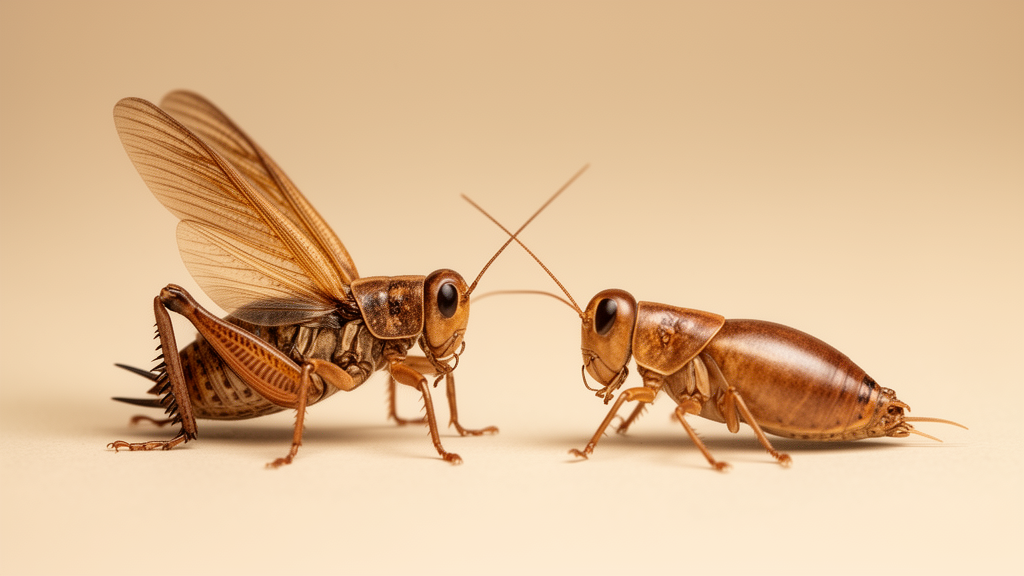
In field-caught field crickets, females with male-like cuticular hydrocarbon profiles did not have higher measured fertility or more inferred contributing sires than females with typical profiles. The animal study examined Gryllus firmus and G. pennsylvanicus, two species whose males court male-like females more readily in laboratory trials.
Researchers collected 47 G. firmus and 39 G. pennsylvanicus females from allopatric Connecticut and Vermont populations in September 2020. They kept the field-mated females in individual cages with food, water and oviposition dishes for two additional months. All eggs from each female were incubated together, and surviving offspring were counted after a period at 6°C followed by incubation at 25°C.
Among 44 scored G. firmus broods, 11 females had male-like profiles and produced an average of 74.2 offspring, compared with 95.3 among 33 females with non-male-like profiles. In G. pennsylvanicus, 11 male-like females averaged 132 offspring, while 27 females with non-male-like profiles averaged 183. Statistical models associated the male-like category with fewer offspring in both species, with p-values below 0.001.
The analysis did not find strong evidence that hydrocarbon category was associated with whether a female produced any offspring (p = 0.09). Across categories, G. firmus females averaged 90 offspring per brood and G. pennsylvanicus averaged 168, a significant difference in the fitted models. This species contrast differed from earlier laboratory observations, but it does not establish a temporal change in fertility.
A separate analysis genotyped 29 G. firmus and 19 G. pennsylvanicus broods using seven microsatellite loci and inferred parentage from multilocus genotypes. It estimated a minimum number of contributing sires because males that fertilized no offspring, or only a single offspring, could not necessarily be detected.
For G. firmus, the estimated minimum sire count averaged 6 for male-like females and 5.5 for typical females. For G. pennsylvanicus, the corresponding means were 8.8 and 8. Neither within-species difference was statistically significant, with p = 0.6 in both cases. Broods from G. pennsylvanicus had a higher estimated minimum sire count than those from G. firmus, with means of 8.2 and 5.6, respectively.
The inferred paternity distribution departed strongly from a fair-raffle pattern in which each male would be expected to contribute similar numbers of offspring. Approximately 81% of individual broods rejected that expectation at the 0.05 significance level, and the combined test gave p approximately zero. The observed pattern was consistent with a loaded raffle, in which one or a few males accounted for a disproportionate share of paternity.
Because field mating was not experimentally controlled, the study could not determine why sperm use was unequal. The authors considered possible differences in sperm quantity or quality, repeated mating with the same males, and nonrandom mixing within the spermatheca, but did not establish which mechanism produced the pattern.
The results do not support male-like cuticular hydrocarbon profiles as indicators of greater fertility in the laboratory conditions tested or as signals of more contributing sires. The study did not measure field fertility, survival, access to food or offspring fitness, and its laboratory setting provided abundant food. The findings therefore do not exclude other fitness advantages or explain the mechanism behind the unequal paternity distribution.
Subject of Research: An animal study of cuticular hydrocarbon profiles, measured offspring production, and inferred paternity in two field cricket species
Article Title: Do favored cuticular hydrocarbon profiles signal fertility? Analysis of Gryllus firmus and Gryllus pennsylvanicus
Article References: Lee, E. H., Kim, J. Y., Lee, J., Cook, N., Heggeseth, B., & Maroja, L. S. (2026). Do favored cuticular hydrocarbon profiles signal fertility? Analysis of Gryllus firmus and Gryllus pennsylvanicus. Journal of Orthoptera Research, 35(1), 69-76. https://doi.org/10.3897/jor.35.161638
Image Credits: AI Generated
Keywords: Gryllus firmus, Gryllus pennsylvanicus, cuticular hydrocarbons, fertility, paternity analysis, sperm competition, field crickets, animal study, microsatellite genotyping, favored, cuticular, hydrocarbon
Cite Scienmag News
Scienmag. (October 21, 2026). Field study finds no fertility or sire-count advantage for male-like chemical profiles in two field cricket species. https://scienmag.com/field-study-finds-no-fertility-or-sire-count-advantage-for-male-like-chemical-profiles-in-two-field-cricket-species/
Scienmag. "Field study finds no fertility or sire-count advantage for male-like chemical profiles in two field cricket species." Scienmag, 21 October 2026, https://scienmag.com/field-study-finds-no-fertility-or-sire-count-advantage-for-male-like-chemical-profiles-in-two-field-cricket-species/. Accessed 21 October 2026.
Scienmag. "Field study finds no fertility or sire-count advantage for male-like chemical profiles in two field cricket species." Scienmag. October 21, 2026. https://scienmag.com/field-study-finds-no-fertility-or-sire-count-advantage-for-male-like-chemical-profiles-in-two-field-cricket-species/


