


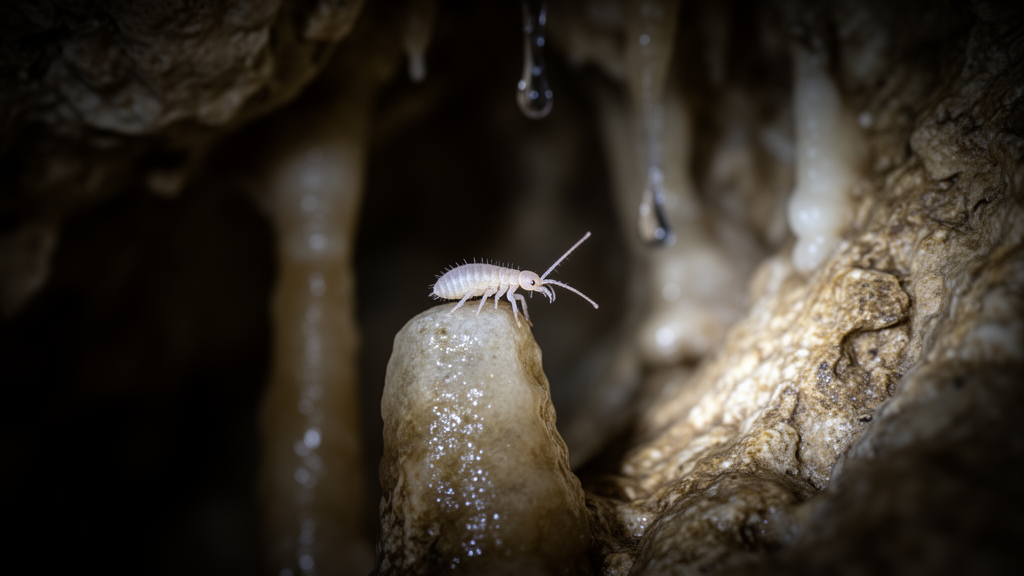
A zoological redescription has clarified the diagnostic features of two subterranean springtail species, Oncopodura cavernarum Stach, 1934 and O. jugoslavica Absolon & Kseneman, 1932, using preserved and newly collected specimens from caves across the Balkan Peninsula. The study documents their anatomy, compares their characters with related species and revises known geographic distributions.
Both species belong to the family Oncopoduridae and are eyeless, with translucent scales covering their bodies. O. cavernarum has a body length of 1.2–1.4 mm, whereas O. jugoslavica measures 1.4–2.2 mm. Their primary distinction is the post-antennal organ: O. cavernarum has one simple lobe, while O. jugoslavica has four short, equal lobes.
For O. cavernarum, the researchers examined permanent slides of type material alongside fresh specimens from caves in Croatia, Slovenia and Bosnia and Herzegovina. Because most of the historical type specimens had dried out, the full redescription relied on recently collected material, including specimens from the Grabovača karst area near Perušić in Croatia. The authors reported that the diagnostic characters were stable across the recent populations they examined.
For O. jugoslavica, the location of the type specimens is unknown and the material is considered probably lost. The redescription therefore used specimens collected in 2023–2024 from Mračna Cave in Bosnia and Herzegovina, part of the Golubina pećina–Govještica–Mračna cave system near the Prača River. This site is the northernmost of the species’ known type localities.
The researchers prepared the animals for optical microscopy by briefly heating them in 95% ethyl alcohol to remove body fat, clearing them in 10% aqueous potassium hydroxide and chlorophenol, and mounting them in Swann medium on permanent slides. Specimens were examined with a Leica DM 2500 light microscope equipped for phase and DIC contrast observation, together with a drawing arm.
Among the diagnostic structures described were the antennae, mouthparts, setal patterns, trichobothria, pseudopores, legs, claws, furca and mucro. Both species had elongated, untoothed ungues, but the basal lamella of O. cavernarum was no longer than half the claw length, whereas that of O. jugoslavica exceeded half its length. The mucro of each species had four teeth and two basal scales.
Comparisons with other described species confirmed that O. cavernarum is one of four world species with a single-lobed post-antennal organ, while O. jugoslavica belongs to a group of 11 species with four simple lobes. The redescription also identified several minor differences from the original illustrations, including setae and spines that had not been depicted.
O. cavernarum has a northwestern and central Merodinaric distribution extending across the Eastern Alps and Dinarides, including northeastern Italy, southwestern Austria, western Slovenia, Croatia and southwestern Herzegovina. O. jugoslavica has a southeastern Merodinaric range across Croatia, Bosnia and Herzegovina and Montenegro. The two generally occur in allopatry, although a record of O. cavernarum in Dahna Cave suggests possible overlap in the central Dinarides.
The authors identified moderate troglomorphy in both species, including elongated claws and, in O. jugoslavica, multiplication of antennal sensilla. They noted that the broad ranges span separate karst units, suggesting that the cave populations may constitute species complexes. The study was morphological, however, and the authors said molecular examination would be required to clarify that possibility.
Subject of Research: Morphological redescription of two subterranean Oncopodura springtails from Balkan caves
Article Title: Redescription of two subterranean species of the genus Oncopodura Carl & Lebedinsky, 1905 ( Hexapoda , Collembola ) from the Balkan Peninsula
Article References: Mayvan, M. M., Ozimec, R., & Kováč, Ľ. (2026). Redescription of two subterranean species of the genus Oncopodura Carl & Lebedinsky, 1905 (Hexapoda, Collembola) from the Balkan Peninsula. Subterranean Biology, 56, 103-125. https://doi.org/10.3897/subtbiol.56.182808
Image Credits: AI Generated
DOI: 10.3897/subtbiol.56.182808
Keywords: Oncopodura, Oncopoduridae, Collembola, springtails, cave fauna, Balkan Peninsula, taxonomic redescription, morphology, troglomorphy, Dinaric karst, Redescription, subterranean
Cite Scienmag News
Margaret Porter. (October 21, 2026). Redescription of two cave-dwelling Oncopodura species from the Balkan Peninsula. Scienmag. https://scienmag.com/redescription-of-two-cave-dwelling-oncopodura-species-from-the-balkan-peninsula/
Margaret Porter. "Redescription of two cave-dwelling Oncopodura species from the Balkan Peninsula." Scienmag, 21 October 2026, https://scienmag.com/redescription-of-two-cave-dwelling-oncopodura-species-from-the-balkan-peninsula/. Accessed 21 October 2026.
Margaret Porter. "Redescription of two cave-dwelling Oncopodura species from the Balkan Peninsula." Scienmag. October 21, 2026. https://scienmag.com/redescription-of-two-cave-dwelling-oncopodura-species-from-the-balkan-peninsula/


