


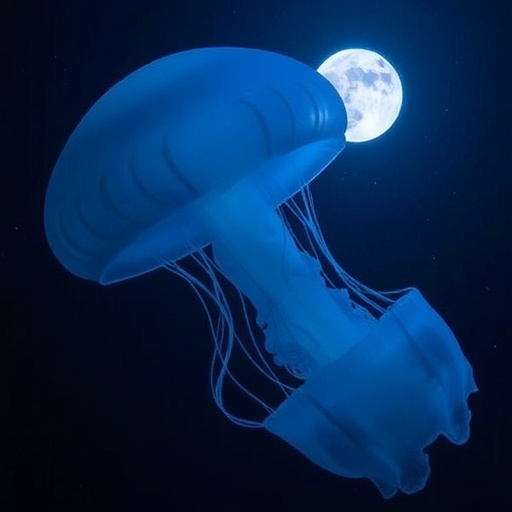
In a groundbreaking study set to redefine our understanding of marine biology, researchers have revealed remarkable findings regarding the behavior of the moon jellyfish, known scientifically as Aurelia spp. Conducted by scientists Pecunioso and Agrillo, the research focuses on the intriguing question: Do jellyfish exhibit social behavior in group settings, or do they simply operate as solitary entities? The answer might surprise those who believe that all marine animals rely on community interactions for survival.
Moon jellyfish, characterized by their translucent bodies and graceful movements, are typically found in coastal waters worldwide. For years, they have puzzled researchers and marine enthusiasts alike, especially with their unique life cycles and ecological roles. However, the intrinsic behavior of these creatures has largely remained shrouded in mystery until now. In their latest work, Pecunioso and Agrillo employed experimental designs aimed at unraveling the complexities of jellyfish interactions and their responses to varying group sizes.
The study meticulously monitored jellyfish in controlled environments designed to simulate their natural habitats. By observing these organisms across multiple scenarios—ranging from solitary to large groups—the researchers gathered quantitative data to assess their behavioral responses. Surprisingly, the analysis indicated that moon jellyfish exhibited characteristics of non-social behavior, challenging the long-held belief that marine life thrives predominantly in groups. Instead of interacting with one another in a meaningful way as some might expect, these jellyfish primarily operated independently, with interactions being minimal and seemingly incidental.
What makes these findings even more fascinating is the implications they have on biological and ecological frameworks. Understanding the behavior of moon jellyfish can offer valuable insights into their role in marine ecosystems and how they adapt to changing environmental conditions. For example, if moon jellyfish do not rely on social structures for their survival strategies, it could point to a level of resilience that allows them to thrive in varied conditions where other species might struggle. This behavioral independence may also suggest evolutionary advantages that could position them successfully in their eco-niche.
Moreover, this research sheds light on the broader aspect of how different species interact within their ecosystems. The non-social tendencies of Aurelia spp. might influence their reproductive strategies, feeding behaviors, and even their predation rates. The researchers propose that if moon jellyfish manage to remain well-adapted without social structures, they could be seen as indicators of ecosystem health and resilience in marine environments, particularly amidst the threats posed by climate change and human activity.
In light of the researchers’ findings, it is crucial for marine biologists to revisit assumptions regarding social behavior in aquatic organisms. This study advocates for a wider exploration into the behavioral patterns of other marine species, as understanding these dynamics may lead to improved conservation efforts. Given the ongoing environmental challenges, each revelation concerning aquatic animals contributes to the collective knowledge necessary for fostering effective marine stewardship.
Furthermore, the implications of the findings extend beyond just jellyfish. The awareness that not all marine life may exhibit social behaviors can help reshape approaches in fields such as aquaculture, biodiversity conservation, and climate change impact assessments. Recognizing the complexities of marine organisms’ interactions can lead to more tailored strategies that benefit both conservation efforts and marine resource management.
The study’s findings also provoke curiosity about how moon jellyfish adapt and survive without social structures. This raises questions about their sensory capabilities and longevity in solitary conditions. Do they possess heightened individual resilience that favors survival strategies? How do their physiological attributes support such independent lifestyles? These questions pave the way for future investigations, promising a deeper exploration into the lives of these enigmatic ocean dwellers.
As scientists gear up for further research, there is hope that ongoing studies will lead to new discoveries about the complexities of jellyfish biology. As venues for sharing these findings expand, there is potential for increased public interest, which could foster greater awareness and appreciation for jellyfish and their critical role in marine ecosystems.
In conclusion, Pecunioso and Agrillo’s study highlights significant findings about moon jellyfish, demonstrating that non-social behavior may be more common among these creatures than previously believed. Their research invites a broader examination of social structures in marine life and encourages a rethinking of how we perceive interactions within the aquatic environment. As we seek to understand the behaviors of these and other marine organisms, it becomes clear that the ocean still holds many secrets, waiting to be uncovered by inquisitive researchers.
The transformative nature of this research could indeed pave the way for healthier oceans—a goal that not only serves the jellyfish but all marine inhabitants. As we continue to explore the depths of marine biology, we move closer to comprehending the intricate and often unseen connections that sustain life in our oceans.
Pecunioso, A., Agrillo, C. Safety in numbers? Evidence of non-social behaviour in the moon jellyfish Aurelia spp..
Anim Cogn 29, 1 (2026). https://doi.org/10.1007/s10071-025-02023-3
Cite Scienmag News
Drew Townsend. (January 20, 2026). Moon Jellyfish: Evidence of Non-Social Behavior. Scienmag. https://scienmag.com/moon-jellyfish-evidence-of-non-social-behavior/
Drew Townsend. "Moon Jellyfish: Evidence of Non-Social Behavior." Scienmag, 20 January 2026, https://scienmag.com/moon-jellyfish-evidence-of-non-social-behavior/. Accessed 4 September 2026.
Drew Townsend. "Moon Jellyfish: Evidence of Non-Social Behavior." Scienmag. January 20, 2026. https://scienmag.com/moon-jellyfish-evidence-of-non-social-behavior/


