

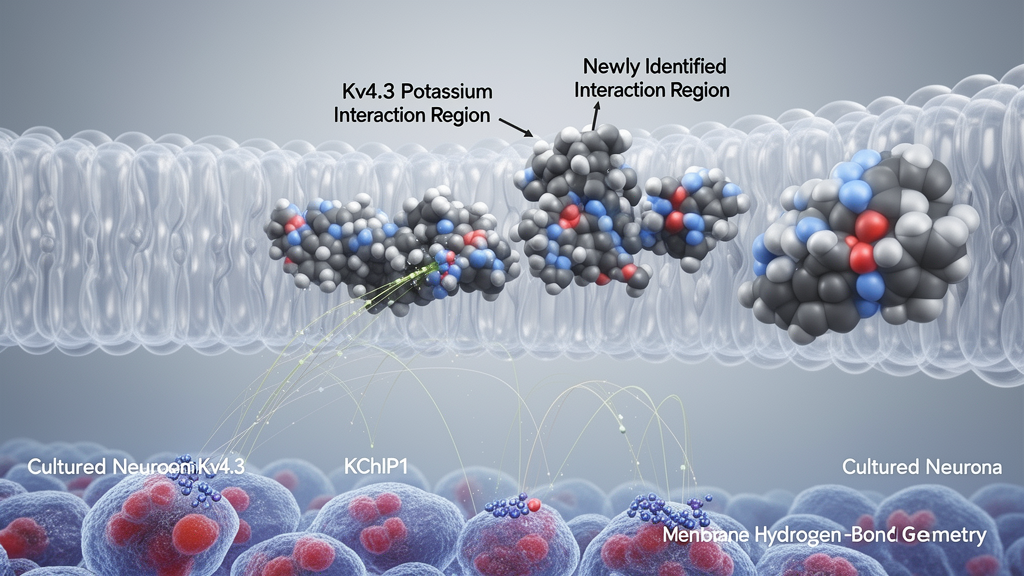
A combined molecular dynamics and electrophysiology study has identified a previously overlooked third interface between the voltage-gated potassium channel Kv4.3 and its auxiliary protein KChIP1. The interface consists mainly of a network of salt bridges linking the H2 helix of KChIP1 to two segments of the Kv4.3 channel. Disrupting these electrostatic interactions destabilized the protein complex, weakened the assembly of adjacent channel subunits and prevented KChIP1 from restoring functional currents in Kv4 mutants unable to coordinate the zinc ion required for normal tetramerization. The findings, reported in Frontiers in Molecular Biosciences, place the new interface between two previously characterized binding regions and suggest that it acts as a molecular bridge that reinforces channel assembly.
Kv4.3 belongs to the Shal-like Kv4 family of voltage-gated potassium channels, which generate fast, transient currents at subthreshold membrane potentials. In neurons, channels from this family contribute to the somatodendritic A-type current and help shape the timing, frequency and backpropagation of electrical signals. Related channels produce transient outward currents in heart muscle, where they also influence excitation. The study focuses on Kv4.3, a channel whose activity depends strongly on KChIP proteins that increase surface current density, modify inactivation and speed recovery from the inactive state. Loss of normal KChIP function has been associated with pathological conditions, although the present work did not examine patients or test a disease treatment.
Previous crystallographic and functional studies identified two principal interfaces in the cytoplasmic Kv4.3–KChIP1 complex. At the first, an alpha-helical segment at the N terminus of the Kv4.3 tetramerization domain, or T1 domain, fits into a hydrophobic pocket on KChIP1. Contacts involving Kv4.3 residues W8, F11 and W19 help stabilize this interaction, which is associated with channel trafficking and inactivation. The second interface links the KChIP1 H1 and H2 helices to the Kv4.3 “docking loop,” including the region around residues 70–78. Hydrophobic and electrostatic contacts there support tetramerization and affect gating. A computational analysis had previously suggested that additional salt bridges might form between KChIP1 and Kv4.3, but their existence and functional importance had remained untested.
The researchers addressed that gap with all-atom molecular dynamics simulations of wild-type Kv4.3 T1 tetramers bound to four KChIP1 subunits. The model was placed in explicit solvent at physiological ionic strength, energy-minimized and equilibrated before one-nanosecond production runs at 310.15 kelvin. Analyses tracked residue contacts, salt bridges, interaction energies, solvent-accessible surface, structural deviation and collective motion. A salt bridge was counted when a positively charged nitrogen atom in arginine, lysine or protonated histidine came within 4.0 angstroms of a negatively charged carboxylate oxygen in aspartate or glutamate. Two mutant complexes were then simulated: a double mutant containing D39R in Kv4.3 and E63A in KChIP1, and a triple mutant replacing KChIP1 R51, R58 and E63 with alanine.
Five recurring salt bridges connected Kv4.3 residues R37, D39, E40 and R60 with KChIP1 residues R51, R58 and E63. The D39–R51 and D39–R58 bridges were the most persistent, occupying 43.2% and 71.0% of the wild-type simulation, respectively, and contributed most of the interaction energy in the region. R60–E63 and R37–E63 depended strongly on the relative alignment of the KChIP1 helix and neighboring Kv4.3 segments, whereas E40–R58 formed less often and appeared to have a secondary role. The network did not maintain an identical pattern in every subunit. It was supported by one persistent salt bridge for 34.2% of the simulated time and by two salt bridges for 57.2%, with configurations containing more than two interactions occurring for only 5.5%.
Mutating the charged residues largely abolished the local electrostatic contribution, which approached zero in both variants. Without the third interface, the KChIP1 H2 helix became more mobile and reoriented, disrupting contacts in the two established interfaces. In the double mutant, the reversal of charge at Kv4.3 D39 repelled positively charged R51 and R58 on KChIP1, causing the upper part of the H2 helix to detach. The rearrangement also stretched a local loop and reduced hydrophobic contacts involving Kv4.3 W8 and F11 in the first interface. In the triple mutant, the lower Kv4.3 segment detached from the H2 helix, the helix shifted toward the second interface and critical salt bridges in that interface weakened. Neither mutant trajectory reached a fully stable state during the one-nanosecond interval, but their larger structural fluctuations and altered collective motions were consistent with greater instability than in the wild type.
To examine mechanical stabilization, the investigators removed the coordinating ions from wild-type and triple-mutant complexes and performed steered molecular dynamics, pulling adjacent Kv4.3 subunits apart in three independent simulations per system. The wild-type complex produced a force peak of approximately 800 piconewtons when the third interface was ruptured. The triple mutant reached only about 400 piconewtons as the subunits separated, indicating that salt bridges in the new interface resisted dissociation. These simulation estimates apply to the modeled cytoplasmic domains under the specified force field and pulling conditions; they do not directly measure tension in intact neuronal or cardiac membranes.
Electrophysiological tests in transiently transfected Chinese hamster ovary cells connected the structural result to channel function. A Kv4.2 construct carrying C110A, C131A and C132A substitutions could not coordinate zinc and failed to express functional current on its own. Co-expression with wild-type KChIP1 restored measurable currents, but co-expression with the triple-mutant KChIP1 did not. A further construct combining Kv4.2 F74A with the three zinc-coordination substitutions also failed to express functional current with wild-type KChIP1, consistent with the requirement for binding across the second and third interfaces. These experiments demonstrate rescue under the tested overexpression conditions rather than a clinical effect, and they used a related Kv4.2 construct to examine assembly rather than directly testing every aspect of human Kv4.3 function.
Taken together, the simulations and cell experiments support a distinct role for the third Kv4.3–KChIP1 interface. Unlike the hydrophobic pocket and cage that dominate the first two interfaces, it depends on electrostatic contacts distributed along the KChIP1 H2 helix. Its position allows it to link the Kv4.3 subunit engaged in the first interface to the H2 helix involved in the second interface, adding cohesion to the assembled complex. The study therefore advances a structural account of how KChIP proteins can help stabilize Kv4 tetramers even when the channel’s own zinc-coordination site is defective. The authors describe the findings as a contribution to the molecular understanding of Kv4 regulation and as a basis for investigating how inherited or newly arising mutations in this region might affect channel assembly; the study itself did not identify such human mutations or demonstrate disease causation.
Subject of Research: Molecular and cellular identification of a third interaction interface between the Kv4.3 potassium channel and KChIP1
Article Title: A combined computational and experimental study of the interaction between the voltage-gated potassium channel Kv4.3 and its auxiliary protein KChIP
Article References: Benedetti, L., Biswas, S., Ferbel, L., Catte, A., Jerng, H. H., Pfaffinger, P. J., & Brancato, G. (2026). A combined computational and experimental study of the interaction between the voltage-gated potassium channel Kv4.3 and its auxiliary protein KChIP. Frontiers in Molecular Biosciences, 13, Article 1901313. https://doi.org/10.3389/fmolb.2026.1901313
Image Credits: AI Generated
DOI: 10.3389/fmolb.2026.1901313
Keywords: Kv4.3, KChIP1, potassium channels, molecular dynamics, electrophysiology, channel tetramerization, salt bridges, protein interfaces, mutagenesis, neuronal excitability, combined, computational
Cite Scienmag News
Scienmag. (October 20, 2026). Molecular dynamics and cell experiments identify third Kv4.3–KChIP1 interface. https://scienmag.com/molecular-dynamics-and-cell-experiments-identify-third-kv4-3-kchip1-interface/
Scienmag. "Molecular dynamics and cell experiments identify third Kv4.3–KChIP1 interface." Scienmag, 20 October 2026, https://scienmag.com/molecular-dynamics-and-cell-experiments-identify-third-kv4-3-kchip1-interface/. Accessed 20 October 2026.
Scienmag. "Molecular dynamics and cell experiments identify third Kv4.3–KChIP1 interface." Scienmag. October 20, 2026. https://scienmag.com/molecular-dynamics-and-cell-experiments-identify-third-kv4-3-kchip1-interface/


