


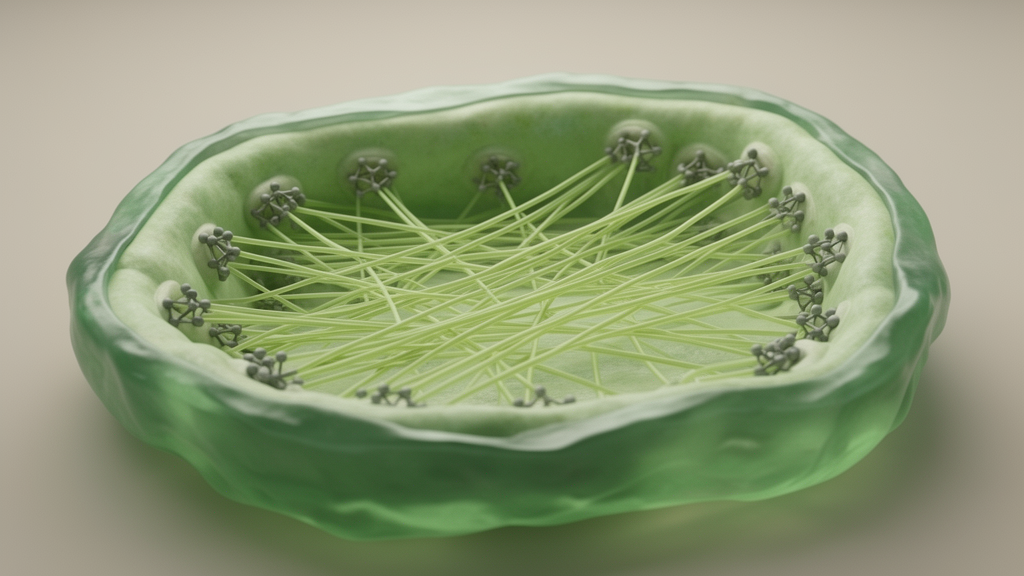
Deep inside every growing plant cell, a microscopic tug-of-war plays out between two structural systems: the actin cytoskeleton, a dynamic meshwork of protein filaments, and the plasma membrane, the fatty envelope that defines the cell’s borders. For decades, biologists have known that these two systems must physically connect for cells to grow in a directed fashion, yet the molecular hardware mediating this attachment in plants remained stubbornly elusive. Unlike animals and yeast, plant genomes contain no recognizable equivalents of the well-studied ERM proteins or Nck adaptors that fasten actin to membranes in other kingdoms. A new study published in Nature Plants now identifies a surprising candidate for this role: a plant-specific molecular motor called ATM2, which turns out to do far more than simply tether filaments to the membrane. It actively remodels the lipid landscape beneath them.
The research, led by Vera C. Wagner and Ingo Heilmann at Martin Luther University Halle-Wittenberg, together with colleagues in Halle and Prague, focused on pollen tubes, the slender cellular conduits that sperm-carrying pollen grains extend through female tissue during plant reproduction. Pollen tubes are among the fastest-growing cells in nature and rely on a process called tip growth, in which new membrane and cell wall material are delivered with extraordinary precision to a single point at the cell’s apex. This polarized expansion demands tight coordination between vesicle trafficking and the actin cytoskeleton, and it makes pollen tubes an exquisitely sensitive readout for any perturbation of that coordination: when the balance is disturbed, the tube tip visibly swells and growth falters.
At the heart of the new work lies a regulatory lipid called phosphatidylinositol 4,5-bisphosphate, abbreviated PtdIns(4,5)P2. This scarce membrane lipid acts as a positional signal, recruiting specific proteins to particular patches of the cytosolic membrane face and thereby controlling secretion, endocytosis and actin dynamics. Earlier work from the same group had shown that in the subapical region of pollen tubes, PtdIns(4,5)P2 is not spread evenly across the membrane but concentrated into nanodomains smaller than a micrometer, and that these clusters exert a focused stabilizing effect on nearby actin filaments. The enzyme responsible for producing the lipid in these domains is a PI4P 5-kinase named PIP5K2. What remained unknown was how PIP5K2 itself is regulated and how, at the molecular level, the lipid communicates with the actin cytoskeleton.
ATM2 belongs to the class VIII myosins, a family of molecular motors found only in plants. Compared with the better-characterized class XI myosins that haul organelles along actin tracks, class VIII motors display only modest motor activity, and it has even been proposed that they may not need motor function for their physiological roles at all. Like all myosins, ATM2 carries an N-terminal actin-binding motor domain and a C-terminal tail, but its tail contains a polybasic region that previous biochemical work had shown to bind anionic membrane lipids. This architecture made ATM2 an obvious candidate for a molecular bridge: one end gripping actin filaments, the other anchoring to the membrane. Yet whether ATM2 actually mediates actin-membrane contacts in living cells, and what consequences such tethering might have, had never been demonstrated.
To find out, the team deployed an arsenal of live-cell imaging techniques in tobacco pollen tubes. Using spinning disc and laser scanning confocal microscopy, they observed that a fluorescently tagged ATM2 accumulates in a structurally inhomogeneous pattern at the plasma membrane, precisely in the zone where dynamic actin filaments, labeled with the LifeAct marker, meet the membrane. When the researchers coexpressed fluorescent PIP5K2, they found that the kinase also resides in membrane nanodomains that intersect with PM-oriented actin filaments. Computational skeletonization of the actin signal revealed that the endpoints of membrane-proximal filaments cluster near PIP5K2 domains, with a median distance of just 1.75 micrometers across more than 1,200 measured filament tips. Fluorescence lifetime imaging confirmed a physical interaction between ATM2 and PIP5K2 in living cells, and split-ubiquitin yeast two-hybrid assays showed that this interaction is specific to class VIII myosins: both pollen-expressed isoforms, ATM2 and VIII-B, bound PIP5K2, while seven class XI myosins did not.
The functional consequences of ATM2’s presence were striking. When the researchers overexpressed full-length ATM2 in pollen tubes, actin filaments became visibly stabilized: kymograph analysis, which tracks filament movement over time, showed a significant increase in mean actin lifetime, and actin accumulated abnormally in the tube tip. The cells responded with pronounced tip swelling, a hallmark of disturbed cytoskeletal regulation. Crucially, these effects vanished when the researchers deleted ATM2’s C-terminal lipid-binding region, which abolished membrane association, or when they expressed only the C-terminal fragment lacking the actin-binding motor domain. Both membrane attachment and the actin-binding N-terminus were therefore required. Complementary loss-of-function experiments in Arabidopsis told a consistent story: pollen from mutants carrying lesions in both the ATM2 and VIII-B genes germinated better than wild type, a paradoxical phenotype previously seen in mutants with destabilized actin, but their tubes grew erratically, requiring significantly more direction changes to describe their wandering paths.
Then came the twist that elevates the study beyond simple tethering. When the researchers artificially depleted PtdIns(4,5)P2 from the membrane by coexpressing specific lipid phosphatases, PTase11 or SAC9, the stabilizing effect of ATM2 on actin disappeared entirely, even though ATM2 remained firmly attached to the membrane. This demonstrated that binding to anionic lipids in general is sufficient to recruit ATM2 to the membrane, but the lipid PtdIns(4,5)P2 itself is specifically required for ATM2 to influence actin. A catalytically dead variant of PIP5K2 likewise acted dominantly to suppress ATM2-induced tip swelling. In other words, membrane recruitment alone is not the whole story; ATM2 needs the lipid product of PIP5K2 to do its regulatory work.
The explanation emerged from a series of experiments probing whether ATM2 might actively promote PtdIns(4,5)P2 production rather than merely respond to it. When ATM2 was overexpressed, a fluorescent biosensor for the lipid decorated an expanded region of the subapical membrane, and the number of PtdIns(4,5)P2 nanodomains per cell increased significantly. More decisively, purified recombinant PIP5K2 protein showed substantially enhanced catalytic activity, converting its substrate PtdIns4P into PtdIns(4,5)P2, when incubated with purified C-terminal fragments of ATM2 or VIII-B in a test tube. No other components were needed. Control experiments with the small GTPase ROP2 and its variants showed no such effect, indicating that the activation is specific to the myosin-kinase interaction. The authors speculate that ATM2 binding may relieve an autoinhibitory interaction between the kinase’s catalytic domain and its N-terminal regulatory regions, a mechanism previously proposed for the related enzyme PIP5K1, though the structural details remain to be resolved.
These findings assemble into an elegant self-reinforcing circuit. ATM2 binds anionic lipids to reach the membrane, encounters PIP5K2 there, and stimulates the local production of PtdIns(4,5)P2. The newly enriched lipid nanodomains then recruit more ATM2, amplifying the signal, while simultaneously serving as platforms for activating ROP GTPases, small molecular switches that promote actin stabilization through the guanine nucleotide dissociation inhibitor NtRhoGDI2, which the study also found to interact with both PIP5K2 and ATM2. The result is a positive feedback loop that concentrates actin-stabilizing lipid signaling precisely at sites where actin filaments contact the membrane. This explains why ATM2’s effects depend on PtdIns(4,5)P2 without requiring any preferential binding of the myosin to that particular lipid: the lipid’s role is to fuel and localize the loop, not to anchor the motor.
The discovery fills a conspicuous gap in plant cell biology and carries implications well beyond pollen tubes. Class VIII myosins have been implicated in endocytosis, root meristem maintenance and auxin signaling, and in moss they coordinate actin with microtubules during tip growth. The demonstration that a myosin can regulate membrane lipid nano-organization, rather than simply cargo transport, resonates with recent work showing that the class XI myosin XI-K helps assemble receptor complexes in membrane nanodomains during plant immune signaling. Whether lipid modulation is a general feature of plant myosin function remains an open question, as does the role of class VIII myosins in sporophytic tissues throughout the plant. What is clear is that the actin-membrane interface, long a black box in plant cells, now has at least one identified molecular architect, and it turns out to be a motor that prefers to stand still and build rather than to run.
Subject of Research: How the class VIII myosin ATM2 stabilizes actin–plasma membrane contacts in pollen tubes by promoting PtdIns(4,5)P2 nanodomain formation
Article Title: The class VIII myosin ATM2 stabilizes actin–plasma membrane contacts in tobacco pollen tubes by locally promoting PtdIns(4,5)P2 formation
Article References: Wagner, V. C., Fratini, M., Uhlenberg, J., Schutkowski, A., Hamm, G., Kastner, C., Bacia, K., Schwarzerová, K., & Heilmann, I. (2026). The class VIII myosin ATM2 stabilizes actin–plasma membrane contacts in tobacco pollen tubes by locally promoting PtdIns(4,5)P2 formation. Nature Plants. https://doi.org/10.1038/s41477-026-02427-0
Image Credits: AI Generated
DOI: 10.1038/s41477-026-02427-0
Keywords: ATM2, class VIII myosin, actin cytoskeleton, plasma membrane, PtdIns(4,5)P2, PIP5K2, pollen tubes, lipid nanodomains, ROP GTPases, tip growth, phosphoinositide signaling, plant cell biology
Cite Scienmag News
Drew Townsend. (October 17, 2026). Molecular Anchor Discovered: How Plant Cells Wire Actin Filaments to Their Membranes. Scienmag. https://scienmag.com/molecular-anchor-discovered-how-plant-cells-wire-actin-filaments-to-their-membranes/
Drew Townsend. "Molecular Anchor Discovered: How Plant Cells Wire Actin Filaments to Their Membranes." Scienmag, 17 October 2026, https://scienmag.com/molecular-anchor-discovered-how-plant-cells-wire-actin-filaments-to-their-membranes/. Accessed 17 October 2026.
Drew Townsend. "Molecular Anchor Discovered: How Plant Cells Wire Actin Filaments to Their Membranes." Scienmag. October 17, 2026. https://scienmag.com/molecular-anchor-discovered-how-plant-cells-wire-actin-filaments-to-their-membranes/


