


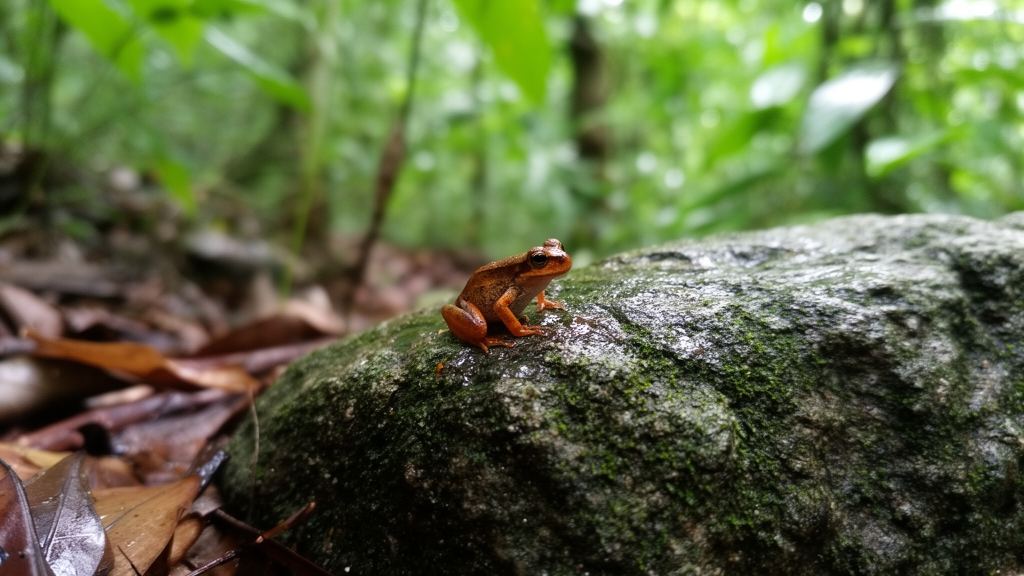
Deep in the limestone karst forests of Quang Tri Province in central Vietnam, a team of herpetologists has uncovered a frog so small, so secretive, and so confined to a single patch of forest that it had gone unnoticed by science until now. The newly described species, named Vietnamophryne abscondita, is a dwarf frog barely two centimeters long that spends its life hidden in leaf litter and soil crevices at the entrance of limestone caves. Its name, drawn from the Latin word for hidden, is a fitting tribute to a lifestyle that has kept it out of sight of both researchers and casual observers alike.
The discovery, published in the journal Herpetozoa, is based on just two adult male specimens collected during fieldwork in May 2022 by researchers from the Joint Vietnam-Russia Tropical Science and Technology Research Center and Moscow State University. Despite the limited material, the team combined detailed morphological examination with mitochondrial DNA sequencing to build a case that these frogs represent a distinct evolutionary lineage, separate from all six previously known species in the genus Vietnamophryne. The genus itself was only established in 2018 to accommodate a group of miniaturized, semi-fossorial frogs scattered across northern Indochina and adjacent southern China, most of which are known from extremely few specimens.
Morphologically, Vietnamophryne abscondita stands apart through a suite of characters that the authors describe as a unique combination rather than any single dramatic feature. The frogs measure between 18.1 and 19.0 millimeters in snout-vent length, making them medium-sized for the genus. Their heads are slightly wider than long, their snouts short and rounded, and their tympanums, the external ear membranes visible in most frogs, are completely hidden beneath a glandular fold of skin. This last character is particularly notable, as it steadily distinguishes the new species from every other member of the genus, all of which have externally visible tympanums. The dorsal skin is finely shagreened, textured with dense low granules that give a slightly roughened but not warty appearance, without enlarged tubercles or a median dorsal ridge.
The coloration is equally distinctive. The dorsum is dark brown to chocolate brown with irregular lighter mottling, while the flanks and limbs are densely speckled with pale spots. The ventral surface is a bright yellow-orange to orange on the chest and belly, with dark marbling on the throat and ventral surfaces of the limbs. Indistinct pale yellow suborbital spotting extends from the eye toward the mouth corner, a feature absent in all other congeners. These visual cues, combined with the hidden tympanum and the relatively well-developed first finger, provide a morphological fingerprint that the authors argue is sufficient to recognize the lineage as a separate taxon even with only two specimens available.
On the molecular side, the team sequenced a long continuous fragment of mitochondrial DNA spanning the 12S rRNA, tRNAVal, and 16S rRNA genes, totaling 2,591 base pairs. Phylogenetic analyses using both maximum likelihood and Bayesian inference recovered Vietnamophryne abscondita as a well-supported independent lineage within the genus. The uncorrected genetic distances between the new species and all currently recognized congeners exceeded 3 percent based on the 16S rRNA gene fragment, a threshold commonly used as a putative indicator of species-level divergence in anurans. The closest relative, Vietnamophryne vuquangensis from Vu Quang National Park in neighboring Ha Tinh Province, showed a divergence of 3.01 percent, while the most distant congener, Vietnamophryne occidentalis from Thailand, showed 4.01 percent.
The phylogenetic picture within the genus is complicated by the fact that several species pairs show relatively shallow mitochondrial divergences, all below the 3 percent threshold. Vietnamophryne occidentalis and Vietnamophryne orlovi differ by only 1.67 percent, while Vietnamophryne orlovi and Vietnamophryne cuongi differ by 1.59 percent. Species delimitation algorithms applied to the dataset produced wildly varying results, with some analyses suggesting as many as ten species in the genus and others as few as four. The authors take a conservative stance, proposing no taxonomic changes beyond the description of the new species and considering current species limits provisional pending a comprehensive integrative revision with broader sampling and multilocus genomic data.
A principal component analysis of 23 size-corrected morphometric characters further supported the distinctiveness of the new species. The first two principal components together explained nearly 73 percent of the total variance, and Vietnamophryne abscondita occupied a distinct region of morphospace compared to Vietnamophryne aurantifusca, Vietnamophryne occidentalis, and Vietnamophryne inexpectata. The highest loadings on the first component were observed for head width, tibia length, snout-vent length, and lower arm length, while the second component was dominated by forelimb length, eye length, and hand length. The analysis retained singleton specimens for two species by log-transforming their raw values, a pragmatic solution given the extreme scarcity of material for many members of the genus.
Ecologically, Vietnamophryne abscondita is only the second member of the genus known to inhabit limestone karst habitats, joining Vietnamophryne aurantifusca from northern Vietnam. Limestone systems are characterized by pronounced environmental heterogeneity, habitat fragmentation, and geographic isolation, all of which promote localized diversification and micro-endemism. The specimens were found in leaf litter and soil microhabitats at the entrance to a small cave within an evergreen karst forest, suggesting a semi-fossorial lifestyle similar to that reported for congeners. The new species was recorded in syntopy with a rhacophorid frog, Gracixalus quyeti, found in the same limestone cave, hinting at a richer community of karst-associated amphibians than currently documented.
The discovery fills an important distributional gap in the Central Annamites, also known as the Truong Son Mountains, a region increasingly recognized as a major center of amphibian and reptile diversity characterized by high levels of micro-endemism and ongoing species discovery. Most previously described congeners were reported from northern Vietnam and adjacent regions of northern Indochina, with records from central Vietnam remaining comparatively scarce. Mitochondrial data also indicate the presence of a genetically distinct lineage of Vietnamophryne from Bac Huong Hoa Nature Reserve in the southern part of Quang Tri Province, closely related to the new species but potentially representing an additional undescribed taxon whose status cannot yet be evaluated without voucher material.
For now, Vietnamophryne abscondita is provisionally classified as Least Concern under the IUCN Red List Categories and Criteria, given the presumed wider distribution across extensive limestone karst formations in Quang Tri Province and the lack of direct evidence of population decline. However, the authors emphasize that forest habitats in these karst regions face mounting anthropogenic pressures, including deforestation, habitat fragmentation, land-use conversion associated with Acacia plantations, infrastructure development, and livestock grazing. The apparent rarity of Vietnamophryne species in collections is likely at least partly an artifact of their cryptic, semi-fossorial lifestyle, which makes them rarely detected by conventional visual encounter surveys. Targeted microhabitat-focused surveys, including intensive leaf-litter searches and shallow soil excavation in both evergreen forests and limestone karst systems, will be essential to better document species richness in this enigmatic genus and to reveal the additional undocumented lineages likely hiding in the rugged landscapes of the Central Annamites.
Subject of Research: More dwarfs: a new microendemic species of Vietnamophryne ( Anura , Microhylidae ) from limestone karst of Quang Tri Province, Central Vietnam
Article Title: More dwarfs: a new microendemic species of Vietnamophryne ( Anura , Microhylidae ) from limestone karst of Quang Tri Province, Central Vietnam
Article References: Poyarkov, N. A., Gorin, V. A., Le, S. X., Trofimets, A. V., Duong, T. V., Nguyen, D. T., Pawangkhanant, P., Suwannapoom, C., & Nguyen, T. V. (2026). More dwarfs: a new microendemic species of Vietnamophryne (Anura, Microhylidae) from limestone karst of Quang Tri Province, Central Vietnam. Herpetozoa, 39, 145-160. https://doi.org/10.3897/herpetozoa.39.e191333
Image Credits: AI Generated
DOI: 10.3897/herpetozoa.39.e191333
Keywords: dwarfs, microendemic, species, Vietnamophryne, Anura, Microhylidae, limestone, karst, Quang, Province, Central, Vietnam
Cite Scienmag News
Gavin Prescott. (October 17, 2026). More dwarfs: a new microendemic species of Vietnamophryne (Anura, Microhylidae) from limestone karst of Quang Tri Province, Central Vietnam. Scienmag. https://scienmag.com/more-dwarfs-a-new-microendemic-species-of-vietnamophryne-anura-microhylidae-from-limestone-karst-of-quang-tri-province-central-vietnam/
Gavin Prescott. "More dwarfs: a new microendemic species of Vietnamophryne (Anura, Microhylidae) from limestone karst of Quang Tri Province, Central Vietnam." Scienmag, 17 October 2026, https://scienmag.com/more-dwarfs-a-new-microendemic-species-of-vietnamophryne-anura-microhylidae-from-limestone-karst-of-quang-tri-province-central-vietnam/. Accessed 17 October 2026.
Gavin Prescott. "More dwarfs: a new microendemic species of Vietnamophryne (Anura, Microhylidae) from limestone karst of Quang Tri Province, Central Vietnam." Scienmag. October 17, 2026. https://scienmag.com/more-dwarfs-a-new-microendemic-species-of-vietnamophryne-anura-microhylidae-from-limestone-karst-of-quang-tri-province-central-vietnam/


