


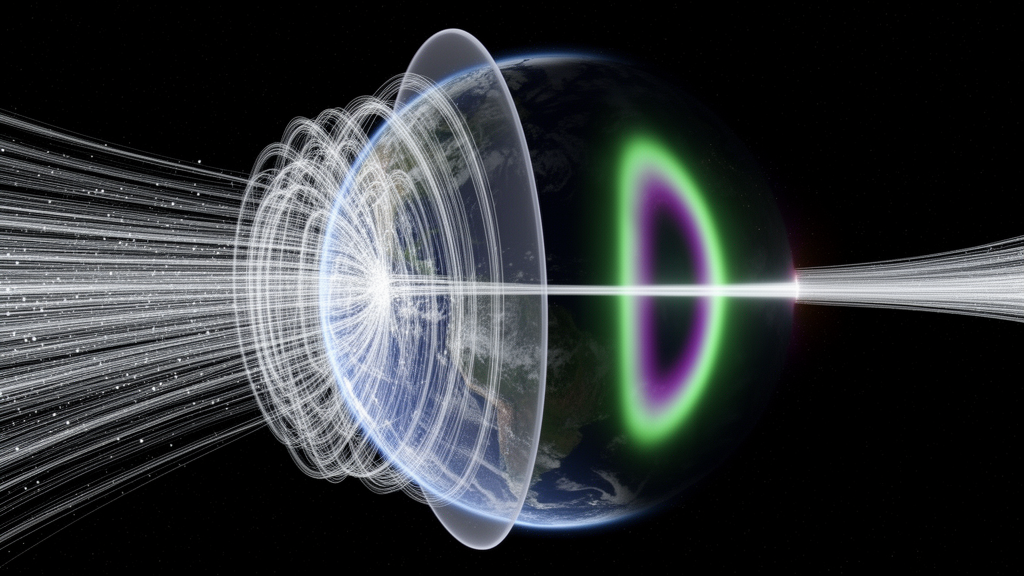
High above the polar regions, the aurora occasionally takes on a shape that looks uncannily like the Greek letter omega: a bright protrusion bulging poleward from the diffuse glow of the morning auroral oval, complete with a stem and two lobes. These omega bands, typically 400 to 1000 kilometers across and drifting eastward at speeds of 0.4 to 2 kilometers per second, have puzzled space physicists for decades. Now, a statistical study of 324 substorms that contained omega bands, published in Frontiers in Astronomy and Space Sciences, has quantified for the first time what kind of solar wind drives these events and how the magnetosphere must be preconditioned before the characteristic auroral structures can appear.
The research team, led by Vivian Cribb of the University of Michigan and NASA’s Goddard Space Flight Center, together with colleagues from UCLA, the University of Colorado Boulder, and the Catholic University of America, identified 500 omega band events between 2005 and 2016 using ground-based all-sky imagers from the THEMIS network. Each candidate had to resemble the Greek letter omega in more than one image, last longer than two minutes, propagate eastward, and fit entirely within the camera’s field of view at some point in its lifetime. After matching these events to a catalog of substorm onsets derived from the SuperMAG westward electrojet index, the team assembled 324 omega band substorms and compared them against 324 randomly selected substorms of similar magnitude from the same decade, matched in monthly and yearly distribution to remove seasonal and solar cycle biases.
The solar wind analysis revealed a striking signature. During omega band substorms, the interplanetary magnetic field magnitude and the solar wind proton density both peaked precisely at substorm onset. During typical substorms, by contrast, these parameters were enhanced one to three days before onset and had already declined by the time the substorm began. The proton density during omega band substorms was roughly one proton per cubic centimeter greater than during random substorms at onset, and the interplanetary magnetic field was about one nanotesla stronger. The team suggests that a density threshold may exist that is necessary to create the conditions for omega band formation in the ionosphere.
These concurrent enhancements in magnetic field strength and proton density are consistent with a magnetic pileup associated with a compression region in the solar wind, particularly a stream interaction region, where fast solar wind streams overtake slower wind and compress it. Indeed, when the researchers cross-referenced their events with a catalog of documented stream interaction regions, they found that 49 percent of the 296 omega band events used in the solar wind analysis occurred during such regions, slightly higher than the 42 percent found in a previous study of 205 events identified from Scandinavian ground cameras. The energy input from the solar wind into the magnetosphere, calculated using a coupling function derived from magnetohydrodynamic simulations that explicitly accounts for solar wind density, began to rise one day before the omega band detections and maximized at the detection time, peaking at around 1.75 terawatts.
Inside the magnetosphere, the differences between omega band substorms and typical substorms were equally revealing. The SuperMAG ring current index was enhanced during omega band substorms, peaking about three nanotesla larger one hour after onset, and remained elevated for days afterward. More telling was the local time breakdown: the dusk sector ring current index was five nanotesla more negative during omega band substorms and stayed depressed relative to random substorms for multiple days, indicating a highly asymmetric ring current. The auroral electrojet indices showed slightly larger peaks during omega band substorms along with sustained activity over the twelve hours following onset, consistent with the long-duration geomagnetic activity that stream interaction region driving is known to produce.
To locate the omega bands relative to the large-scale current systems of the inner magnetosphere, the team used magnetic field measurements from GOES satellites at geostationary orbit, 6.6 Earth radii from Earth, combined with local electrojet indices from ground magnetometers. They estimated the positions of the upward and downward ionospheric current closures of the substorm current wedge, the field-aligned current loop that forms when the cross-tail current is diverted into the ionosphere at substorm onset. Two independent classification methods were applied: a visual assessment using dipolarizations in the GOES magnetic field data, and a formal inversion technique that applies the Levenberg-Marquardt algorithm to magnetic field measurements from 45 midlatitude ground magnetometers.
Both methods agreed on the essential picture. Combining the results and removing disagreements yielded 242 classified events, of which 62 percent occurred on the eastward edge of the substorm current wedge or outside of it to the east, 30 percent occurred inside the wedge, and only 8 percent occurred on the westward edge or outside to the west. The majority of omega bands, in other words, form inside or on the eastward edge of the substorm current wedge, a result that held regardless of whether the classification was done by eye or by inversion, with only eight percent disagreement between the two independent assessments.
The most novel part of the study concerned magnetospheric preconditioning. Using THEMIS satellite data from the plasma sheet, the team compared the inner magnetospheric configuration in the three hours before omega band substorms against the same interval before typical substorms. They found that the transverse magnetic field in the dawn sector, from about 2 to 6 magnetic local time, was roughly 30 nanotesla stronger before and during omega band substorms, a signature that persisted for at least three hours. This stretched magnetic field on the dawnside is consistent with the activation of a field-aligned current system colocated with the expected downward closure of the substorm current wedge in the ionosphere. The persistence of this signature three hours before the assigned onset time supports an association between omega band formation and multiple onset substorms, in which repeated activations occur during prolonged geomagnetic activity.
Equally significant was the plasma observation. The ion density at the dayside magnetopause was about 25 percent higher than typical substorm activity prior to omega band substorms, with the enhancement centered near 9 magnetic local time at most time steps and near noon shortly before onset. This increased density is consistent with magnetospheric compression driven by pressure pulses in the solar wind, and its dawnward bias suggests that omega band substorms may be associated with asymmetrical compression of the magnetosphere, an association the authors note should be verified with future work. The variability of the density enhancement in time hints that repeated, periodic pressure pulses may drive intervals of compression that would not appear clearly in a superposed epoch analysis.
The findings carry practical weight beyond auroral science. When omega bands pass overhead, ground magnetometers record Ps6 magnetic pulsations with periods of 4 to 40 minutes, and the rapidly varying magnetic fields can drive geomagnetically induced currents in this frequency range that pose a documented threat to power system infrastructure. Recent work has shown that omega bands are a significant cause of large geomagnetically induced currents, particularly in the dawn sector. By demonstrating that omega band substorms are preceded by identifiable large-scale solar wind drivers, enhanced interplanetary magnetic field and proton density, and by measurable magnetospheric preconditioning, the study provides statistical foundations that could eventually feed into space weather forecasting tools. The authors emphasize that while the intermediate mechanisms by which global magnetospheric current systems drive the formation of localized auroral structures remain to be identified, considering the requisite large-scale drivers and preconditioning of these events is vital for developing effective forecasts of when these beautiful but potentially hazardous auroral forms will appear.
Subject of Research: Space Physics
Article Title: Solar wind driving and magnetospheric preconditioning during omega band substorm events
Article References: Cribb, V., Pulkkinen, T., Kepko, L., Gallardo-Lacourt, B., McPherron, R., Weygand, J., & Chu, X. (2026). Solar wind driving and magnetospheric preconditioning during omega band substorm events. Frontiers in Astronomy and Space Sciences, 13, Article 1953664. https://doi.org/10.3389/fspas.2026.1953664
Image Credits: AI Generated
DOI: 10.3389/fspas.2026.1953664
Keywords: Solar, wind, driving, magnetospheric, preconditioning, during, omega, band, substorm, events, scientific research
Cite Scienmag News
Cameron Wolfe. (October 17, 2026). Dense Solar Wind and a Primed Magnetosphere Set the Stage for Omega Band Auroras. Scienmag. https://scienmag.com/dense-solar-wind-and-a-primed-magnetosphere-set-the-stage-for-omega-band-auroras/
Cameron Wolfe. "Dense Solar Wind and a Primed Magnetosphere Set the Stage for Omega Band Auroras." Scienmag, 17 October 2026, https://scienmag.com/dense-solar-wind-and-a-primed-magnetosphere-set-the-stage-for-omega-band-auroras/. Accessed 17 October 2026.
Cameron Wolfe. "Dense Solar Wind and a Primed Magnetosphere Set the Stage for Omega Band Auroras." Scienmag. October 17, 2026. https://scienmag.com/dense-solar-wind-and-a-primed-magnetosphere-set-the-stage-for-omega-band-auroras/


